

“I was never here!”
The smorgasbord of Doctor Who laid on for its 60th birthday continued last night with a 5 minute skit on the BBC’s annual charity telethon, Children in Need. Monsieur BBC, with these Who specials you are really spoiling us!

Of course the association of Who with Children in Need is far from new. The telethon itself has a long history, beginning 43 years ago in 1980, and Doctor Who got in on the act fairly early, when 20th anniversary special The Five Doctors was broadcast in its entirety as part of the 1983 evening’s festivities.
With the show off air for its 30th in 1993, Children in Need kept the flag flying with batshit crazy Doctor Who / EastEnders crossover Dimensions in Time, an insane attempt to tell a story depicting every surviving Doctor and companion travelling to Albert Square. In fifteen minutes. If you think Terrance Dicks had his work cut out trying something similar with The Five Doctors, at least he was given 90 minutes to do it 😊
The revived show has followed the tradition, with David Tennant’s post-regeneration scene on the 2005 evening, and Steven Moffat’s hilarious and heartfelt Tennant / Davison clash Time Crash in 2007. 2011’s Time and Space mini-episodes were perhaps less successful, revolving as they did around the show’s male characters being reduced to drooling imbeciles by an accidental glimpse up Amy Pond’s skirt.

For the 60th anniversary, it’s perhaps fitting that this year’s charitysode took the Doctor back to the beginning of his greatest foes, the Daleks. We’ve seen their beginnings before of course – “wait, is this the genesis of the Daleks?” exclaims the newly regenerated Fourteenth Doctor, inadvertently (and amusingly) naming a classic serial onscreen.
But while that classic was unremittingly bleak and dark, this had to be light and funny without undermining the original. Thankfully, Russell T Davies is the kind of writer who can pivot from horror to humour on the head of a pin, so he managed to make that work. What we got was faithful but funny, as the Fourteenth Doctor, inevitably crashing his TARDIS as is now mandatory post-regeneration, found himself on Skaro before the Fourth Doctor’s fateful visit.

The humour lay in the timey-wimey way that the Doctor himself is now responsible for many of his deadliest enemies’ famed attributes. Having knocked off the prototype Dalek’s “multi-purpose claw thing”, he scrambles around in the TARDIS, emerging with a sink plunger to replace it. Blurting out the beasties’ name, he accidentally solved the branding conundrum faced by Mawaan Rizwan’s hapless marketing guy, Mr Castavillian – “er… Adlek? Klaed?”
Given that this is a five minute comedy skit, it’s not really fair to analyse it in the sort of depth that I usually do the show’s episodes proper, but I did have a few thoughts. While I remain ambivalent about bringing back a previous Doctor (though I now know Ncuti Gatwa’s filming schedule was too packed for him to step straight into the role), it was good to see David Tennant again, stepping into the role like he’d never been away. This seems like a return to the earlier version of his Doctor, before he became so angsty and arrogant in later stories. Mind you, it did occur to me that it might have been interesting to bring back a previous actor and have him play the part quite differently; still, with only three episodes, that might have been a bit too ambitious.

As his onscreen foil, comedian Mawaan Rizwan dialed down his hyperactive man-baby persona (as seen in his hilarious BBC sitcom Juice) but still managed to be funny as, presumably, one of the less evil of the Kaled Elite. I like Rizwan a lot, and I hope we get to see him in the show proper at some point.
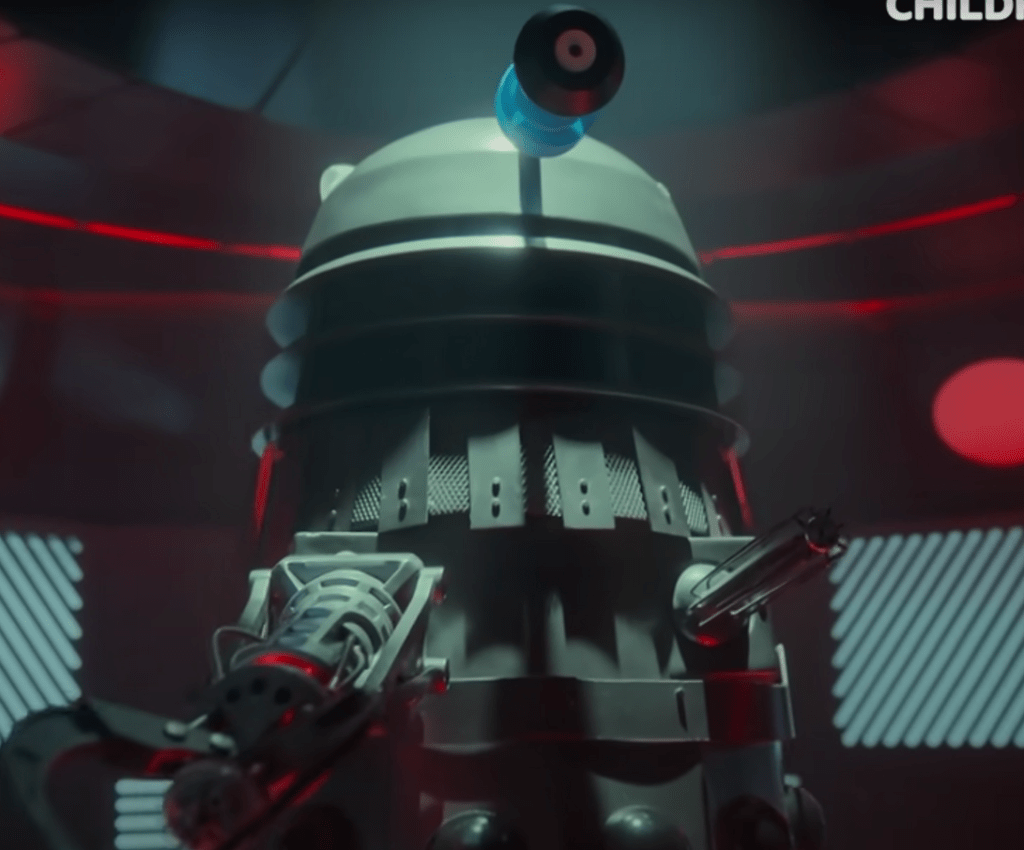
The requisite nods to the past were very much present, with a traditional Dalek in the black and grey colours seen in 1975, rather than one of the beefy new gold ones. Then there were those faithfully recreated black Elite uniforms (no Iron Crosses present here, I noticed), and Davros being called away by what was unmistakably the voice of Peter Miles as Nyder on the tannoy. As it wasn’t a line spoken by Miles in the original Genesis of the Daleks, I wonder where they got it?
Then there was Davros himself, played once again by Julian Bleach, but this time presumably pre-injury, as he looked very much like a normal human. Bleach has been seen sans facemask in the Whoniverse before, of course – he was the Ghostmaker in PJ Hammond’s spooky Torchwood ep From Out of the Rain, and the eponymous Nightmare Man in The Sarah Jane Adventures. As you might guess from those two roles, his skeletal features very much lend themselves to his casting as spooky bad guys. So his recurring role as Davros, starting with 2008’s Stolen Earth/Journey’s End two-parter, wasn’t much of a surprise.

He expanded Davros’s emotional range in 2015’s Magician’s Apprentice/Witch’s Familiar with a powerful performance that arguably bettered the legendary Michael Wisher’s original from 1975. And seven years later, he’s still got it, giving us a Davros who can deliver comic lines with perfect timing, while never undermining the fact that this is, basically, an analogue of Hitler. Stripped of ring modulation, Davros’ distinctive, staccato speech patterns are still very much present, and even more effective when delivered in a non-electronic voice.
Some fans have objected to the idea that Davros’ accident happened after he designed the Daleks’ travel machines, given the implication in Genesis of the Daleks that his life support system/wheelchair was the inspiration for the design. I don’t see a problem there – why can’t it have been the other way round? Faced with life-changing injuries, why couldn’t Davros have adapted his existing life support design from the travel machine to keep himself alive?

What’s really set the cat among the pigeons in fandom, though, is Russell’s later statement when interviewed about why he chose to portray Davros this way.
“We had long conversations about bringing Davros back,” Russell commented, “because while he’s a fantastic character, time, society, taste has moved on. And there’s a problem with the Davros of old in that he’s a wheelchair user who’s evil. And I had problems with that. And a lot of us on the production team had problems with that, of associating disability with evil. And trust me, there’s a very long tradition of this.
“I’m not blaming people in the past at all, but the world changes and when the world changes, Doctor Who has to change as well.
“So we made the choice to bring back Davros without the facial scarring and without the wheelchair – or his support unit, which functions as a wheelchair.
“I say, this is how we see Davros now, this is what he looks like. This is 2023. This is our lens. This is our eye. Things used to be black and white, they’re not in black and white anymore, and Davros used to look like that and he looks like this now, and that we are absolutely standing by.”
Predictably, a lot of the more reactionary fans have problems with this, and the usual cries of “political correctness gone mad” and “woke agenda” are currently flying around the internet. For once, though, I have actually found myself agreeing with them – though for far, far different reasons.

Russell is right that there has been, historically, a long tradition of depicting villains as having one disability or another. Shakespeare’s ‘hunchbacked’ Richard III, Dr Strangelove, any number of Bond villains – it’s a long list. Where we differ is that, for me, I don’t agree that this means I equate disability with evil. Bond villains may not be the most complex characters, but I think most viewers are intelligent enough to recognise that just because Blofeld or Jaws may be disabled, it doesn’t mean that all disabled people are evil.
Worse than that though, I think it’s actually patronising to suggest that no disabled character can ever be evil. I have every sympathy for the viewpoint expressed by the disabled author of the Guardian piece linked to in the previous paragraph, but I find myself agreeing with a viewpoint I read on the internet this morning: “I’m a disabled person and Iiiieee am not sure I’m on board with this one. Sounds almost condescending, like he thinks the disabled community can’t handle being represented by a villain. Better to own that every community has its share of evil people.”

Obviously, not being disabled, I’m not in the position to properly speak for the disabled community. But I have seen similar sentiments expressed about the excessive past use of gay people in fiction as villains, and/or gay characters’ tendencies to come to tragic ends, and demanding that this should no longer happen. And as a gay man, this one I can speak to, and my views are pretty much the same as the disabled commenter above. It’s not only patronising but unrealistic to expect that every gay character from hereon in be portrayed a saint, or always have a happy ending. Sad to say, that’s not how the world works. There are awful gay people – there always have been. And not every gay person’s life has a happy ending – you only need to look at Russell’s own It’s a Sin to see that demonstrated.
It also would cripple storytelling to have no gay or disabled character ever be the baddie. There’s plenty of stories where the reveal of the bad guy from a group is a key plot point; how much less effective would this be if you could automatically rule out any character who is gay or disabled? You could avoid it by not having any gay or disabled characters, but I don’t think that’s much better.

Russell T Davies is an award-winning scriptwriter and showrunner. I’m just a hack who posts stuff on the internet from time to time. So he may be right, and I may be wrong. There certainly is a problematic history of these kinds of portrayal, and I think his viewpoint is well-intentioned. But I’m afraid I disagree. If so, why bring Davros back at all? Either use the show’s time travel aspect to always depict him pre-injury, or retire the character in favour of other, less problematic villains? I really don’t like the idea that, even with timey-wimey stuff going on, we now have to retcon all previous, often excellent, portrayals whose very basis was a scarred, disabled shell of bitterness. And I really don’t think that taking an established, well-known disabled character and ‘improving’ him by making him able-bodied sends the message that RTD thinks it sends.
I dislike the ‘slippery slope’ argument, but I can see this being extended to other characteristics, until the only acceptable villain would have to be an able-bodied straight white man. At which point the whole situation might go into reverse, as minorities like us angrily demand why we can’t have a turn at playing the bad guy. This isn’t diversity – in my view, it’s the exact opposite.
 Simon’s Incoherent Blog