
“It all started out as a mild curiosity in the junkyard, and now it’s turned out to be quite a great spirit of adventure…”
And so, on the 23rd of November, the TV show that has been such a huge part of my life – and of so many of my friends – turned 60. Now, I’ll grant you, ‘60’ seems somewhat less momentous than ‘50’ (despite being a bigger number), but the celebration of what’s now one of the BBC’s tentpole brands was far from diminished.
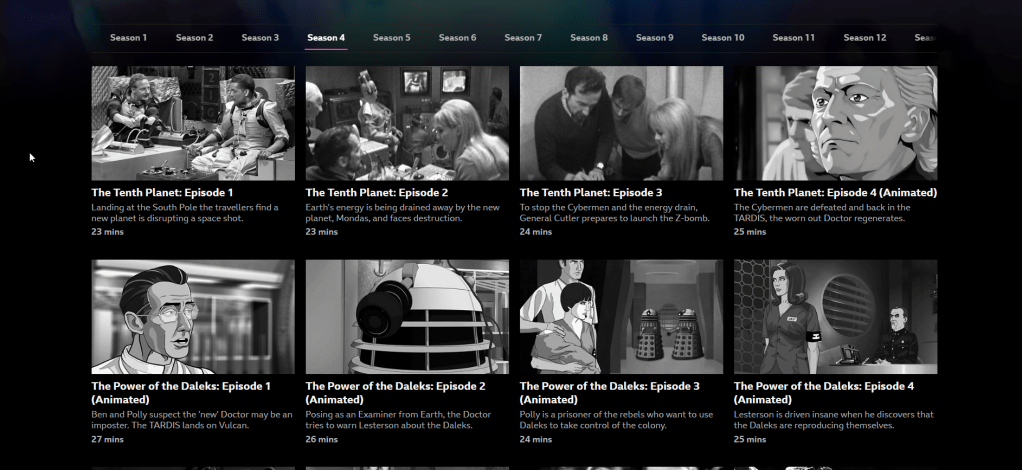
Every episode that exists has been made available on BBC iPlayer – with the sad exception of the very first story, due to a somewhat mad dispute with the son of the original author. There was a massive water show in Cardiff Bay, with a medley of classic moments projected onto a shimmering, watery screen that would have made Professor Zaroff proud.
There have been documentaries aplenty, including Who-inclined comedian Toby Hadoke’s excellent Radio 4 two-parter, Surviving Doctor Who. David Tennant hosted a compilation of interviews with the show’s stars, Talking Doctor Who, which stretched from a 1966 interview with William Hartnell right up to the stars of the show now. You could even listen to William Hartnell’s 1965 appearance on Desert Island Discs (spoiler – he loves classical music)!
In the spirit of the 50th’s Doctor Who Prom, there was a special edition of BBC Radio 2’s Saturday Night is Music Night showcasing the scores for the show and hosted by Jo Whiley – Doctor Who at 60 – A Musical Celebration. While rather less impressive than the Albert Hall and a parade of in-character cameos by the stars of the show, this was nonetheless wonderful.
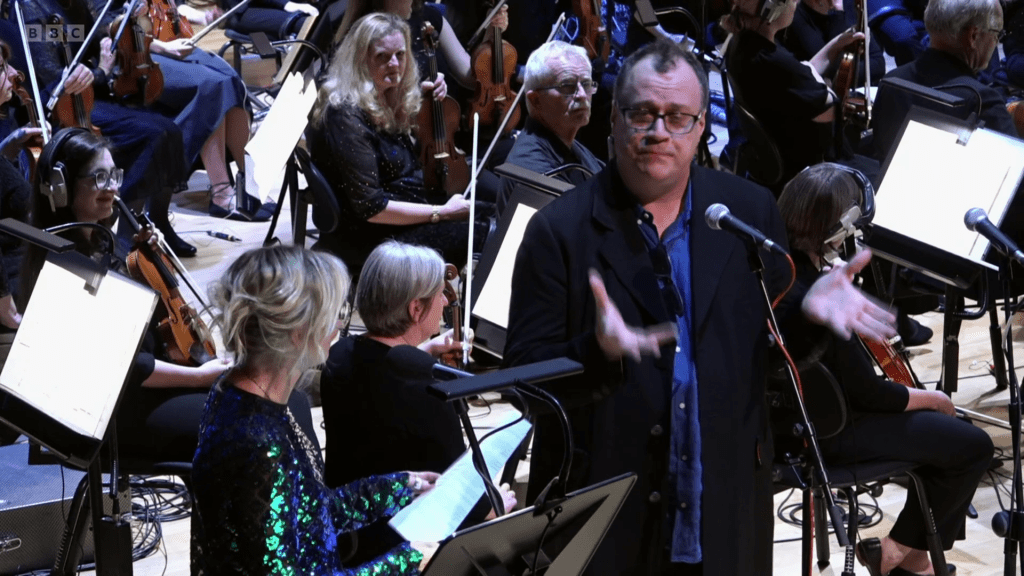
About half the setlist was the material from the Prom, but we were brought nicely up to date with the inclusion of a medley of Segun Akinola’s scores, and returning composer Murray Gold’s new themes for the Fifteenth Doctor and new companion Ruby. The icing on the cake was onset interviews with the composers (including classic show stalwarts Peter Howell and Mark Ayres), and every modern showrunner. I don’t know if it was a jokey, off the cuff remark, but Russell T Davies at one point appeared to imply he was staying on for four more seasons!
Six adventures were retooled as feature length stories, and bookended with new material featuring the original stars, reflecting, in character, on the events depicted. These Tales of the TARDIS (of which more later) were a delight, presumably intended to introduce newer viewers to the classic show by putting them in a context that could be understood – after all, after Power of the Doctor, even younglings must now be aware of Peter Davison, Colin Baker and Sylvester McCoy.
There wasn’t, significantly, a new actual episode. For that, we have to wait until tonight, Saturday the 25th. But I can understand why – Russell T Davies has said that Saturdays are the spiritual home of Doctor Who, and I must say I agree. However, we were spoiled by a “new version” of the classic show’s second serial, The Daleks – now in colour!
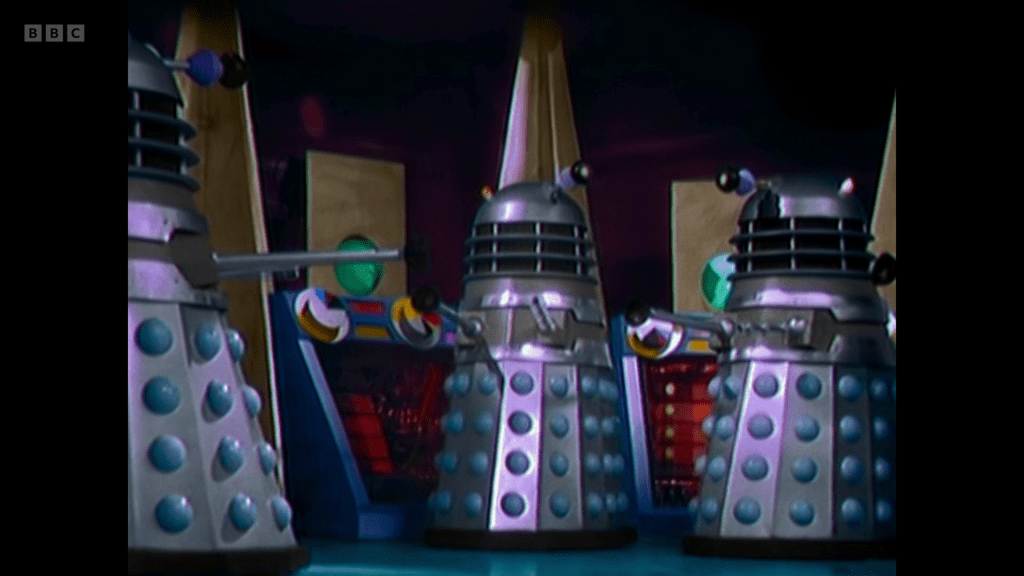
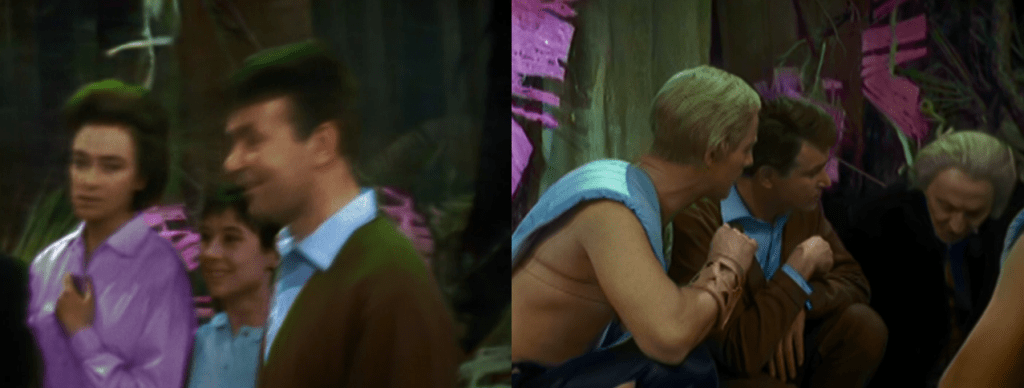
Somewhat erroneously introduced by the BBC4 continuity announcer as “60 years to the day since we first saw them”, The Daleks has, by some quantum magic, now been changed from black and white to colour. Now, colourisation was all the rage in the 90s, when Turner Classic Movies decided that modern audiences were only capable of appreciating movies like Casablanca if they were in colour. Purists, insisting that these classics had been made with monochrome in mind, were predictably outraged – rather forgetting that the original, black and white versions still existed, and that, if they had to watch them on TCM, they could always turn the colour down on their TVs.
But, beloved though Casablanca may be, its fans have nothing on the vitriol that can be spouted by Who fans. So the reaction to this decision was rather… mixed. Which was as nothing compared to how they felt that its original, seven 25 minute episode runtime was to be reduced to a truncated, feature length 75 minutes.

Once again, though, the originals still exist – you can even watch them on iPlayer. This was an intriguing experiment to present one of the early 60s show in a modern style, perhaps to hook younger fans who might have found the ponderous grammar of 60s TV rather… well, boring.
And I thought it worked rather well. True, there were things I might have done differently, but then I’m not employed by the BBC to do these things. To take the colourisation first, I thought it was a valiant attempt that perhaps could do with a bit more work. I don’t know what kind of process was employed to do this, but a couple of years ago I saw a fan-made colourisation, using AI, of many classic stories. The results were rough, flickering, and predominantly blue where colour has been inserted.

I suspect the process here may have been an evolution of that one, as blue still predominated throughout. Some fans, comparing colour production stills to the result, have complained that Barbara’s blue blouse has been rendered in a lurid pink, but I can see why that choice was made – something needed to stand out from Ian’s blue shirt, Susan’s blue blouse, the Daleks’ blue bumps and blue floors, and the Thals’ blue jerkins.

Speaking of the Thals, the colourisation showed far more clearly the way their costumes were rather… revealing. We knew they were barechested under those skimpy jerkins, but the insertion of flesh tones also clearly showed the strategically placed holes in the edges of their kinky leather trousers. Nice.

Elsewhere, I think conscious decisions had been made to make vivid colours that popped against all that blue. The Dalek control room, in particular, was a positive riot of colour, rather making up for the fact that the forest outside was rendered in more muted tones. Well, it was petrified – it would have been weird if it had been bright green.
The colour generally was good, though. It could perhaps do with some refinement to give a greater variety so that the sudden appearance of bright colour against muted tones was less jarring, but the tantalising montage of colourised clips from other 60s stories showed a far more naturalistic look. Perhaps stories with a less alien setting would be easier to illuminate. And I think most fans accepted that, if they want to watch the shows in b/w, the originals are still readily available.

The editing, however, was more divisive. The original story is, by today’s standards, very, very slow – seven 25 minute episodes works out as nearly three hours, for a story that is actually fairly slim. Film adaptation Dr Who and the Daleks managed to do the same story perfectly well in less than 90 minutes.
Much of this is to do with the limitations of how TV was produced in the early 60s. I have frequently mentioned the tedium in one episode of seeing seven characters make the perilous jump over an underground chasm while trekking to the Dalek city, in mind-numbing detail without a single cut. Well, there was a reason for that. The show was shot ‘as live’ – not actually broadcast live, but filmed as though it were. It would have been logistically impossible for the cameras, in real time, to cut halfway through that sequence, move to another set, then move back to show the final, most dangerous crossing.
So that sequence was an obvious candidate for trimming, and it duly was, in exactly the way I always thought it should be. Some of the cuts, though, in the name of keeping the story moving swiftly along, seemed to lose something – particularly the loss of Susan’s terrifying encounter with a fossilised alien beastie shortly after leaving the TARDIS.

Much of the cutting was judicious – even bearing in mind the strictures of 60s TV production, the original story has a lot of padding. But a seeming determination to make the story as fast paced as possible lost a lot of depth, and seemed to be at one frantic, kinetic pace throughout, rather than building from a slower pace to a faster one as the narrative reached its climax. Consequently, what we got seemed rather rushed even by modern standards, with some of the plot unclear. 75 minutes is an odd choice of target length – perhaps 90 would have been better to allow the story a bit of time to breathe.
Then there was the rather excessive use of flashbacks to remind the audience of details that, in such a short runtime, they couldn’t possibly have forgotten unless they had the memory span of goldfish. “Remember what they did to your legs,” Susan cautions Ian, followed immediately by a flashback to what they did to his legs. Which, in this version, happened all of fifteen minutes previously.
The decision to keep every shot short was a sensible one from a modern perspective, with editing techniques that would have been unavailable to a 60s vision mixer being barked at by a perma-smoking director. But on occasion, the fast cutting produced some odd results when characters seemed to move at light speed from one place to another; during the discussion at the Thal camp, Ian and the Doctor have moved from standing at one side to the middle of the gathering in two consecutive shots, during an apparently uninterrupted conversation.
If this sounds like carping, I should stress that I thought most of the editing was impressive, given the challenge of reducing a slow-moving three-hour story from the 60s to a modern style 75 minutes. I gather the editor given this Herculean task was Benjamin Cook, a longtime collaborator with Doctor Who and a prominent YouTuber. Criticisms aside, I think he did pretty well. The intercutting of the discussion at the Thal camp with the Daleks watching it on the monitor was clever, snd there was some nice use of cross-fading. Your mileage may vary at the discreet cleaning up of Hartnell’s “Billy-fluffs” of the lines – no mention of “anti-radiation gloves” here.
Adding to the modernisation of the story were some nice retroactive touches, such as introducing the Cloister Bell TARDIS alarm to the scene where the Ship is unable to take off. Joining in with the spirit of the thing were Nicholas Briggs, supplying some more modern Dalek voices alongside the originals, and composer Mark Ayres, augmenting Tristram Cary’s sparse, experimental score to give the story a suitably Murray Gold-esque feel. Which was added to by the way the music often drowned the dialogue, but fair’s fair – that wasn’t Mark’s decision. And it is in keeping with the modern show 😊 I did think that the jolly, upbeat music over the (now much shorter) escape from the Dalek city was oddly comedic; but I’m sure I also detected notes of Malcolm Lockyer’s score for Dr Who and the Daleks here. If so, it was a nice touch.
OK, it wasn’t perfect, but as a first go at this sort of thing, I really enjoyed this new version of what’s now called “Doctor Who and the Daleks”. It’s a first go, and as that post-story montage deluged us with colourised clips from other 60s stories, I found myself thinking I wouldn’t mind seeing some more of these.

But it wasn’t all for the anniversary evening! Immediately following was a repeat of Mark Gatiss’ beautiful docudrama about the show’s beginnings, An Adventure in Space and Time. Now, this one I didn’t see, but I gather some of the material relating to debut story An Unearthly Child had to be removed because of the aforementioned spat with the writer’s son, which is rather a shame. Thankfully I still have my original copy.
But what made it more special than a mere repeat was the (now widely known) touch of replacing the then-current Doctor, Matt Smith, with the forthcoming one, Ncuti Gatwa. With a cheeky wink! I gather this was always the intention – that any reshowing of the drama could easily have the current Doctor inserted into that scene. But it was entirely unexpected for most of us, and a lovely surprise!
Some fans have commented that Hartnell, with his rather… unreconstructed reputation, might have been less than pleased to see his mantle taken on by a queer black man. Maybe, but then this was a guy who started a long-running classic alongside a Jewish woman producer and a gay Indian director. I wonder whether he really was as reactionary as reputed.
And now it’s Saturday. And it’s nearly time for the first of three new episodes that we are going to get to celebrate the anniversary. We may not have had a new ep on the day itself, but I’m breathless with anticipation! Let’s see how quickly I can find a way to watch it from Spain…
 Simon’s Incoherent Blog