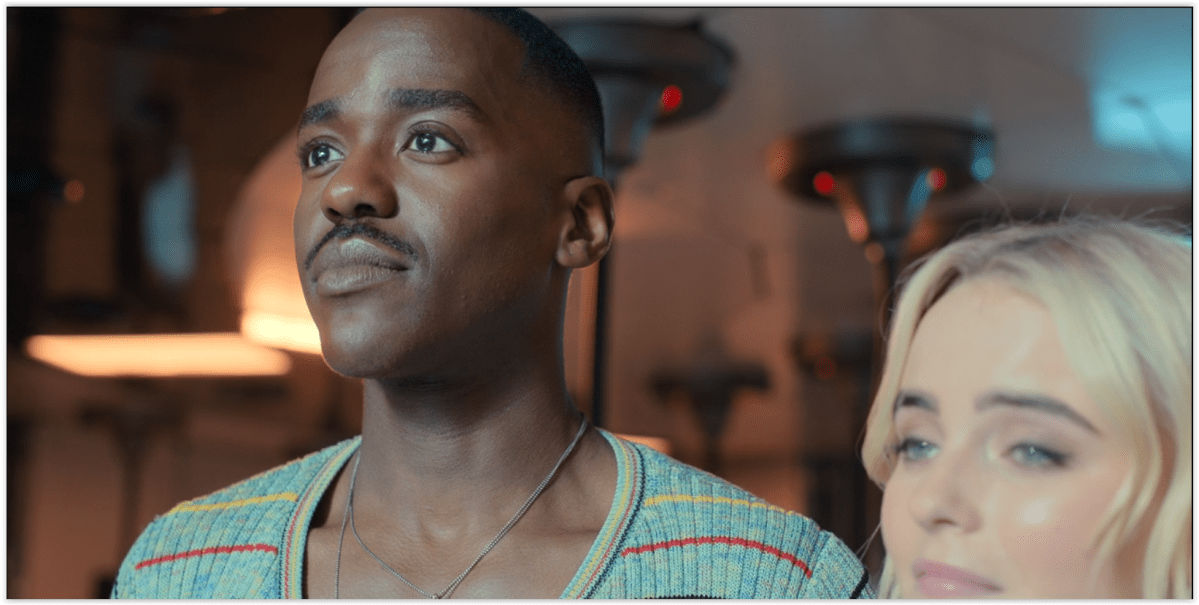
“I don’t have a people, I don’t have a home – but I don’t have a job either. I don’t have a boss, or taxes, or rent or bills to pay. I don’t have a purpose, or a cause, or a mission, but I have… freedom. That’s what keeps me going. To see the next thing. And the next, and the next.”
(SPOILER WARNING!)
So, it’s back, the show I started to write this blog about – and it’s confusing. Not so much the plot – though we’ll get to that later – but as to what exactly the numbering should be. It’s the 14th full season since the show’s return in 2005. I always thought it was justifiable to refer to the 2005 season as “Series 1”, given the 16 year gap since the end of the original run’s “Season 26”.

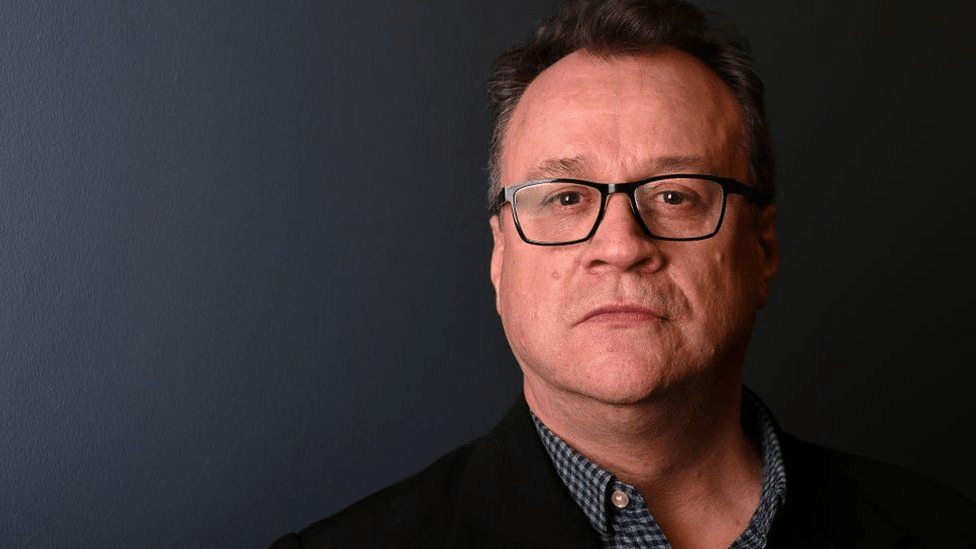
Now though, in this brave new world of Disney+ co-production, showrunner Russell T Davies says this is “Season 1” – presumably of a ‘new’ show. IMDB agrees. Wikipedia doesn’t. Me, though – I’m an old stick-in-the-mud, and it was hard going, when I started writing about the show, not to refer to 2005 as “Season 27”. Given that there’s been no long break, and this is demonstrably the same show, I’m going to stick to calling it “Season 14”.
But is it the same show? Well, we’ve had a change of showrunner, so a change of style. More than that though, the involvement of Disney on the funding side, however much it may be denied, certainly seems to have had an influence on its creative direction.
Previous showrunner Chris Chibnall’s run was divisive, to say the least – some loved its breathless, flashy style, others (me, for example) found it muddled and incomprehensible, a ‘triumph’ of style over substance. News that much-vaunted dramatist Russell T Davies was to return to the show was met with a sigh of relief from Chibnall-haters (who seemingly forgot how much criticism RTD drew in his original run).
If you were expecting a return to the style of the show from 2005-2009, though, you would be wrong. Very, very wrong. From the start, this is very much a different style to RTD’s original run. It’s gaudy and frenetic – one friend memorably described it as “like someone had thrown technicolor paint in my face and shouted a lot”. I certainly see his point – though as middle-aged men, we’re hardly the show’s target audience. The style is very much in keeping with Disney’s intended, much younger demographic. More than ever, it seems like a show for children (as opposed to families, its original brief).
So some may find it no better – worse, even – than Chris Chibnall’s run. On that, I disagree. In between all the frantic running around, there was still plenty of time for reflective character beats, more so than poor Jodie Whittaker ever got. New companion Millie Gibson as Ruby Sunday still seems a bit by-the-numbers, but Ncuti Gatwa’s Doctor had plenty of moments to ruminate on his life, his philosophy, and crucially, the consequences of events in his life. He’s back to being “the last of the Time Lords”, as a result of the “genocide” against his people by the Master, a theme both episodes return to frequently.

It’s a good contrast to Chris Chibnall’s approach. That genocide was originally shown as little more than a throwaway plot point in the Master’s evil scheme – there wasn’t even any indication as to how it was accomplished, much less so on its impact for the Doctor. These episodes put it in a far more appropriate context, as a hugely traumatic event. The recent David Tennant mini-run did the same for the events of the Flux. I don’t want the events of Chibnall’s run, controversial though they were, to be forgotten or glossed over, and in fact so far, RTD seems to be treating them with more seriousness than Chibnall ever did. That’s a good thing.
What of the episodes themselves, though? This is the first time, I think, that I’ve ever discussed two episodes in one post. But it’s also the first time two eps have “dropped” at the same time, an increasingly common tactic as broadcast TV becomes less and less relevant in the age of streaming. Given the co-producer, it’s also the first time that American audiences have seen the show first – though for die-hard fans, it was simulcast to the UK in the middle of the night.
And showing us two eps at once gives us a chance to more properly assess what the ‘new’ show is going to be like, and to compare and contrast. That’s probably good, as at first glance, the opening ep – Space Babies – seems like pretty lightweight stuff. It certainly does what it says on the tin; it’s about babies. In space. As the dialogue kept reminding us by repeating the title so frequently it became somewhat irritating.

Your tolerance for cutesy schmaltz may vary, and I’m sure for some, the depiction of talking babies in motorised pushchairs crewing a space station might have pushed it a level too far. It’s hard to assess the ‘performances’ of the babies, voiced as they were by adult actors with CG mouth movement to synchronise. More than once though, knowing what real babies are like, I found myself reflecting on what a nightmare those scenes must have been to shoot.
And of course there was a monster. If you’re trying to grab a new audience for Doctor Who, there pretty much had to be, it’s always been part of the show’s USP. This one was perhaps less than convincing, though director Mark Tonderai perhaps wisely kept its appearances to brief snap cuts, rarely showing us the whole thing until then end. I did find myself wondering about its name, given the show’s new American audience – “bogeyman” is very much a British usage, the equivalent American term being “boogeyman”. And the gag that the computer has taken the name literally and created the creature out of snot doesn’t really work if you use the American name – they refer to “bogeys” as “boogers”, and “boogey” (or “boogie”) is a dance.

Semantics aside, though, if you dug beneath this seemingly lightweight stuff, there were some pretty serious themes at play here, some of which seemed pointedly directed at the US. For starters, the babies were there because the corporation running the baby farm had abandoned it for being unprofitable, but legal regulations prohibited the turning off of the baby-making machines. I found myself reminded of a similar plot point in the second radio series of The Hitchhikers’ Guide to the Galaxy, where a law recognising that clones were alive prevented the deactivation of a cloning factory, resulting in a multitude of Rula Lenskas confronting Arthur Dent.
But that’s as nothing compared to the larger point. This was, fairly clearly, an allegory condemning pro-life fanatics. As Ruby comments at one point, “so, the planet down below refused to stop the babies being born, but once they’re born, they don’t look after them?” Subtle it wasn’t, but still far better handled than the show’s previous hamfisted take on this issue in 2014’s dire Kill the Moon. For added controversy, those oh-so-cute babies were described as “refugees”, that only one planet would be willing to house, and only if they made a difficult and dangerous journey to get there.

So, some genuinely political righteous anger – one wonders whether Disney picked up on that. They usually seem resolutely apolitical, the better to appeal to as wide an audience as possible; but despite my opinion, perhaps it was a little too subtle to be noticed. Against that was the fairly silly central idea, which, as frequently with Who, falls apart if you think about it too closely.
And then there was the Doctor’s refusal to kill the ‘monster’, even going so far as to risk his own life to save it (as so often over the show’s history, the laws of physics went out the window for this sequence). OK, it was ludicrously idealistic – this was, after all, an artificially created being whose entire purpose was to terrify babies; what were they going to do with it now? But his insistence that, whatever your differences in nature, you have a right to exist, was a perfect restatement of the show’s philosophy.
Thematically, then, a lot to like. If you could deal with the cutesy premise, the unconvincing monster, and the very limited settings. It wasn’t a spectacular episode. And I wasn’t best pleased to see that RTD still thinks fart gags are the way to win over young audiences, as the station combusted all that methane from the old nappies, letting out a blast of gas from what was clearly designed to be a gigantic space bum. I’d hoped he’d gotten over that kind of thing with the Slitheen.

The second episode, The Devil’s Chord, was, on the face of it, a better one. More handsomely staged, with more expansive settings and imaginative visuals, it was certainly the better liked of the two. And yet, despite its worthy musings on the value of music to humanity, it seemed rather lacking in depth compared to the first one.

I imagine Rupaul’s Drag Race alumnus Jinkx Monsoon was a rather controversial bit of casting as the villainous Maestro, but they were perfect for the tone of the episode. It demanded over-the-top campness, and Monsoon certainly brought that, chewing up the screen with every appearance. For all that, the character worked well as a villain, the first of the previously mentioned “legions” of the Toymaker to put in an appearance. (As an aside, that makes it even weirder to claim this is a “new” show, given that it’s following up plot points from the “old” one).

As with the Toymaker (both in 1965 and 2023), we were firmly in the realms of fantasy here, so I had no problem with nice little visual conceits like musical notation appearing out of thin air and grabbing people (one of whom was legendary Who costume designer June Hudson). Just as the Toymaker was the embodiment of games, so the Maestro was the embodiment of music, and that fit in thematically perfectly with the long-anticipated meeting of the Doctor with the Beatles. Historically? Perhaps less so.
Following Ruby’s wish to see the Fab Four recording their first album, the Doctor whisked her off to Abbey Road studios where they met four people who looked almost but not quite entirely unlike Lennon, McCartney, Harrison and Starr. In another studio was somebody who looked even less like Cilla Black. The twist? Their music was awful. Clearly something had gone wrong with history.

It’s a little petty to criticise the looks of the actors playing real people, two of whom are actually still alive; after all, there have been plenty of films about the Beatles, and what counts are the actors’ performances. In that regard, Chris Mason as John Lennon and George Caple as Paul McCartney were… ok. Nothing against them, but the parts were pretty broadbrush. True musos like me were probably sad that George and Ringo didn’t even get a look in, but this was already a story with a large cast, and their appearances would just have been tokenistic.
It was fitting, though, that they were the ones to save the day by finding the “lost chord” and banishing the Maestro back to… wherever, after some epic, musically themed battles with the Doctor and Ruby. But here, the story fell apart rather. We knew that the Maestro had “consumed” all the world’s music since 1925, and a Pyramids of Mars-style flashforward to an alternate present showed us that music was vital in preventing nuclear Armageddon. Somehow.
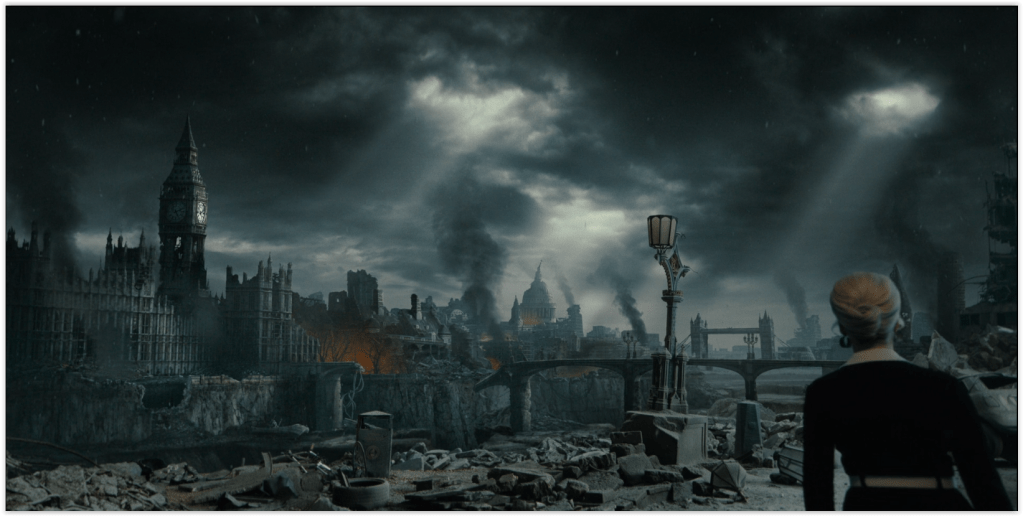
And with the Maestro defeated, music joyfully returned to the world. But did that still mean the period from 1925-1963 was musicless? Did the Maestro’s defeat apply retroactively? And there’s a lot of music that predates 1925 – did people just forget about it? Why did the disappearance of music cause people to view it as distasteful, rather than just forgetting it existed? Fridge logic all, I know, but it occurred to me while I was watching the show. And saying that kids wouldn’t notice doesn’t wash – kids are the most pedantic audience of all.
Still, at least we got a musical number. That one has really divided the fans. In other shows that have done ‘musical episodes’, there’s always been a (usually feeble) in-universe explanation for why people who don’t normally behave that way are suddenly singing and dancing without thinking it’s weird. Remember Buffy’s demon curse, and Star Trek Strange New Worlds’ “interdimensional waveform”.
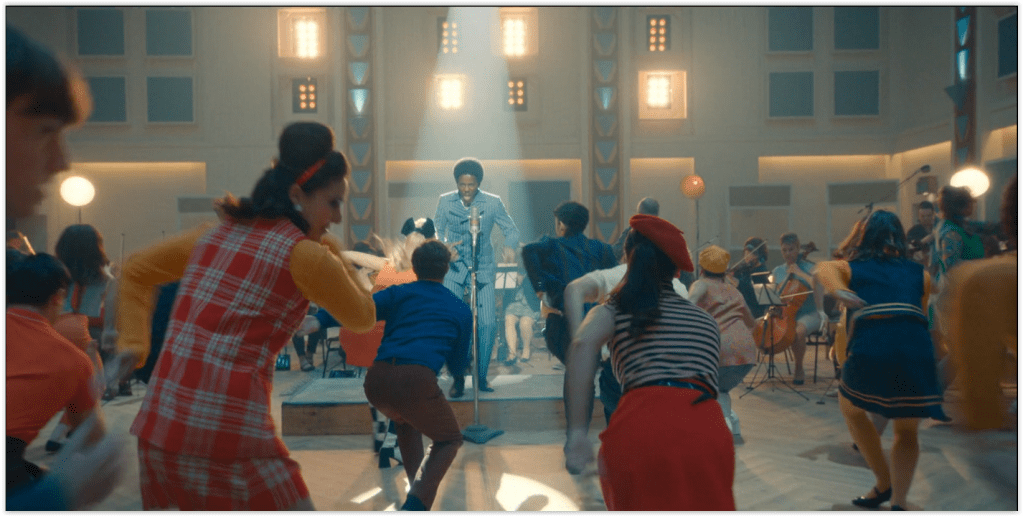
Nothing like that here. Charitably, you could put an in-universe musical number down to the sheer joy of rediscovering music, as was certainly the intention. But to be honest, the show did a musical number in the Christmas episode, and few people seemed to mind there. And this was a good one, though the title – ‘There’s Always a Twist at the End’ – didn’t seem to be referring to this episode. Should we be watchful for something at the end of the season? Certainly the Maestro’s parting shot about “the One Who Waits” sounded suitably ominous.
Ultimately, though, for all its greater spectacle, this episode had less to say than the previous one. It was, however, a rather more engaging story. Your preference hangs on which of those aspects is the higher priority for you. For me, both episodes were fun without being particularly memorable. I didn’t hate them, but neither did I love them.
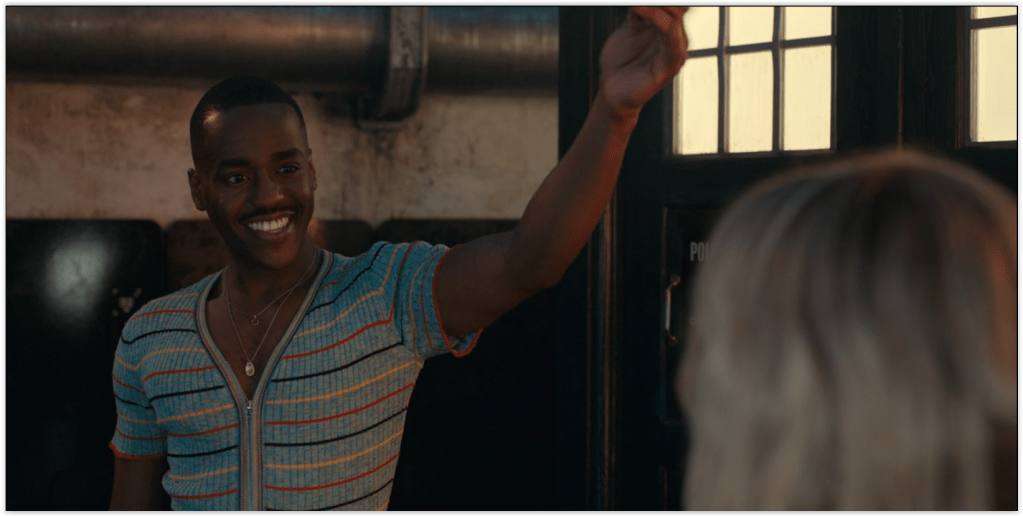
The one aspect I did love, though, was Ncuti Gatwa, who’s perfect casting as the Doctor. He has charisma to burn, and despite the apparent attempt to reinvent the character with a fresh sense of joie de vivre, can do world-weary and traumatised every bit as well as his predecessors. And he’s fun – which the Doctor should always be, and sometimes wasn’t in recent incarnations.

Mind you, I do question the wisdom of putting two episodes next to each other in which he’s also terrified. Yes, there are good reasons for both – the monster in Space Babies was scientifically created to be frightening, and the Maestro, like the Toymaker before them, is a godlike elemental force with unimaginable power. But really, having your lead character look so frightened two episodes in a row is only going to make your new audience think the hero is a scaredy-cat.
They might not if they followed the onscreen explanations, but that would depend on being able to hear them. Because, even more so than in previous years, the sound mix caused the music and effects to completely swamp the dialogue at some crucial points. According to surveys, more than half of Americans now find it impossible to watch TV without subtitles, and it’s not because of unfamiliar idioms or accents – 61% of those say they simply can’t hear the dialogue over the background music and sound effects. That this trend is still increasing, and it doesn’t seem to bother programme-makers enough to change their approach, is ridiculous. It’s also a massive insult to the actors trying to deliver dialogue – why bother, if the audience can’t actually hear it and has to read it instead? You might as well go back to silent movies with intertitles. Al Jolson is presumably spinning in his grave.
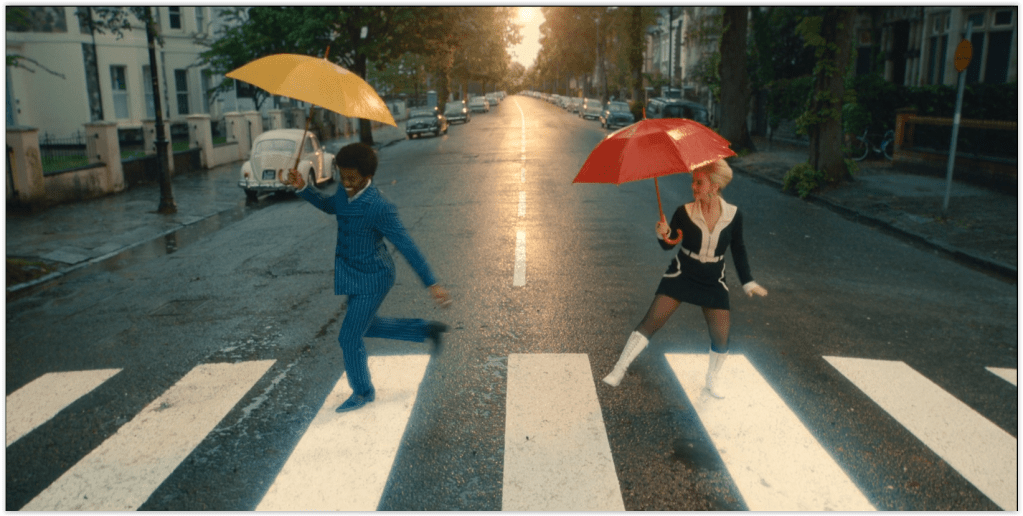
Rant aside, this was determinedly a new Doctor Who, whatever season number it is. Old school fans hoping for a return to the likes of Midnight or Turn Left are going to be disappointed, on this evidence – this is not the Russell T Davies (you think) you remember. For me, I didn’t mind that at all.
Yes, it’s garish, brightly-coloured and distinctly child-oriented. But I’ve been watching this show for most of my life, and I’ve always found something to enjoy in it, even when I’ve disliked the overall approach, as with Chris Chibnall. There was still plenty to like here for me (though plenty to dislike too), and a better approach to drama, characterisation and exposition than in the recent, muddled years. When you could hear it, that is. And if there’s anything I actively hated, it was that. For goodness’ sake, RTD, show your actors some respect and let us hear them.
 Simon’s Incoherent Blog