
“It’s taken me all this time to realise what I’m here to do.”
“And what is that?”
“I’m gonna save the world.”
(SPOILER WARNING!)
Well, that was a weird one. As if on a mission to demonstrate just how flexible a show Doctor Who can be, this week Russell T Davies veered away from cutesy babies, musical numbers and earnest anti-war polemic to deliver a genuinely creepy, off-kilter ghost story that deserves a place in the show’s long history of nightmare fuel for its child viewers.
It was also weird for being a ‘Doctor-lite’ story, with Ncuti Gatwa only appearing in the first and last scenes. Not that there’s anything unusual in itself for the show to do a ‘Doctor-lite’ episode; they’ve been almost a fixture of each season since 2006’s Love and Monsters, a chance to bulk up the episode count without overexerting the star. But it felt odd to have one here, only four episodes into a much shorter run for a new Doctor.
I gather the reason for this is that this was the first ep to be filmed, and the much in-demand Gatwa was at the time finishing up on the final season of Sex Education. That’s what you get for casting a major rising star as the Doctor, I guess. Ncuti has been terrifically busy of late, with major roles in Barbie and Masters of the Air alongside Sex Education just last year.
Doctor-lite episodes don’t have to be forgettable filler, though. Indeed, they’ve provided us with some of the show’s most memorable stories. Not everyone liked Love and Monsters, with its witty and acerbic dissection of the show’s fans themselves (full disclosure: I loved it), but Blink and Turn Left have been widely regarded as classics. As with the latter, 73 Yards used the absence of the Doctor to foreground the companion, and Millie Gibson was the star of this week’s show.
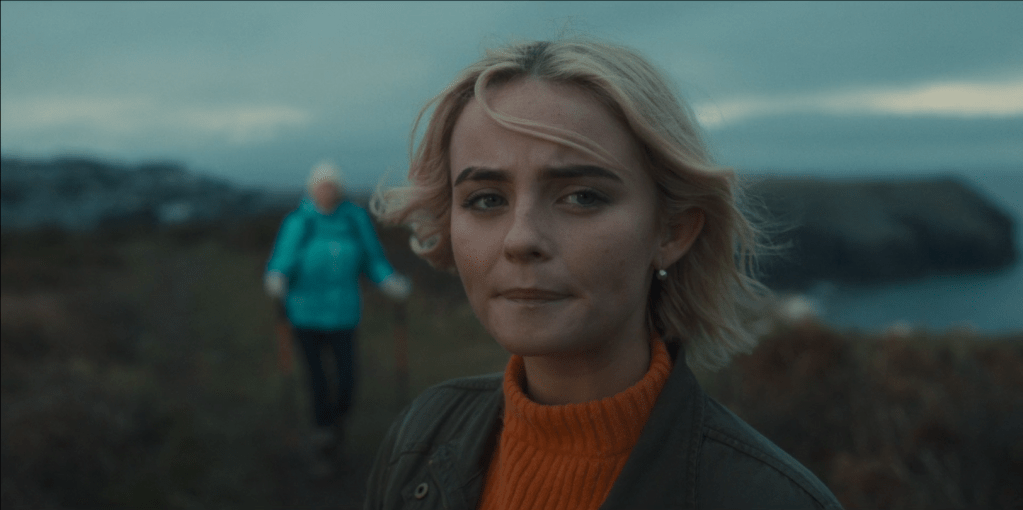
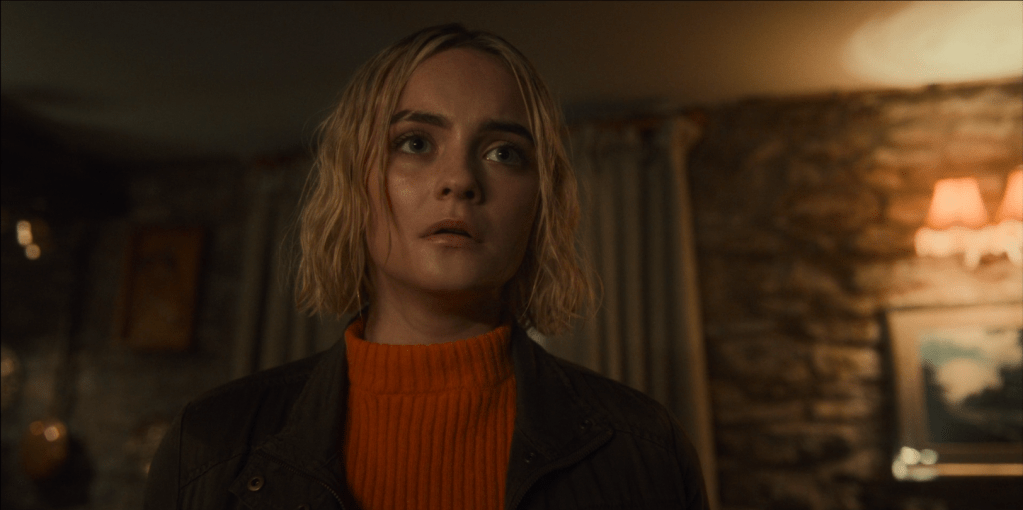
This was a good thing, as it gave RTD the chance to flesh out a character who, so far, has been rather ‘companion-by-the-numbers’. I’m not sure how successful it was in that – we know little more about Ruby than we did before. But Millie Gibson, given the chance to carry a whole story, showed herself to be well up to the task, showing us snapshots of the next 20-odd years in the character’s life with some aplomb. That said, I’m not entirely convinced that just putting a wig and glasses on her convincingly made her appear to be in her 40s.

That whistle-stop tour of the next two decades was the unexpected second act of a story that started out quite differently. Initially, we were in very much trad ghost story territory, with the Doctor’s unwitting vandalism of a ‘fairy circle’. His subsequent disappearance coincided with the arrival of a mysterious figure, a sad-looking, hand-wringing old lady who could never be seen other than at a distance, and who, it transpired, would always be that same distance from Ruby. Others could approach her, but when they did, she said… something to them, and they ran away screaming.
The script took a decent time to establish the ground rules of this, revealing them gradually as Ruby herself figured them out – a good approach that reflected the way this story was told entirely from her perspective. Hence, we started with a lengthy and very effective scene in what must be the most unfriendly rural pub in Wales which both paid homage to and subverted the standard ‘dark warnings from the locals’ scenes in so many classic horror movies – think of the pub scene in American Werewolf in London, in particular.
All the tropes were present – thunder and lightning underscored the villagers’ doom-laden utterances, and a sinister knocking at the door that apparently provoked fear from all concerned. However, this was then cleverly subverted by the reveal that it was all a joke being played by the locals playing on just such cliché-inspired stereotypes that tourists had of such communities (I dread to think what that pub’s TripAdvisor reviews must be like). The clever kicker was the realisation that there really was a supernatural menace, which only Ruby realised.

It was an effective, lengthy scene, played well (acting legend Siân Phillips was a particular standout as the seemingly well-educated old lady at the bar). It also led to the expectation that the whole story would play out like that, but in fact the pacing ramped up and up throughout, from the real-time pace of that unsettling sequence succeeded by faster and faster scenes until we were seeing vignettes taking place years apart.
We saw Ruby becoming more and more isolated from the world courtesy of her spectral hanger-on. First her mother was driven to reject her, then a surprise (albeit rather perfunctory) appearance from Jemma Redgrave’s Kate Lethbridge-Stewart showed that even UNIT couldn’t help out, with Ruby being ‘blacklisted’ by them too. The years then began to fly by, as a montage of failed relationships showed how the mysterious phantom was keeping Ruby alone forever.

The rapid change of pacing seemed a little dizzying and unreal, but helped contribute to the generally unsettling atmosphere of the piece. Surely this can’t be happening, you kept saying, but it really was – the Doctor was gone, the TARDIS mouldering away on a Welsh cliff, and Ruby was living a lonely life without him. It was, in some nonspecific way, really disturbing given what you would expect; heaven knows what fans new to the show must have made of it.
The pacing did slow down somewhat for the main plotline of the story’s second act, which might almost have seemed like a completely different story, but was cleverly interwoven with the first. My first thought was of Stephen King’s The Dead Zone, an episodic thriller in which the final plotline involves the supernaturally-empowered main character setting out to stop a politician who is destined to start a nuclear war. But the depiction of a dystopian near-future Britain is one of Russell T Davies’ frequent preoccupations. We see one in the aforementioned Turn Left, and he managed to make the concept into an entire series with the excellent, righteously angry Years and Years.

Aneurin Barnard’s Roger ap Gwilliam was believably charismatic, though as with King’s Greg Stillson, it’s never really explained why he would want to start a nuclear war. But after the recent years’ chaos at the head of the British government, and (purely coincidentally) with a General Election just announced, he was a timely figure. It was understandable, if cynical, to imagine that the British public would turn away from the increasingly indistinguishable main political parties for a new, Trump-like strongman upstart. “He’s a monster,” muttered dejected-looking campaign volunteer Marti; RTD wisely left it to the imagination as to exactly how, but it wasn’t difficult, in these days of #MeToo, to guess. Particularly after the chaotic reign of Boris Johnson.
Ruby’s solution, using her ghostly follower to precisely target him by standing exactly 73 yards away, was certainly more inventive than King’s hero’s method of just shooting the bloke; but it seemed oddly inconsistent that it caused him to resign his position rather than just starting to despise Ruby, as every other character who encountered the being did. It also made for a time paradox that doesn’t really work. We were told at the outset that Gwilliam “almost” started World War III; then we were shown that it was the future Ruby that stopped him. Except, with the events of the story cancelled out (again, how exactly?) by the end of the episode, presumably that never happened. So what did stop him?
It was one of a number of lapses in logic in an otherwise effective story. We were eventually shown that the ethereal figure dogging Ruby’s every step was none other than herself, a future version at the moment of her death. But older Ruby seemed like a genuinely nice person – why would she then dedicate a spectral existence to making her younger self’s entire life a living hell? (Indeed, one of my friends has pointed out the uneasy fact that this ep shows a woman suffering for 65 years because of something a man – the Doctor – did, which doesn’t sit too well with RTD’s apparent commitment to diversity). It’s possible that her entire purpose in inflicting all that misery on herself was to ensure that she stopped Gwilliam – except that the ghost (somehow) caused that to be undone by the end of the episode.

It’s certainly a neat twist, in this kind of ghost story, to reveal that your main character was actually haunting herself, but it doesn’t really make sense. Far better, at least in my opinion, to have left the viewer with no explanation at all, as in RTD’s classic Midnight, than offer a twist that falls apart the moment you think about it too much.
It is possible that all this will be resolved later in the season, as part of the solution to the puzzle that is Ruby. Certainly the mysteries surrounding her were again at the forefront here; her unidentified birth mother was again mentioned, and we saw the Sundays’ mysterious neighbour Mrs Flood again for the first time since the Christmas special. The snow was back, as was actor Susan Twist (previously shown as a Comms Officer in Space Babies, a tea lady in The Devil’s Chord, and the face of the Ambulances in Boom). This time she was the unfortunate hiker who was the first to encounter Ruby’s ghostly stalker, and Ruby actually half-recognised her. I’d be very surprised if she isn’t an important part of the explanation.

73 Yards is an effective, atmospheric ghost story (even taking into account its logical inconsistencies) with a pervasively creepy atmosphere of the supernatural. It seems that this is the direction in which the show is going; Kate referred to UNIT’s purpose as combatting aliens “and, increasingly, the supernatural”. I’m not sure I like that. Doctor Who has always been a SCIENCE-fantasy show; it has frequently shown classic supernatural elements, but always with a handwaving scientific explanation (even if the science is frequently nonsensical).
Don’t get me wrong, I like the fact that the show is flexible enough to have room for an occasional Celestial Toymaker or Mind Robber, but I wouldn’t want it to be like that all the time. Russell T Davies, it seems, does, and has apparently based most of this season’s arc on the villain of the former. Still, I’m just a keyboard warrior while he’s an award-winning dramatist. Let’s see how this season is resolved – I have a feeling that will cause us to reassess the criticisms of earlier plot holes. But I wouldn’t mind a story that made sense on its own terms rather than only as part of a wider arc, however much I enjoyed this week.


I know a lot of folks are disappointed with the lack of a better explanation – any explanation – for the ending, but I do suspect this was a solid bit of world-building for our new Companion…and setting us up for a better understanding of what Ruby is all about as we move forward. Regardless, I thought it was a brilliant concept and the episode I’ve enjoyed the most this season by far. I think Gibson did a wonderful job. Looking forward to giving this ep another watch this week, and I even suspect it will be on my list of all-time favorite episodes…thought it was that good.
LikeLike
Yes, I’ve read many online comments that make sense of the inconsistencies I noticed – interestingly, not always in the same way. I think this is an episode with a deliberate ambiguity, which will reward multple viewings. I’d only just seen it when I wrote this, and am now going to watch it again with the interpretations of others in mind!
LikeLiked by 1 person