

“Duty is sacrifice. It eclipses all things, even blood. All men of honour must pay its price.”
(SPOILER WARNING!)
Gird your loins (metaphorically speaking), for after a gap of nearly two years, HBO’s spinoff/prequel to Game of Thrones is finally back for a second season. That large gap reflects a very big, expensive production – but of course it also represents a lot of backstage difficulty with both a writers’ and actors’ strike. Nonetheless, it’s notable that it’s back a couple of months before arch-rival Amazon show Lord of the Rings: The Rings of Power.
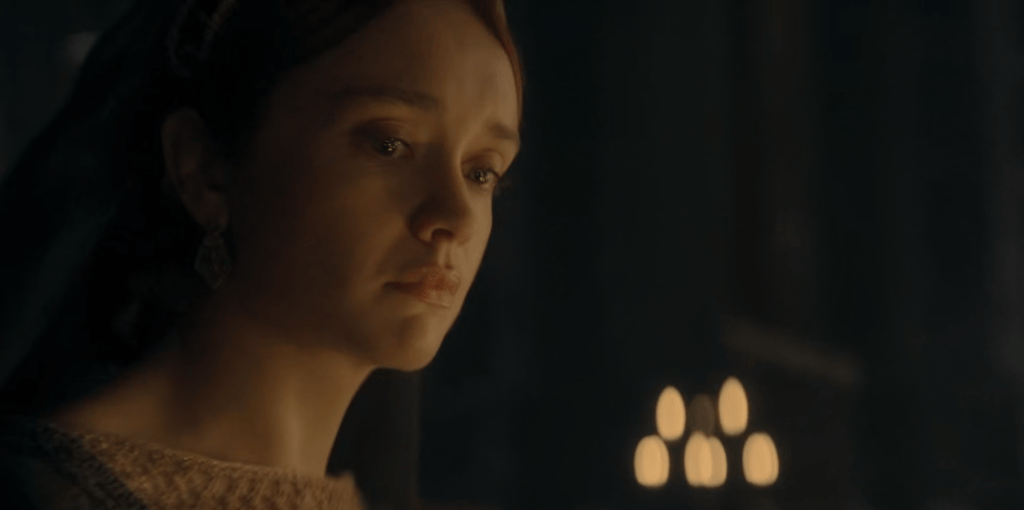
House of the Dragon’s first season was a far bigger success both in popularity and critical reception than Amazon’s lumbering Tolkien adaptation, and also had the advantage of a more recent, massively popular parent show (whatever you thought of Game of Thrones’ final season). It works as a spinoff in that, while it certainly delivers much of the same in George RR Martin’s meticulously constructed fantasy world, it’s just different enough from the original to be worth watching.
While Game of Thrones thrived on high spectacle, with bloody, action-packed battles, House of the Dragon is an altogether subtler proposition, foregrounding the political intrigue that was very much a part of the parent show while eschewing its more grand guignol excesses of sex and violence. It also, being set a couple of centuries before the original, focuses less on the fantasy aspects of magic and an Unstoppable Supernatural Menace. That’s a good thing in my opinion – we’d seen both ad infinitum in plenty of fantasy stories before, while the byzantine Machiavellian scheming of its mostly self-serving characters was far more interesting.
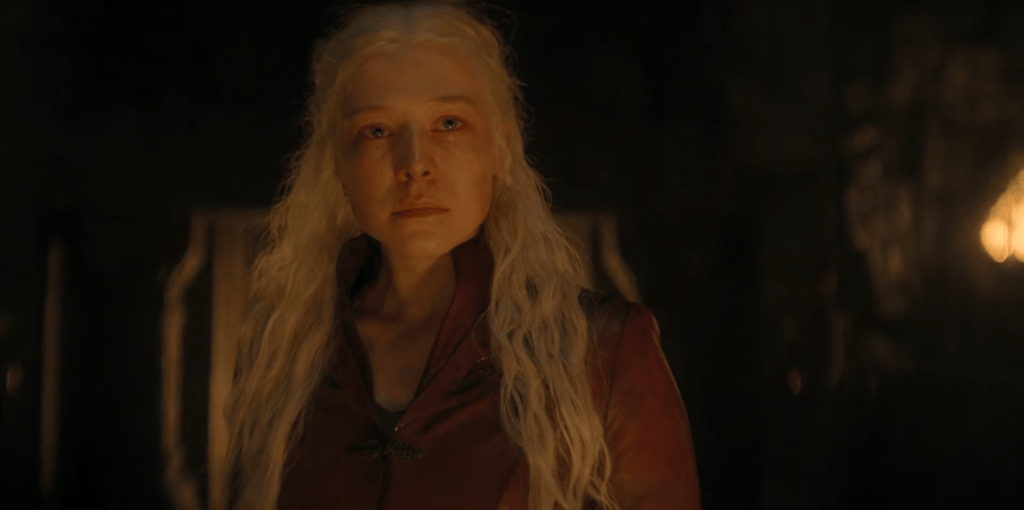
And that’s what we get more of here. Like Game of Thrones, House of the Dragon has its roots in real history. While the original show was the Wars of the Roses with the serial numbers filed off, this one skips back a few centuries to take inspiration from yet another of England’s multifarious civil wars – this time, the 12th century struggle for the throne later nicknamed The Anarchy. As here, that power struggle started as a result of a male dominated aristocracy refusing to accept a female successor to a well-liked king, with noble houses taking sides between her and her male rival. This is that. Only with dragons.
Like its parent show, the second season of House of the Dragon starts with an obvious advantage over the first. The show has a huge ensemble cast, and given the political scheming involved, knowing who they are and what positions they hold is vital to understanding the plot. It took a few episodes to get my head around all that last time, but this time viewers know who these people are and (at least apparently) what they’re trying to do.
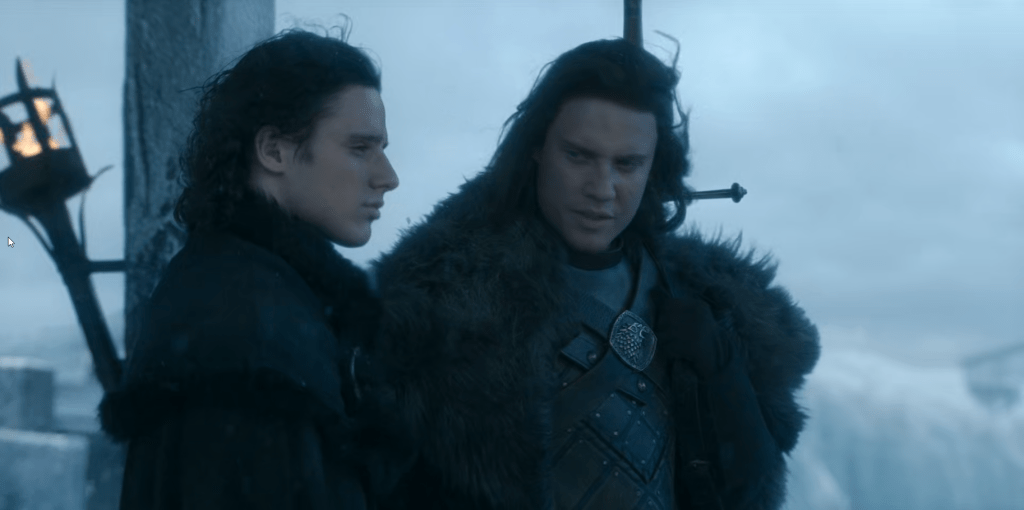
Not that there aren’t new characters to get to know. The season picks up pretty much where the last one ended, but we’re introduced immediately to a new player in the nascent war between Targaryen factions – Ned Stark’s ancestor Cregan, played with a suitably dour Northern demeanour by young actor Tom Taylor (who’s actually from Surrey). He’s introduced as Prince Jace (actor Harry Collett’s hair seems to have grown implausibly longer in the narrative’s few days) takes a fan-pleasing visit to the Wall to try to recruit Northern support for Queen Rhaenyra’s cause, which means we do get some ominous warnings about the Unstoppable Supernatural Menace. But given that this is a prequel, that’s mostly for fanservice – we, the viewers, know that it’s going to be another couple of centuries before the White Walkers become a problem.
It’s here that Jace receives raven-borne news of the death of his little brother in last time’s season finale, at the hands and claws of Prince Aemond and his monster dragon Vhagar, the event that’s sure to kick off actual war between Jace’s mother Queen Rhaenyra and recently anointed King Aegon, son of Rhaenyra’s childhood friend turned bitter rival Allicent Hightower, whose father Otto, as Hand of the King, is cementing his position of power as the ultimate power behind the throne.
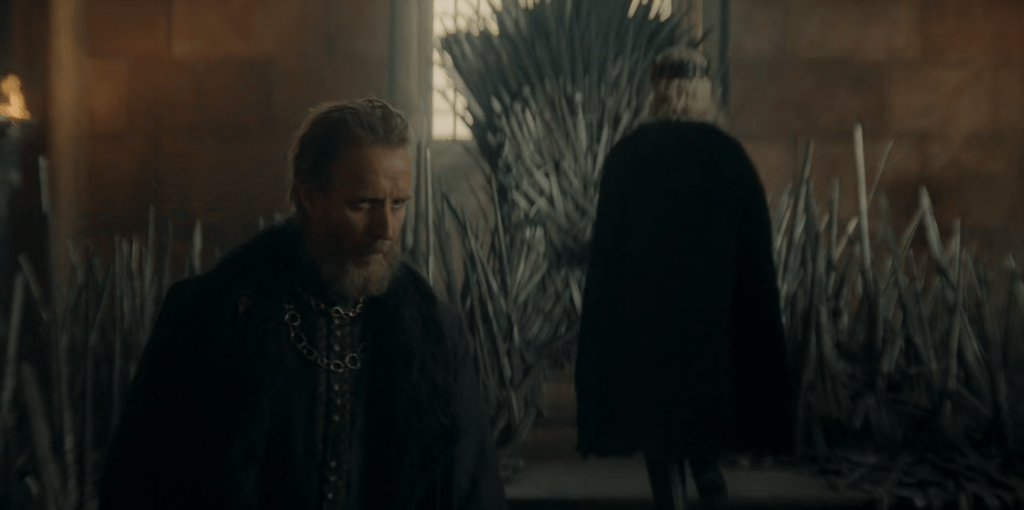
Got all that? Yeah, after two years, remembering the myriad interwoven plot threads of who’s doing what to whom in a scheme for power wasn’t easy. And the show doesn’t make it any easier with convenient but clumsy exposition where characters tell each other things that logically they must already know (“as you remember, my lord…”). I had to spend a lot of time rereading my blogs from 2022, but I gather HBO helpfully provided a pre-show primer to stir viewers’ memories rather than having a 20 minute “Previously on…” before the show itself.
If you were expecting a stonking great spectacle of a season opener, though, you would have been disappointed. House of the Dragon is (so far, at least) a far more low key show than its predecessor, so what we got was very much centred on the characters, as all reflected on where they are now. Rhaenyra seemed to forsake that previously much-discussed Royal Duty in favour of moping around on her dragon in a quest for her son’s body – quite believable for a recently bereaved mother – while down in King’s Landing, we got more interminable meetings of the Small Council as the incumbent faction dithered over what to do next.
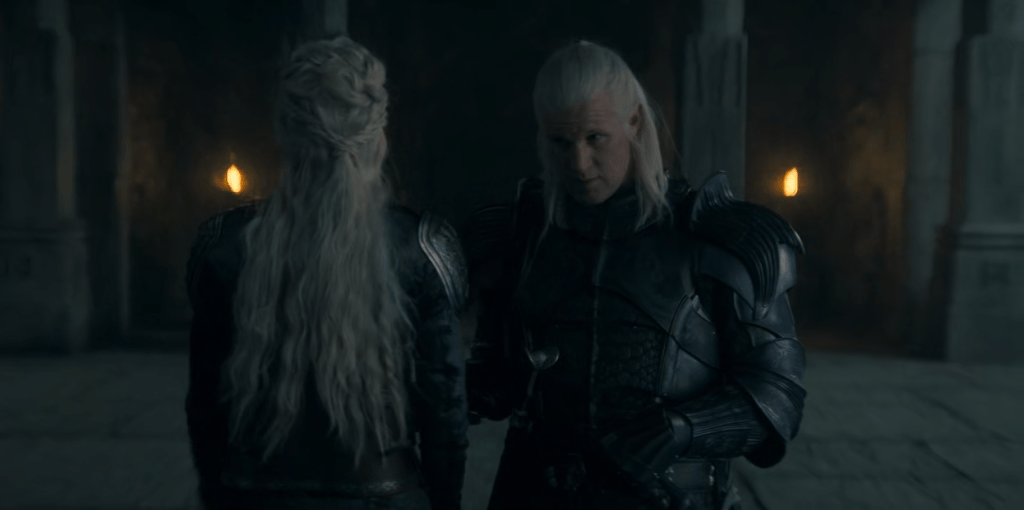
As ever, Matt Smith was the star of the show as rascally Rogue Prince Daemon. Still encumbered with perhaps the show’s most Ridiculous Targaryen Wig, Daemon is clearly not one for self-reflection, and wants to send dragons off to incinerate his niece/wife’s rivals right away. Smith, as usual, chewed up the screen magnificently even as wiser heads (well, Princess Rhaenys anyway) blithely ignored his bloodthirsty commands.
Down in King’s Landing, it was more jostling for power as various individuals schemed the downfall of various other individuals. Larys Strong, notably, looks to be angling for the position of Hand by pouring poison about Otto into the ears of Queen Allicent; it’s typical of these shows’ constantly infighting families that she seems half-convinced to dethrone (metaphorically speaking) her own father.
And he definitely does have all the power here, despite not actually being, y’know, the King. That was amply demonstrated in a cringeworthy scene of Aegon trying his very best to be a munificent ruler to his petitioning commoners, while Otto overruled him at every step. Rhys Ifans, more usually known for madly OTT performances (see his Rasputin in The King’s Man) has nicely toned down his usual excesses as the watchful, manipulative Ser Otto.

His chairing of that Small Council meeting only served to underline where the real power lay; as Aegon messed about using his son to humiliate the cringing Tyland Lannister, it was Otto who took all the big decisions. A fact that Allicent clearly hugely resented. Otto may be her father, but he’s basically undermining her son as King. Otto should watch himself – Larys’ exhortations may bear fruit sooner than he thinks.
All this intrigue in King’s Landing rather overshadowed any attention being given to the rival faction based on Dragonstone, but it was that which led to a truly shocking climax for the ep. Having hired a pair of incompetents to infiltrate the Red Keep and assassinate eyepatch-wearing baddie Prince Aemond, Daemon may not be best pleased to discover that, failing to find him, they killed Aegon’s infant son – the heir to the throne – instead.
It was a scene taken directly from Martin’s books, and it wasn’t a pleasant one. With the demand to bring the head of a royal son, the clueless assassins found themselves confused by two children of both genders rendered near-identical by their Ridiculous Targaryen Wigs. It was therefore down to Queen Helaena, asked to identify which was the boy, to effectively choose which one of her children would die.
That’s a horrific choice for a mother to make (it’s a key plot point in classic Meryl Streep drama Sophie’s Choice), and Phia Saban, who hasn’t made much of an impression up till now as Helaena, conveyed the horror of it really well, masking her feelings until able to, trembling, take her daughter and run from the room. In the books, it’s an incident she never really recovers from, and I’m guessing we’ll see that here too.
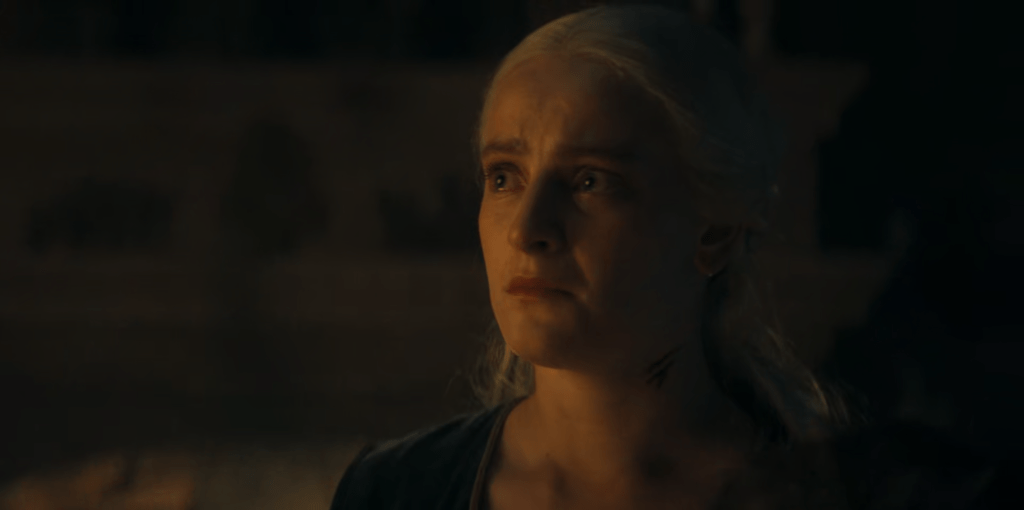
It could – and perhaps in the original show, might – have been even more horrifically depicted, as the inept assassins had to basically saw off the boy’s head to bring back to Daemon. Instead, House of the Dragon eschewed the original’s excessive violence by not actually showing that; but by lingering on Helaena’s face as we heard the sawing sounds, it was somehow even more horrible than if we’d actually seen it. It was a well-played decision from director Alan Taylor, a veteran of both the original Game of Thrones and the often near-impenetrably subtle Mad Men.
As a season opener, this wasn’t a big spectacle, but felt all the better for it, positioning its players for the plotlines to come. Just as in the original Game of Thrones there are no ‘goodies’ or ‘baddies’ here; and even more so than there, pretty much none of these people are likeable in any way. What they are, though, in their Machiavellian scheming, self interest and endless cruelty, is compellingly watchable. If it’s Big Battles you want, I’m sure (based on the source material) that in time, you’ll be very satisfied. But it’s the political manoeuvring that I love about this show, along with the larger than life characters – and this opening instalment delivered both in spades.
 Simon’s Incoherent Blog