“There is no war so hateful to the gods as a war between kin. And no war so bloody as a war between dragons.”
(SPOILER WARNING!)
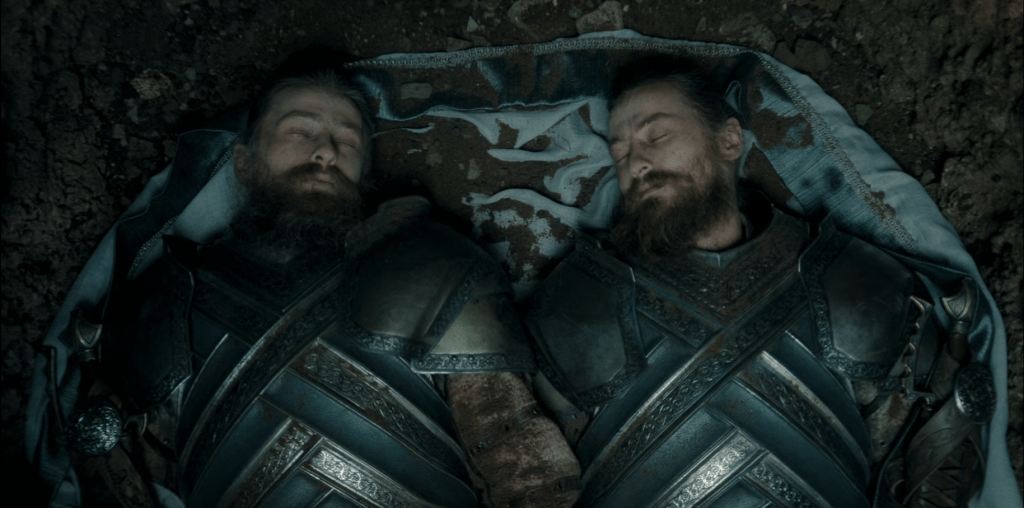
This week’s ep of House of the Dragon ramped up the show’s ever-present sense of impending doom to maximum as everyone ruminated on the causes and reasons for a war that now seems not only inevitable, but imminent. From the outset, we were shown how such wars often have roots in much older grudges, as what appeared to be a trivial argument between two groups of spotty teenagers with swords quickly escalated to become the bloody battle that gave the ep its title.

Scripter David Hancock and director Geeta Vasant Patel’s choice to cut from the moment when swords were drawn to the aftermath of the battle itself may have seemed like an odd one, especially given the franchise’s fans’ known love of a Great Big Battle. But in context, it really worked. Cutting straight from the escalating argument to one of its participants lying dead in the mud, then panning out to reveal a field literally covered in bloodied corpses was extremely effective, but it also served to underline points made later in the episode.
Firstly, that this scrap between longtime rival Houses Bracken and Blackwood wasn’t really a part of the war proper, but a taste of things to come. And secondly, that the causes of such things often go back so far in history that it can be difficult to remember why they even began. “From ancient grudge, break to new mutiny,” as Shakespeare put it at the start of Romeo and Juliet, another story detailing a feud that started so long ago nobody can remember why.
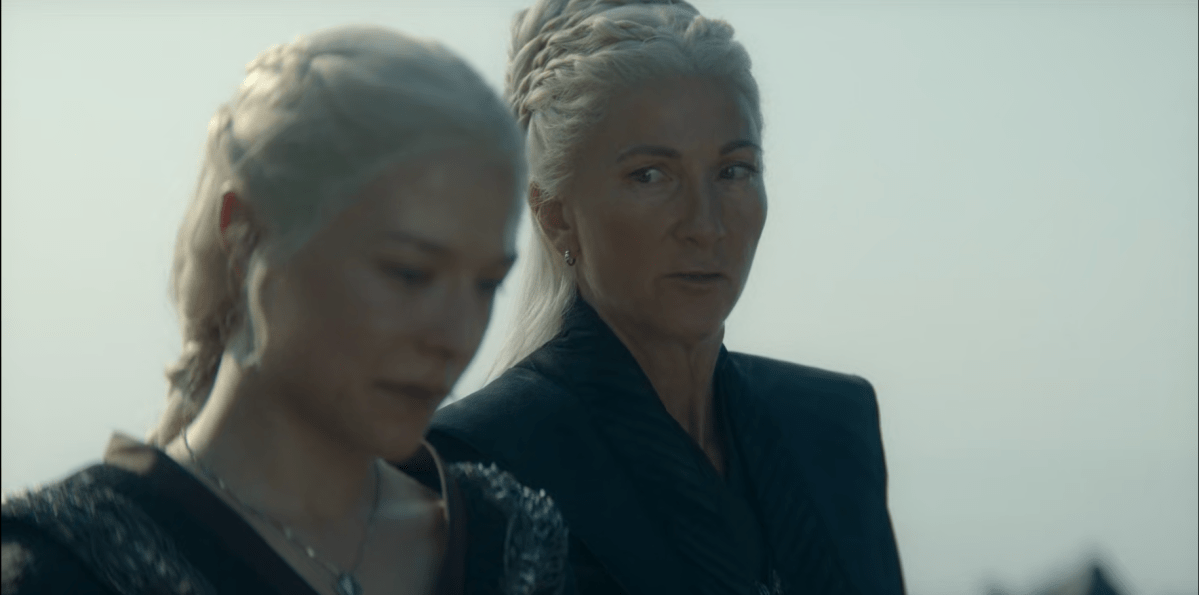
Not only was this ruminated on in the Greens’ Small Council, it was spelled out with crystal clarity by the sage Rhaenys in a conversation with her still-war reluctant niece Rhaenyra. Still shocked by the mutual annihilation of two literal brothers last time, Rhaenyra clearly saw that as a foretaste of things to come. Maybe the spark that would start the war.
The war, asserted Rhaenyra, had its beginnings “when they usurped my throne”. “That is one answer,” was Rhaenys’ response. “Or was it when the child was beheaded? Or when Aemond killed Luke? Or when Luke took Aemond’s eye? We teeter now at the point where none of it will matter.”

It was a powerful speech, well-delivered by Eve Best as Rhaenys, who clearly is the best Queen Westeros never had. But even she thinks that, even now, “there might be another way”. Of course there can’t be, or there wouldn’t be a show. But the last-ditch efforts at peace were another theme of the ep, reminiscent of the desperate appeasement of Hitler in the last few months of peace before World War II.
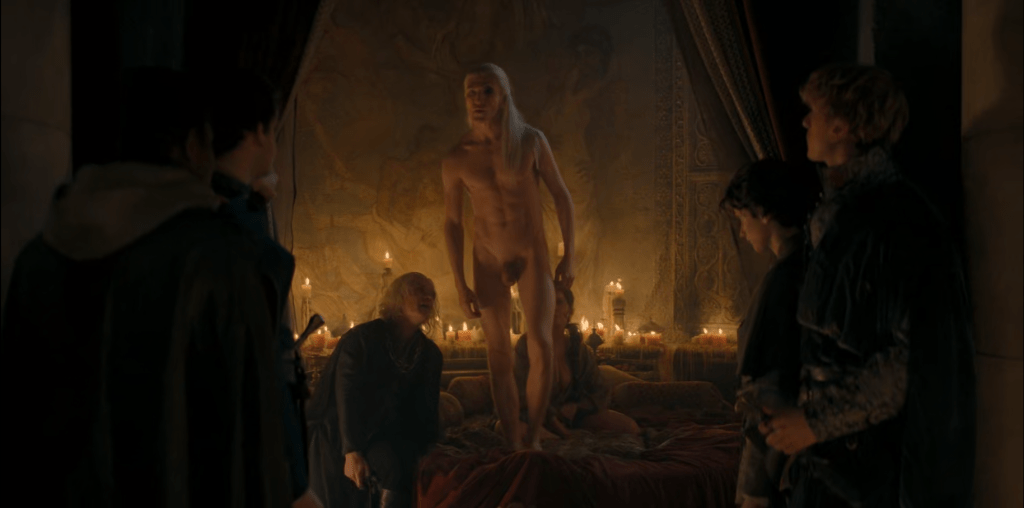
Amidst all this philosophical rumination, though, there was still plenty of room for the show’s trademark internecine squabbling with its increasingly impressive cast. I don’t think I’ve mentioned before now, but Tom Glynn-Carney is capturing the immature, needy character of King Aegon extremely well, where he could have just been another sadistic Joffrey Baratheon. His belittling of his unexpectedly sensitive brother Aemond is obviously rooted in his own deep insecurity and need to feel superior, as shown here in a kingly frat boys night out to “make a man” of a youthful squire.
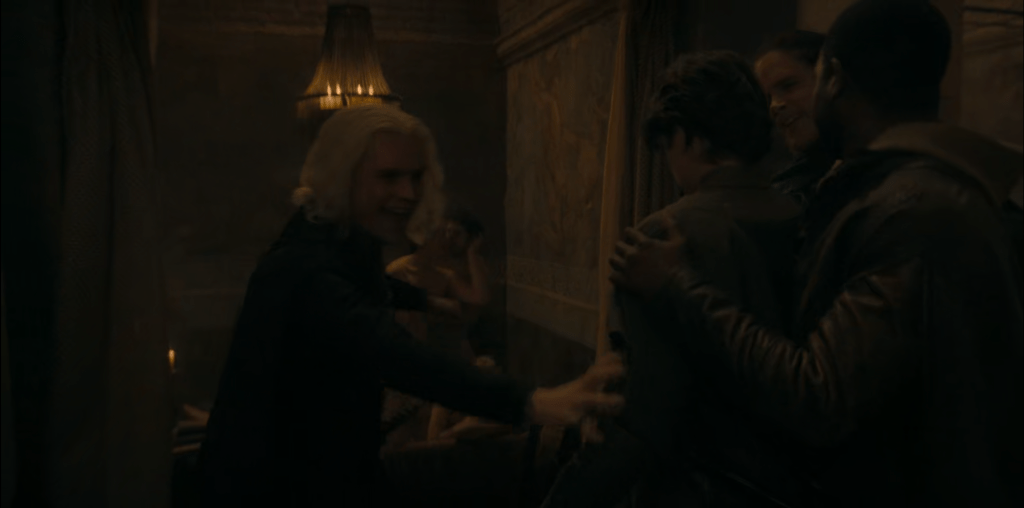
That scene in the brothel felt like a return to the tropes of the original Game of Thrones. Firstly, it had humour, one of GoT’s best features which is the only one I find sadly lacking in the very earnest House of the Dragon. Also, though, it was full of explicit sex.
This was something that Game of Thrones was frequently criticised for, and with some justification – the titillating nudity was frequently put in just to enliven what would be otherwise dull bits of lengthy exposition, hence the show’s own portmanteau word, ‘sexposition’.

It’s also fair to say that most of the nudity was on the part of nameless extras, but the show was criticised too that when it was a main cast member involved, it was always one of the female ones. Emilia Clarke, in particular, is on record as having been made quite uncomfortable by her nude scenes in the first season, to the extent that she refused to do any more later. Lena Headey circumvented this in her ‘walk of shame’, by using a body double with her head CG’d onto it to represent the nude Cersei Lannister. Still, though, it could be seen as a woman, rather than a man, whose nudity was displayed. Even if it wasn’t really Headey.
Still, though, it’s worth noting that (as far as I recall) the only main cast member that did do actual, unfaked, full-frontal nudity was Alfie Allen as Theon Greyjoy (he stopped doing this later, for obvious reasons). So, whatever online commentators may be saying, there’s precedent for it being a man who was the only actual main character to show it all off. Here, it was Ewan Mitchell as Aemond, but unlike the gratuitous flashes of Allen’s cock, it had a dramatic purpose. Aemond, having been found at his most vulnerable by his mocking older brother, was defiantly trying to reassert his masculinity in the most literal way possible. It was a revealing scene in more ways than one.
There were more flashes of the original show in the sequences of Daemon setting himself up at Harrenhal, as this mostly non-fantasy fantasy show went back to the old tropes of magical visions. Harrenhal itself, of course, is familiar from the original, as the massive castle that was burned, even to its stones, by the dragonfire of Aegon the Conqueror, making it a foreshadowing of the dragon-based conflict to come.
But when Daemon was confronted with visions of the younger Rhaenyra (nice to see Milly Alcock back, however briefly) sewing the head back onto the boy he’d had murdered, and prophesying that Harrenhal would be the death of him, we were firmly into the territory of magic, something this show’s avoided until now. Matt Smith sold it well, as ever, but I’m not sure how much I like that. Your mileage may vary, of course, but I prefer it when these shows keep magic firmly in the background. I’m not a fan of magic in fantasy; it’s far too commonly used as a deus ex machina to resolve plotlines a lazy writer can’t sort out.

It’s only a bit of foreshadowing at this point, so I’m not too worried. Far more effective though was the clandestine meeting between Rhaenyra and Alicent at the Great Sept, as Rhaenyra, following Rhaenys’ advice, sought out her friend-turned-enemy in one last effort to avert the war we all know is coming.
Emma D’Arcy and Olivia Cooke were electric in the scene; I particularly loved the dawning realisation, for both of them, that they were about to plunge the Kingdom into war based entirely on a mistake about what the dying Viserys had said. Along with the despair that both showed at the realisation that, however mistaken the flashpojnt may be, war is inevitable now. I mean, yes, it might be a much shorter show if they both fessed up, but even then, as the narrative has shown, the momentum towards war may now be unstoppable. It’s a pertinent comment on how wars, horrifyingly, sometimes can’t be avoided – something that’s been true throughout history.

That theme made this a thoughtful ep, but there was plenty to enjoy with the character work. The rivalry between King Aegin and Prince Aemond in particular is being nicely developed, with a pair of excellent performances from Tom Glynn-Carney and Ewan Mitchell. You might have been disappointed, given the entirely skipped carnage at the beginning of the ep, with the absence of a Big Battle; but having read the source material, I know there’s plenty to come. And it looks like next week will be the first of them…
 Simon’s Incoherent Blog