

“Rhaenyra’s supporters will believe what they wish. And so will Aegon’s. The war will be fought, many will die, and the victor will eventually ascend the throne.”
(SPOILER WARNING!)
If it was a Bloody Big Battle you were waiting for, this week’s episode of House of the Dragon delivered in spades. For many people (though not me), the show’s deliberate, sometimes slow pace has been its weakness. For myself, I’ve enjoyed all the political skulduggery that’s characterised this more thoughtful prequel to Game of Thrones thus far. But even I enjoy some carnage-based medieval spectacle now and again. Especially if it involves dragons.
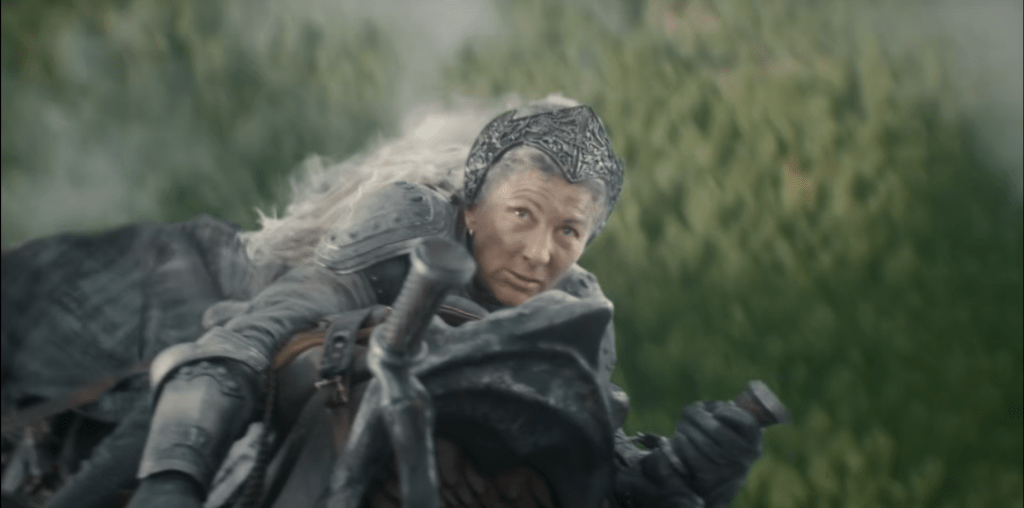
This was a well-structured episode courtesy of a script by showrunner Ryan Condal, which took its time to get to the spectacle while ramping up the tension through more of the show’s excellent character work. There was, as usual, a lot of dithering from the Small Councils of both the Greens and the Blacks, as they sat around discussing what might happen instead of actually taking any action.
This might have led you to believe that it was going to be another ep of men with beards sitting around talking, but the urgency was building up throughout. We already knew that Criston Cole’s ever-growing army was cutting a swath through Rhaenyra’s supporters in the Crown Lands – sooner or later, someone from the Blacks would have to take a stand.
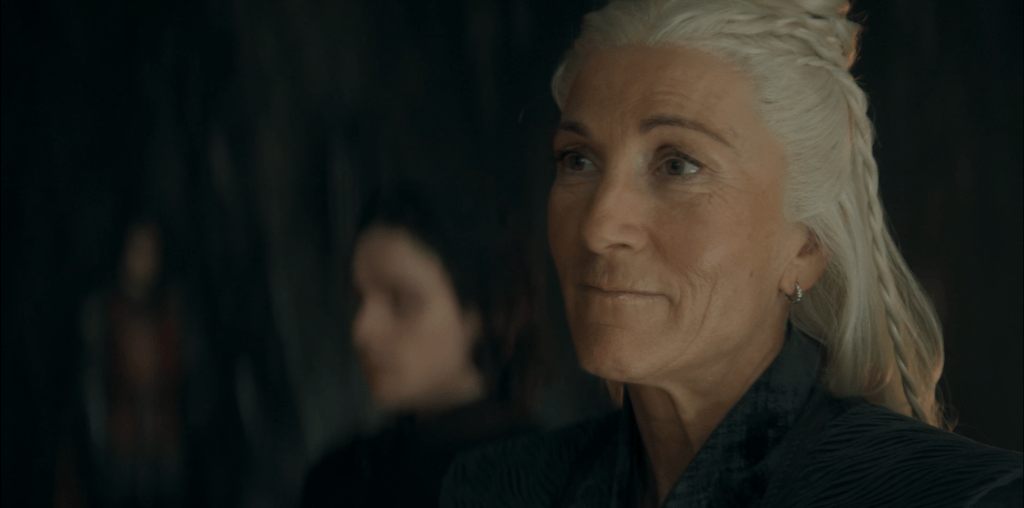
Typically, it was the royals themselves who ended up taking decisive action in both camps. Also typically, it wasn’t the respective monarchs, but their wiser relatives advocating for some actual military strategy. In the case of the Blacks, this meant Rhaenys, her hopes of peace dashed by Rhaenyra’s account of her meeting with Alicent. And in the case of the Greens, it wasn’t the hot-headed, inexperienced Aegon who provided the wisest counsel, but his more thoughtful, much-mocked brother Aemond.
The rivalry between Aegon and Aemond has been nicely simmering throughout the season, and in this ep it reached an actual boiling point. After his humiliation at the brothel last week, Aemond repaid his kingly brother in spades with news that he had been working on strategy with Ser Criston, then delivered a coup de grace with a speech in High Valyrian – which, to Aegon’s obvious shame, he’s plainly less than fluent in.
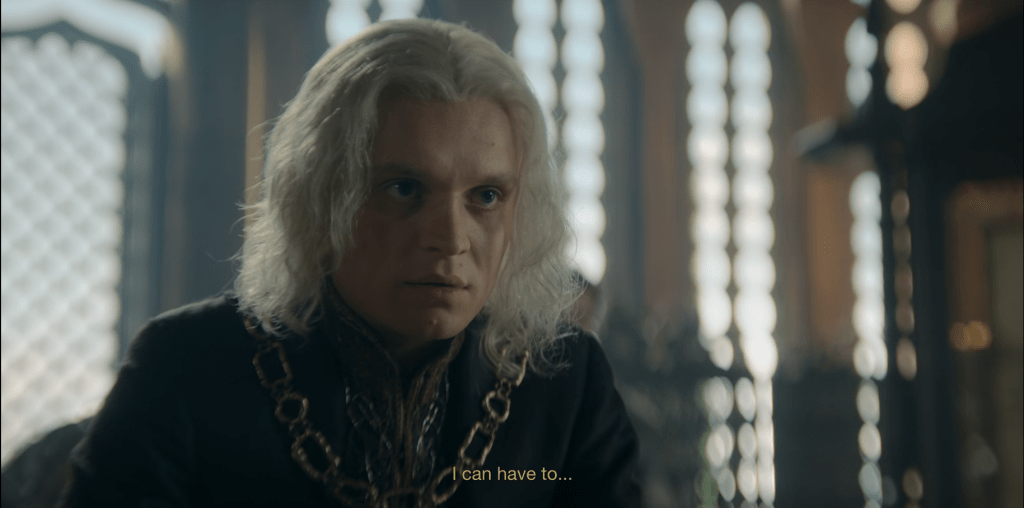
It was a tense scene, excellently played by Tom Glynn-Carney and Ewan Mitchell as the fraternal rivals. Obviously more was at stake than the outcome of one battle, or even, possibly, the outcome of the war itself. Aemond, clearly bearing a huge grudge at his brother’s constant belittling of him, plainly has his eye on a bigger prize – the throne itself.
And he’s not the only one. Over in the Blacks’ faction, there were more spooky goings-on in the haunted castle of Harrenhal, as Daemon continued to be plagued by portentous visions; firstly of young Rhaenyra (Milly Alcock) again, but also of his late wife Laena Velaryon. The constant jump-cutting of one scene to the next, from Daemon’s point of view, was disorienting. As it’s plainly meant to be – you get the impression, thanks to Matt Smith’s usual superb performance, that the King Consort is rather losing touch with reality. His vision of ‘Aemond’ as himself with an eye patch was particularly revealing.

His ambition is plainly undimmed though, being fostered throughout by the bitter Ser Simon Strong (the ever-compelling Sir Simon Russell Beale, an actual knight in real life). Last week, Ser Simon’s apparent misuse of the title “Your Grace” (usually reserved for the monarch) was challenged by Daemon; this time, it went unremarked upon. And Beale’s line delivery was subtly clever as he introduced Daemon to prospective ally Ser Oscar Tully as “His Grace, the King… Consort”. That little pause was subtle but telling, as was the look on Beale’s face.
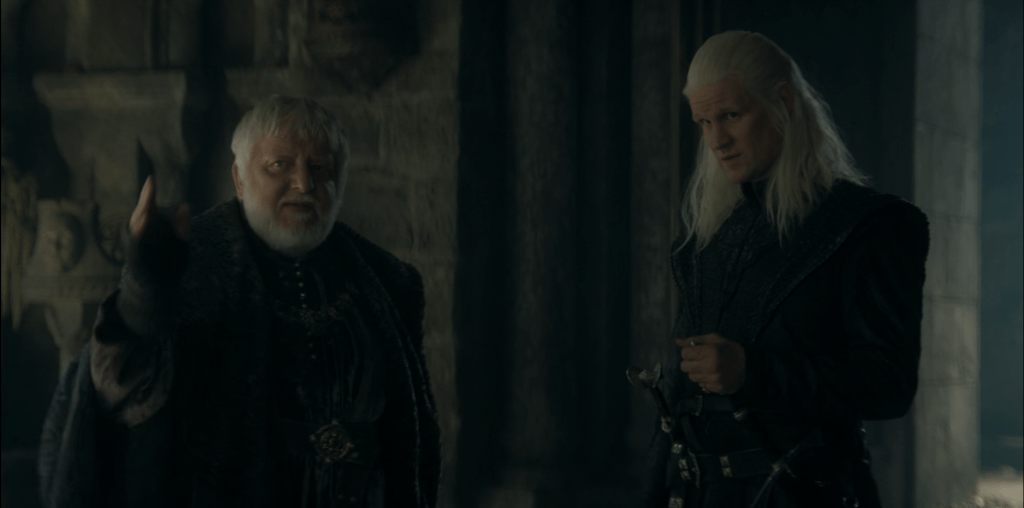
So both the Greens and the Blacks already have pretenders to their pretenders. And Alicent was of little help to her fumingly impotent son, spending most of the ep cloistered away, haunted by her recently-acquired knowledge that the impending war was all down to a mistake made by her. “You have no idea of the sacrifices made to put you on that throne,” she despairingly told the petulant Aegon, in another revealing line.
Olivia Cooke’s haunted performance as Alicent is a new aspect to the character, but one that’s likely to grow worse as the war progresses. It’s hard to live with the knowledge that your own personal mistake has led to the deaths of thousands of people. It was left to the ever-sly Ser Larys to provide a crumb of comfort – Matthew Needham, as the arch-manipulator who’s now Lord of the Whisperers, is another strong asset in a brilliant cast.

All of this may have seemed like nothing more than the usual cogitations, humiliations, and self-flagellations, but in fact it was very cleverly putting the pieces into place for the set piece Battle of Rook’s Rest. Aemond’s collaboration with Ser Criston was a vital piece of the Kingsguard Commander’s scheme, while Aegon’s humiliation by his brother and his mother led him to the unwise course of taking dragon-based action himself.
It was a battle worthy of the best of the original Game of Thrones, but with some very different perspectives. There, we were often placed into the thick of the action (frequently by director Miguel Sapochnik) as though we were in the melee of the fight. And there was some of that here, as Ser Criston’s massed forces launched their assault on Rook’s Rest Castle, while its defenders frantically sought to cut them down with longbows.

Genuine medieval battle tactics can be thrilling indeed. But there was another element here, as Rhaenys arrived on the dragon Meleys to defend the castle by incinerating Cole’s screaming forces. Ser Criston, though, is a shrewder strategist than we thought, and had an ace up his sleeve – Aemond, with his mega-dragon Vhagar, waiting in the woods for the moment to get involved.
In hindsight, that was nicely seeded by Aemond’s earlier discussions in the Small Council. But it came as a genuine surprise, and at a stroke justified Ser Criston’s earlier, apparently unjustified, confidence. Director Alan Taylor played Vhagar’s unexpected appearance well, emphasising the sheer size of the beast by only showing us parts of it at a time, while Ramin Djawadi’s ominous score underlined the threat.
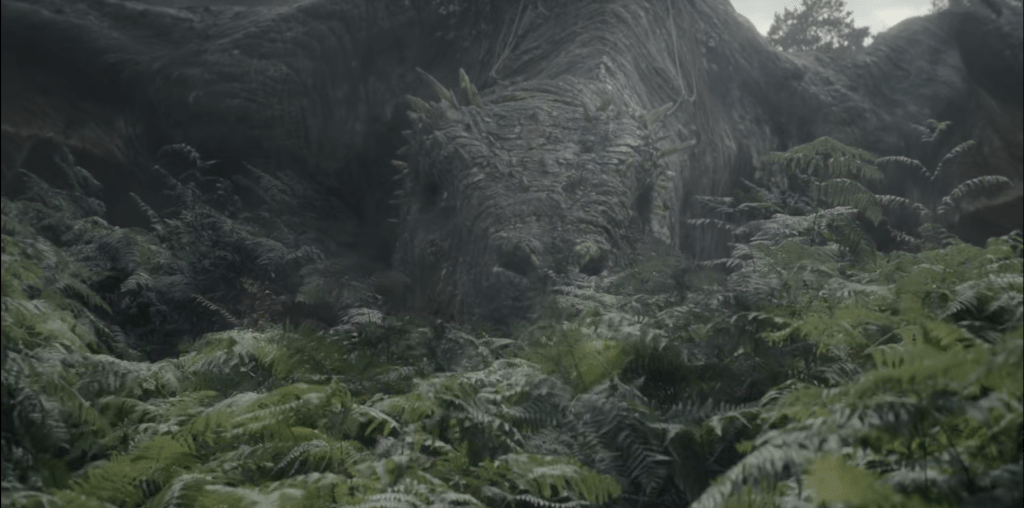
Until, of course, it was time to take flight, and take the battle to Rhaenys and Meleys directly. This is where the ep stood or fell on not just its direction, but its visual effects, and thankfully both worked very well. Seeing the battle from the perspective of dragonriders was rare in the original show, but with the fire-breathing monsters a decisive factor in this war, we’re liable to see it a lot. We got a taste of that last season with the heartstopping sequence of young Aemond trying to ride Vhagar for the first time; here, we saw it in actual combat, and it was thrilling.
It should have been a masterstroke by Aemond and Ser Criston – and indeed the enthralling sky-borne combat did lead to the desired result, with Rhaenys defeated, and her dying dragon crashing down to breach the walls of the castle. But as so frequently in this show, both had reckoned without the vainglorious stupidity of their King, whose headstrong charge into the melee led to his own defeat at the claws of Meleys before Vhagar tore her apart.

The little details of the battle were expertly realised – I liked the shots of Vhagar obliviously crushing Ser Criston’s soldiers with its massive feet – as was the depiction of its aftermath. I’d never considered that a crashing dragon might actually explode – but given the beasties’ ability to breathe fire, it makes perfect sense. Presumably their bodies are full of highly volatile chemicals.
Then there was the nasty little moment when the recovering Ser Criston tried to rouse his bannerman to action, only to have the still intact armour clatter to the ground around the disintegrating ashes within. Say what you like about the final episodes of Game of Thrones, one thing they did masterfully was to emphasise the sheer destructive power of a dragon in full force, an intentional echo of real world nuclear weapons in a medieval setting. So it was here. Whoever wins, with the dragons now fully involved, this war is going to be absolute carnage.

It’s farewell, then to Rhaenys, the last voice of reason in the Blacks’ camp, where presumably hotter heads will now prevail. Eve Best will be missed, and her final shot, all weary resignation as her dragon plummeted to the ground, was up there with her best moments. The fate of Aegon, lying blackened in the charred remnants of his dead dragon, is less clear – but judging by the look on his face, Aemond isn’t exactly devastated at the prospect of his brother being dead. Even if he isn’t, the battle of these two brothers also has a decisive victor, and nobody’s going to be laughing at Aemond any more. Which was surely his intention.

We’re halfway through the (shorter than last time) eight episodes of the season, and with the introduction of the dragons, the war is truly joined. This is, presumably, why until now we’ve only seen the aftermath of more conventional battles – the show was saving the spectacle for the absolute holocaust of a battle between Westeros’ ultimate weapons. It was a well-structured episode, taking the deliberate pace of the show until now and expertly ramping it up to the utter chaos of extremely well-realised carnage. To be sure, the political manouevring and complex machinations are bound to continue (and intensify) in the aftermath. But if you were concerned that that was all this show had to offer, this episode must surely have disabused you of that notion.
 Simon’s Incoherent Blog