
“Do not underestimate your subjects. They are a thousand thousand living in the shadow of the Red Keep, and forgotten for too long.”
(SPOILER WARNING!)
After last week’s Bloody Big Battle, it was back to House of the Dragon’s trademark political scheming this week – but with some justification. The fallout from the Battle of Rook’s Rest is seismic, and even if you find the show’s predilection for men with beards arguing in dark rooms tiresome, given last week’s events it was entirely necessary dramatically.

I use the phrase “men with beards” advisedly, as both camps saw their respective female leaders sidelined this week, much to their respective frustration. It was a neat parallel that both Alicent and Rhaenyra were found, for different reasons, not entirely suited to command the war they’d started. Both Olivia Cooke and Emma D’Arcy nicely conveyed their frustration, emphasising yet again how alike these friends turned bitter rivals are.
And yet, the Small Councils of both the Greens and the Blacks had a point. In King’s Landing, the incapacitation of King Aegon (unceremoniously carried into the Red Keep in a plain wooden box) meant that a temporary ruler – a regent – had to be found. And while Alicent may have the political experience her power-hungry younger son lacks, it would be absurd to foist a female leader onto the Seven Kingdoms during a war that started because of their refusal to accept a female leader.
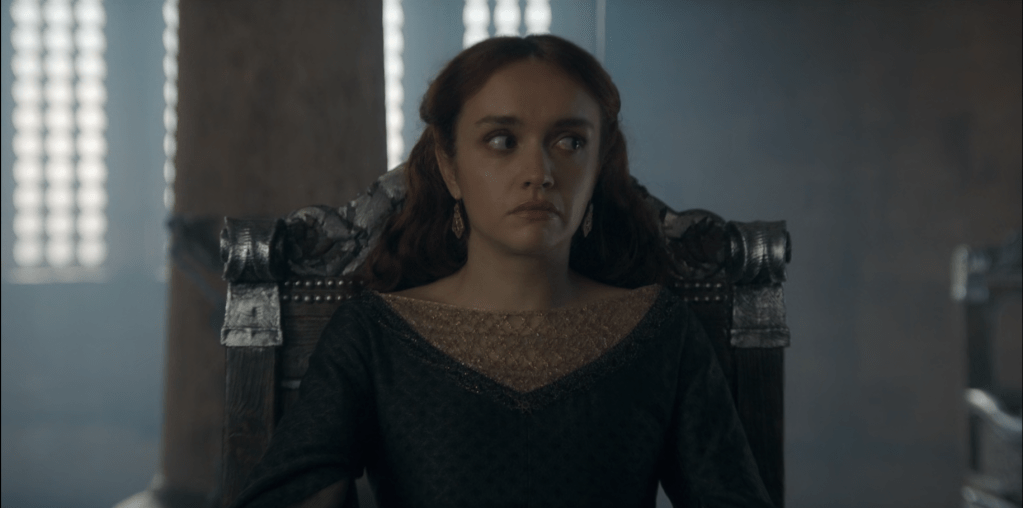
It took the ever-cunning Ser Larys Strong to point this out, but judging by the embarrassed looks around the table, everybody else had worked it out too. It was a nice touch by director Clare Kilner to have the ensuing discussion of strategy fade into inaudibility while the camera focused on the seemingly composed Alicent, and Olivia Cooke effectively portrayed the turmoil beneath that calm exterior.
Over at Dragonstone, Rhaenyra might have been defiant in Council, but it was a different matter when speaking privately to Mysaria. She might be a dragonrider, but unlike the men, she’d never been trained to fight, being her father’s cupbearer instead. Keeping her out of the fight was probably the wisest course, but as Mysaria herself pointed out, that didn’t mean she couldn’t direct events in other ways.
It was Mysaria who noted that the Kingdom is more than just its feuding royals – it’s also made up of a vastly larger number of subjects, or ‘smallfolk’, as they’re rather patronisingly known. More so than Game of Thrones, House of the Dragon has repeatedly shown us the war from their perspective, and plainly they’re going to have an important role to play.

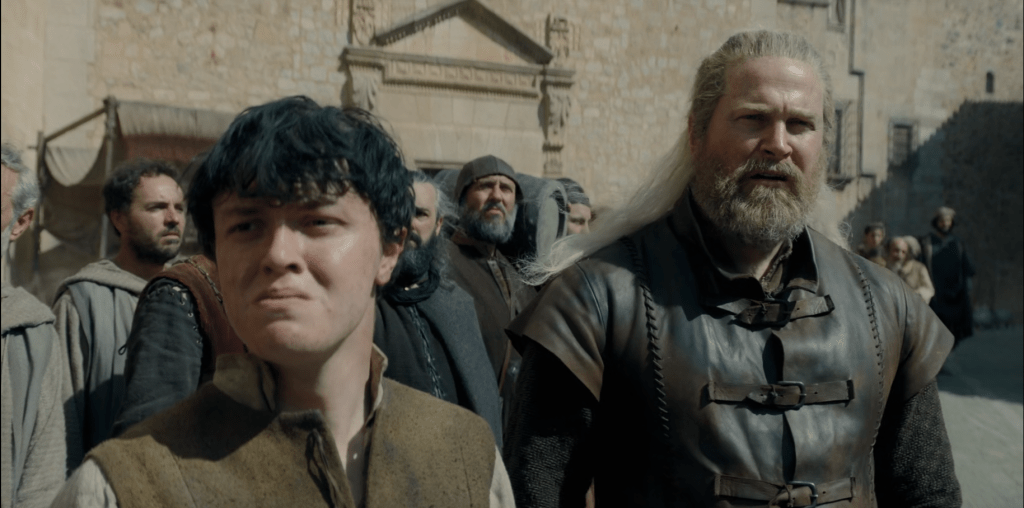
Indeed, there were more real hints of disquiet among the King’s Landing populace from the first this week. I don’t know whether Ser Criston’s decision to parade the still-steaming head of the dragon Meleys at the head of his victory procession was just a ploy to draw attention from the notably absent King (in reality stuffed into the plain box on an unremarkable cart). But as a symbol, it misfired, showing the smallfolk that dragons too are mortal, and can be defeated. “I thought the dragons was gods,” remarked an awestruck young peasant. “Just meat,” replied the sturdy, cynical Hugh beside him.
Hugh featured heavily this week, and it’s clear that, after having featured in several pivotal scenes in recent episodes, he’s going to be an important character. If you’re wondering how, his hair might be a bit of a clue – don’t you think it looks a bit… Targaryen-y? Together with drunken sot Ulf a couple of weeks ago claiming to be the illegitimate offspring of some Targaryen or other, and twins Addam and Alyn being the people that Corlys Velaryon has spent more time with than anyone else this whole season, it’s clear that the lot of them are, well, bastards. In the literal, rather than pejorative sense.
This was a plot point in the original GoT as well, with Joffrey’s slaughter of the innocents to eliminate any possible threat from genuine offspring of Robert Baratheon. But there, engaging though Joe Dempsie may have been as Gendry Waters, his plotline didn’t actually go anywhere; in fact he was MIA for several seasons before anyone seemed to notice, and nobody seriously entertained the possibility of putting him on the Throne.
This lot, though, have been subtly seeded as important characters throughout, and the end of the ep finally revealed why. After the death of Meleys, the Blacks are a dragon down – but there are plenty of wild dragons, some from riders now dead, that nobody has been able to tame. Only those of dragonrider blood – Targaryen or Velaryon – would be able to claim them, and all those close enough to the bloodline have already tried and failed. All, that is, except the ones conceived out of wedlock – and Rhaenyra, with prompting form Mysaria, is determined to find them.
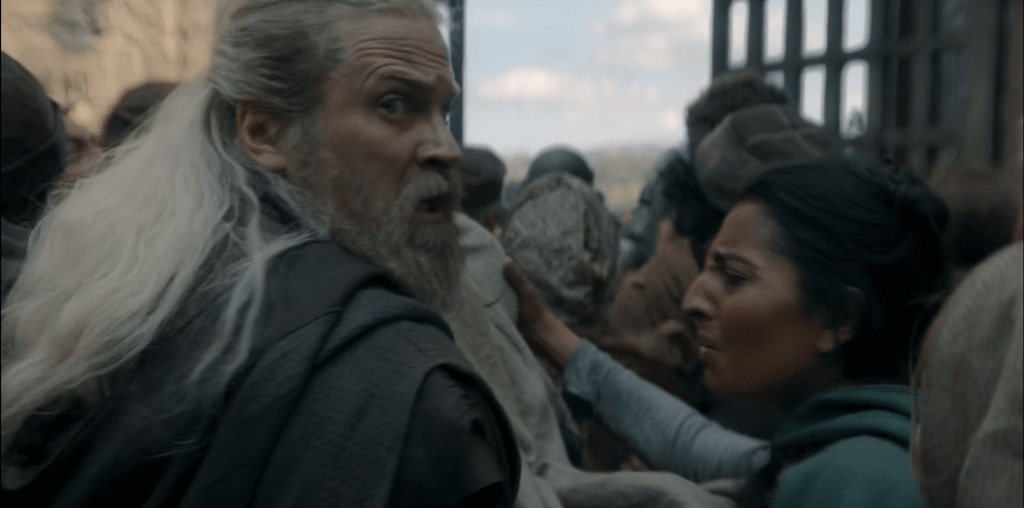
So these smallfolk, at least, are about to find themselves more important than they imagined. But the masses in King’s Landing are discontented too, particularly now that the gates have been closed to bar them leaving a city they fear is about to be immolated. We’ve already seen some of their discontent with Aegon’s rash decision to hang every ratcatcher in the Red Keep; now they’re muttering that the slaying of Meleys is an “abomination”, and publicly wondering where the King actually is.
But which King? Aemond may only be Regent, but he’s surely praying that his idiotic older brother won’t survive his grievous wounds. In an otherwise gore-free episode, it was a wince-making scene as Maester Orwyle gingerly peeled the scorched armour from Aegon’s burned, suppurating flesh. Not coincidentally, as he lies insensate in his bed, his left side heavily bandaged, he could now be the very image of his father King Viserys in his final days – the hint of mortality is not subtle.
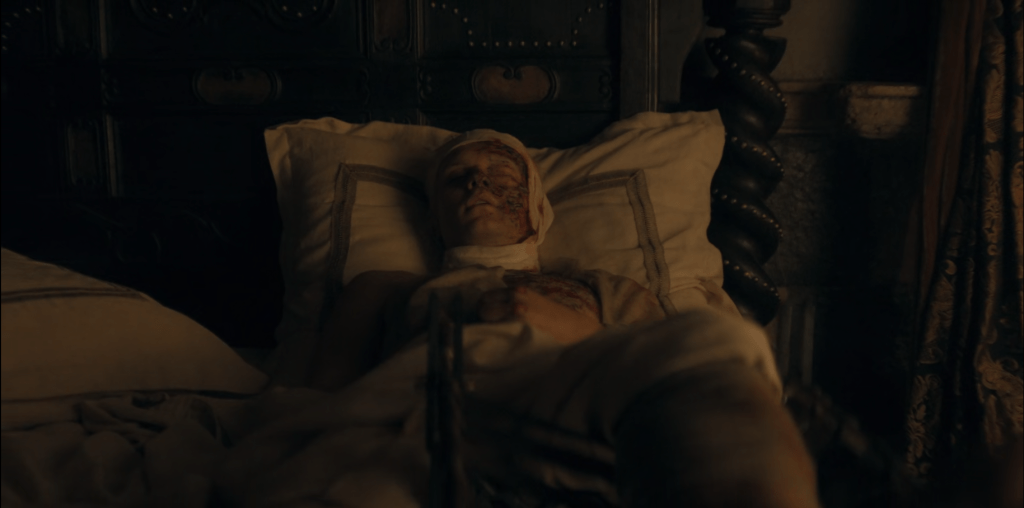
Over at Harrenhal, Daemon, still plagued by eerie visions courtesy of witchy Alys Rivers, has also abandoned all pretence at supplication and is calling himself King. Even the obsequious Ser Simon Strong, who’s been gently nudging him in that direction since they met, seemed to think it was going too far, too soon, but Daemon was having none of it. Pragmatically, he acknowledged that if he loses, “then I’ll be dead, and none of this will be my problem”. As usual, Matt Smith and Simon Russell Beale were great, but praise must also go to Gayle Rankin as the mysteriously Scottish Alys Rivers, whose agenda remains unclear.
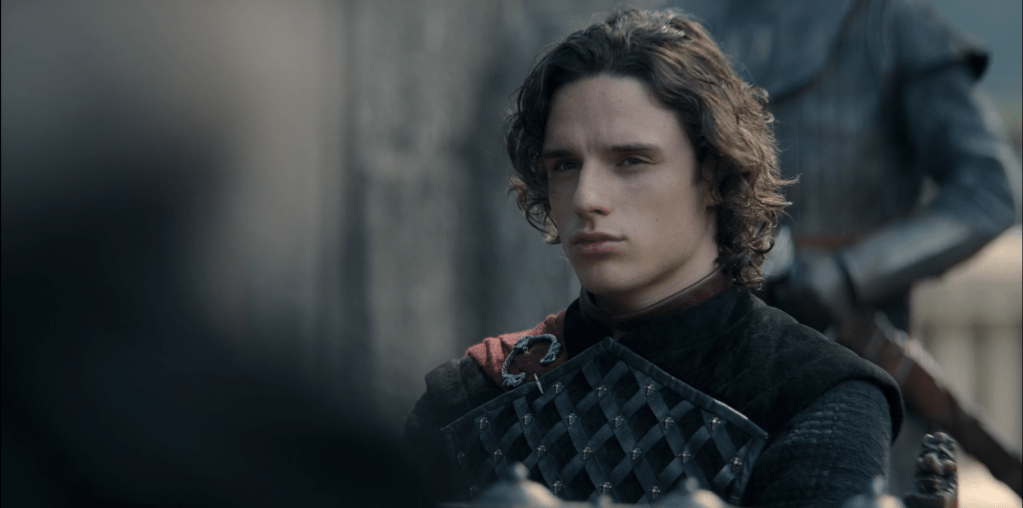
Perhaps luckily for him, Prince Jacaerys, chafing at having been a narrative spare part thus far, ultimately chose not to drop in at Harrenhal to enlist Daemon’s support. The very pretty Harry Collett, sort of a budget Timothee Chalamet, has had little to do so far this season – understandably Rhaenyra wants her son and heir kept out of the fray. But waltzing off to meet the actual Freys and promising them the moon in return for their support may come back to bite him.
All these power moves made for a sedately paced episode, and after the sturm und drang of last week, you may have found yourself frustrated at a return to the plot’s often glacial pace. But as ever with this show, it’s as much about the characters and their (usually thwarted) lust for power as the actual events. And with the pieces cleverly seeded in previous episodes starting to bear fruit, who knows what seemingly inconsequential moments here may lead to events of great import later? The show may be back to its slow burn style, but after last week a breather was clearly necessary, and I think we’re seeing yet more pieces being brought into play for what could be a very fiery season finale.
 Simon’s Incoherent Blog