
Summer in Barcelona. A time of heat, humidity, and the cautious running of that oh-so-expensive air conditioning. Many of my friends, quite sensibly, choose August as the time to take holidays out of the city. But this year, I didn’t have enough money saved to do that, so in between frequent trips to beaches and parks, I’ve been having my own private little film festival instead.
Generally, I’ve been watching at least two films a day. The rule is that, ideally, it has to be a film I’ve never seen. If I have seen it, it has to have been only once, and many years ago (there were a few of these). As we’re coming up to the end of August, and work’s about to begin again, I thought I’d jot down some capsule reviews of the movies I’ve watched, in no particular order. They stretch from the 1930s to 2024, of all kinds of genres, some big budget extravaganzas, some little known indies…
As a big nerd, I love horror and sci fi movies, and lots of them featured in my summer viewing. Often, the boundary between the two genres is blurred (see Alien), so I’ve grouped them together for this post. There’s a lot of them!
Planet of the Vampires (Italy, 1965)

When you think of cult Italian director Mario Bava, you don’t usually think of spaceships and alien planets. Rather, you usually think of gothic castles shrouded in dry ice fog, with demons running loose (and probably a seductive Barbara Steele rising from a coffin to drink your blood).
And yet Planet of the Vampires is very obviously a Bava movie from the moment the luckless astronauts, clad in their cheap biker leathers with hugely impractical collars, land on the planet of the title. Despite a tiny, tiny budget, it’s beautifully realised, with typically garish Bava lighting, and that familiar dry ice (mostly) succeeding at concealing the extremely cheap sets.
It’s an atmospheric, ominous movie, with a slow pace – don’t come here if you’re looking for action. The titular creatures aren’t actually vampires, but as energy beings who possess the mutilated corpses of the hapless astronauts, they do qualify as living dead – and the term “zombie” wasn’t in common usage at the time. Its Italian title, Terrore nel Spazio (Terror in Space) sums it up better, but US distributors AIP obviously preferred something even more lurid.
Bava succeeds at making something genuinely eerie on the lowest of budgets, and one sequence, of the heroes investigating a crashed alien ship with the huge skeletons of its crew, is inescapably reminiscent of Alien; in fact, Dan O’Bannon later admitted this is where he got the idea.
7/10 – low budget chills with remarkable visuals, typical of Bava though not his best work.
The Awakening (UK, 2011)

No, not the 1980 Charlton Heston mummy/reincarnation flick. This is an effective little ghost story in a very traditional vein. Set in 1921, just after the First World War, Stephen Volk’s screenplay sees professional sceptic and debunker of false seances Rebecca Hall dispatched to the traditional empty country house to investigate an apparent haunting.
This house is currently a boys’ boarding school, where an apparent child spectre recently caused the death of one of the pupils. As the boys depart for their holidays, Hall is left to investigate the now deserted mansion. But her scepticism will (as ever) be pushed to its limits, as she finds she’s more connected to the haunting than she’d like to admit…
There’s solid support from Dominic West, as a PTSD raddled teacher and veteran of the trenches, Imelda Staunton as a mysterious housekeeper, and Game of Thrones’ Isaac Hempstead-Wright as the only boy left at the school for the holidays. Volk’s script makes great use of the period setting to inform the story, and Nick Murphy provides some workmanlike direction to give exactly the kind of spooky atmosphere required. Some may find the deliberately ambiguous ending irritating, but I liked it.
6/10 – An effective ghost story with an intriguing setting, though if I’m honest it’s nothing I haven’t seen before.
Mother of Tears (Italy, 2007)
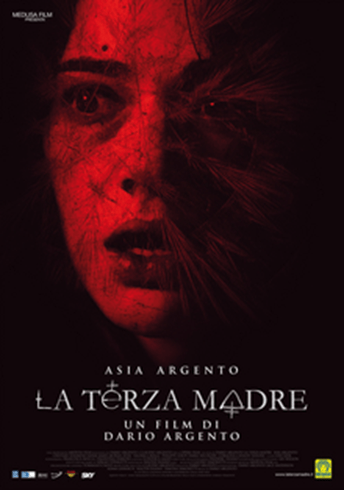
The long-awaited conclusion to Dario Argento’s “Three Mothers” trilogy, after 1977’s Suspiria and 1980’s Inferno, Mother of Tears is perhaps inevitably a disappointment. While the storytelling of the earlier films is shaky at best, what makes them great is Argento’s bravura cinematic style, lending them an artistic look and sound that’s unmistakably Argento.
Mother of Tears has perhaps a more effective story, as the unwise exhumation of a priest’s tomb unleashes the titular Mater Lachrymarum into an unsuspecting 21st century Rome. Cue the populace being gripped by an epidemic of mindless violence, as witches from all round the world gather to celebrate the Mater’s return, and a murderous cult works to bring about her domination.
There’s lashings of some very typical Argento gore, as gruesome as ever, and a good cast including daughter Asia Argento, former wife Daria Nicolodi in her final role, and cult favourite Udo Kier. But the style is workmanlike rather than inspired, with none of Argento’s trademark garish lighting, sweeping camera moves or pulse pounding prog rock. In fact, the score is by Goblin’s Claudio Simonetti, but it’s very low key compared to his vintage work, and only Dani Filth’s end title music makes much of an impression.
6/10 – this could never have lived up to its predecessors, but it’s disappointing to find Argento’s usual artistic style almost completely lacking.
Kill List (UK, 2011)
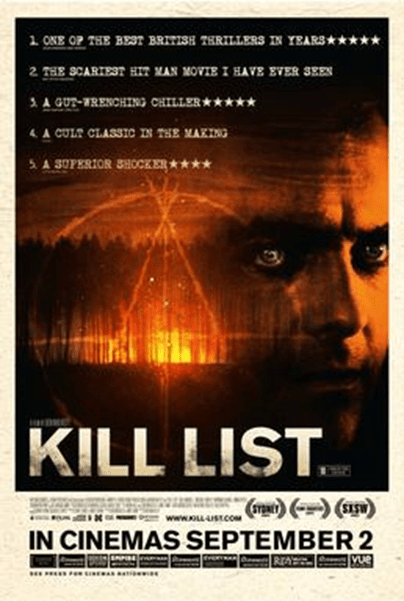
A bit of an oddity from talented British director Ben Wheatley, Kill List for the most part does not seem like a horror movie. Starring the epitome of working class hardmen Neil Maskell alongside the ever-genial Michael Smiley, for the most part it’s a tale of two hitmen working out a multi-hit contract, while dealing with tensions in their families and relationships.
Proceeding at a leisurely pace, and more concerned with its characters than the story, it has some brilliantly naturalistic dialogue as Maskell and Smiley pontificate on their lives, contrasted between a tedious suburban existence punctuated by sudden, shocking bursts of extreme violence (there’s a scene involving a hammer that’s particularly horrific).
That character/dialogue driven approach is reminiscent of nothing so much as king of British naturalism Shane Meadows, creator of This is England. But a sudden, unexpected turn into trad horror during the third act also calls to mind Robert Rodriguez’s From Dusk Till Dawn, another movie that seems like a crime thriller before turning into something else entirely. While that’s very definitely a film of two halves though, here the horror aspects are subtly seeded throughout to great cumulative effect.
8/10 – a clever, subtle little gem that takes some very unexpected turns, from a now-feted director early in his career.
Lore (UK, 2024)

There’s nothing like a good old-fashioned horror anthology story. But despite a wave of classics like Tales from the Crypt, Vault of Horror and From Beyond the Grave in the 60s and 70s, the form rather fell out of fashion; perhaps the most well-known ‘recent’ examples being the Creepshow films of the 80s. Since then, horror anthologies have found a more natural home on TV, though with separate episodes, the ‘framing story’ is sadly lost.
Lore, a low-budget effort from several different writers and directors, goes back to that format, with the tried and tested framing conceit that its stories are campfire tales related by four young people who’ve ventured unwisely to a remote forest, where they’re met by sinister MC Richard Brake (a cult actor still perhaps best known for his turn as the baddie in Muse’s futuristic video for Knights of Cydonia).
Four not entirely serious shorts ensue, ranging from criminals stuck in a warehouse with an unstoppable monster, to a spectral ballerina, to a kink weekend run by a folk horror cult, to a tall, masked slasher cutting his way through the patrons of a North East cinema. Of these, the last is perhaps the best, with some great gore along with knowing, post-modern direction. But then again, I’ve already seen Scream.
5/10 – Starring nobody you’ve ever heard of except Primeval’s Andrew Lee Potts, and, improbably, Rufus Hound (if you find him irritating, you’ll enjoy what happens to him), Lore comes across as nothing more than a set of slightly polished student films. It’s fun, but again, nothing you haven’t seen before.
Lord of Misrule (UK, 2023)

Folk horror is definitely having a moment right now, and into its increasingly crowded, muddy field comes… another one. Directed by William Brent Bell, previously known for churning out average potboilers like The Boy, Lord of Misrule is a by the numbers folk horror story with all the usual tropes – weird rituals, missing children, and unnerving shots of the British countryside.
Tuppence Middleton stars as a fresh faced young vicar recently arrived in the usual insular English village, who finds herself caught in the supposedly now-forgotten local religion when a solstice celebration leads to the kidnapping of her daughter. The locals display the standard ominous, unsettling behaviour, particularly local bigwig Ralph Ineson, anointed as the titular Lord of Misrule, whose own son disappeared under similar circumstances some years ago.
If you’ve ever seen any folk horror before, Lord of Misrule will hold no surprises whatsoever, but it’s undeniably entertaining watching the familiar tropes unfold. It’s enlivened by a couple of excellent performances from Middleton and Ineson, coming across rather like The Vicar of Dibley meets The Wicker Man – but without any of the originality of either, sadly.
6/10 – This is one field in England that has been very, very well-trodden.
Censor (UK, 2021)

I well remember the tabloid-induced moral panic of “Video Nasties” in the mid-80s, and quite honestly it’s a surprise that it’s taken so long for a horror film to exploit that period setting. A clever, knowing screenplay from writer/director Prano Bailey-Bond sees an uptight, prudish British Board of Film Classification employee caught in a press scandal over a murder apparently inspired by a cheap horror video, while becoming increasingly convinced that a low budget VHS gorefest may hold the key to finding her long-missing sister.
The period details are impeccable, every workplace saturated with cigarette smoke, while the ersatz ‘video nasties’ shown in the BBFC viewing room are convincingly cheap and nasty. Niamh Algar puts in a stunning performance as the gradually unwinding censor, ably assisted by the ever-reliable Michael Smiley as a seedy exploitation film distributor and Adrian Schiller as a low budget auteur of movies with titles like Don’t Go in the Church.
Inevitably it descends into some pretty brutal violence, with some memorably gory moments as Algar’s sanity crumbles, but it’s a psychological horror more than anything. Niamh Algar is impressively intense as a highly repressed young woman in a male-dominated, macho environment, and as a study of a disintegrating mind, it’s disturbing and effective.
8/10 – a very clever period piece revelling in both analysing and recreating a particular style of cheap horror, and playing devil’s advocate with the idea that, for a certain type of person, those movies really can destroy their sanity.
Starve Acre (UK, 2023)

Another folk horror, but this one is way more interesting than the well-trodden field of Lord of Misrule. With a subtle period setting of the 70s (I didn’t realise this until I noticed the characters were driving Ford Cortinas and Austin Maxis), it’s a very unsettling low key story, based on a well-regarded novel (which I haven’t read).
Matt Smith and Morfydd Clark star as a couple who’ve moved with their child to his ancestral home, the titular Starve Acre, in Yorkshire. The mood is disturbing from the outset, as their little son is found having put out the eyes of a horse (shades of Equus), then tragedy ensues as he dies for no apparent reason. Both parents, shattered by grief, veer off into separate obsessions; for the father, an archaeologist, the long buried trunk of a mighty tree may hold some answers, while the mother finds evidence of long-forgotten (?) arcane rituals. Meanwhile, the unearthed skeleton of an apparently sacrificed hare starts showing some very unusual aspects…
As mentioned earlier, there’s a lot of folk horror about right now. But Starve Acre eschews the usual imitations of The Wicker Man to present something far more thoughtful and subtle – a low key story of a couple’s grief intruded on by the ever-present spirits of the English countryside. If you’re looking for massive conspiracies, rhubarbing locals and sinister clergymen, you won’t find them here. But if you have the patience for something that’s almost pure, unsettling atmosphere, it’s richly rewarding.
8/10 – spooky and effective, with great performances from Smith and Clark.
Don’t Torture a Duckling (Italy, 1972)

An early film from Italian goremeister Lucio Fulci, Don’t Torture a Duckling (the English title is for once a literal translation of the Italian one) is more of a giallo than his later, supernatural tales. It focuses on a series of child murders in an isolated South Italian village; a very disturbing theme right at the outset. But it also has aspects of (yet again) folk horror, as one of the principal suspects is the local “witch” – and to be sure, her behaviour is pretty suspect.
Despite some early examples of Fulci’s trademark excessive gore, it’s the themes of the story that are the most disturbing – the murder, and sexualisation, of young children. Alongside that, it’s a study of an insular rural community, and the tensions between their fervent Catholicism and their earlier paganism. There’s a lot of meat on these bones.
Most of the characters come across as pretty unlikeable, but the mystery is gripping, and Fulci makes something deeply unsettling of the beautifully shot Southern Italian locations.
6/10 – Fulci’s best films would come later, but arguably this has way more substance than the likes of The Beyond or Zombi 2.
Longlegs (US, 2024)

A surprise commercial and critical hit, Longlegs’ biggest selling point was yet another excessively bonkers performance from the never knowingly underplayed Nicolas Cage. But there’s a lot more to Osgood Perkins’ indie horror than that. First and foremost, it’s obviously a love letter to Silence of the Lambs; its 90s setting and FBI procedural serial killer story make that obvious from the outset.
But even that doesn’t cover how deeply weird this movie is. The advantage of making a movie independently is not having to conform to the standard style of Hollywood storytelling, and Longlegs determinedly doesn’t. Its non-linear narrative is all over the place (but effective for all that), and scene after scene, however impactful, seem to have nothing to do with the larger story. Until, of course, they do. And it turns out not be the story you thought you were watching.
A near-unrecognisable Cage is still unmistakeable if only for his so-over-the-top-it’s-in-orbit performance, but it’s exactly what this movie demands. Often, his scenery chewing comes across as more funny than anything else; here, it’s deeply chilling. But the low key performances of the rest of the (mostly unknown) cast work extremely well in counterpoint. And its offbeat mystery has more twists and turns than you could reasonably expect.
9/10 – a superb horror movie that starts off as one well-realised thing before becoming something completely unexpected.
Woodlands Dark and Days Bewitched: A History of Folk Horror (UK, 2021)
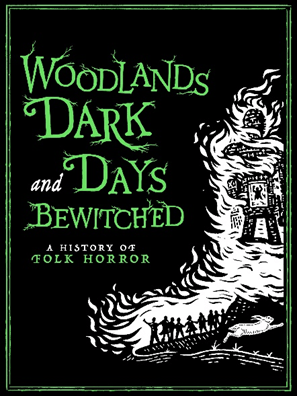
OK, this isn’t actually a horror film – it’s a film about horror films. But its thorough analysis of the history of folk horror – in literature and TV as well as film – is probably the most comprehensive you will ever see.
You’ll need a long attention span – this documentary, originally produced for the Shudder horror channel, is more than three hours long. It’s perhaps easier watched in hour-long chunks, but I was so fascinated I binged the whole thing in one sitting.
Taking as its starting point the so-called ‘holy trilogy’ of folk horror – Witchfinder General, Blood on Satan’s Claw and The Wicker Man – it goes on to show that folk horror is far more than just an English thing (whatever that awful American remake of The Wicker Man might have made you think). Every country in the world has its tradition of folkloric horror, and this film is nothing if not exhaustive in trying to cover them all.
Mostly in the form of ‘talking head’ style interviews, it’s sometimes reminiscent of a very long DVD extra. But the insights of those involved – academics, writers, directors and stars, going all the way back to Witchfinder General’s Ian Ogilvy – are genuinely fascinating. And unlike most of those cheap DVD featurettes, this has the rights to show actual clips of the films under discussion – and there’s a lot of them.
10/10 – your mileage may vary as to how you enjoy a three hour plus discussion of one particular strand of a genre. But if, like me, you’re a fan, it’s totally absorbing; and you will learn a lot you never knew. Plus coming away with a very, very long list of films you’d never heard of that you now really want to see.
 Simon’s Incoherent Blog