
“There’s something behind me.”
(SPOILER WARNING!)
Doctor Who has never been shy about stealing from… er, homaging other sources for its stories. I mean, The Brain of Morbius is just Frankenstein, The Androids of Tara is The Prisoner of Zenda, Robot is King Kong, and so on. It’s even, on multiple occasions, plagiarised itself – every Terry Nation Dalek story is basically the same as his first one. So it was hardly surprising, in a slew of well-blended ‘homages’ this week, that several of them were to earlier episodes of the show. The new thing here was the realisation that the ‘new’ show has now been going so long it can plagiarise itself too.

To be clear – I’m not meaning any of this as a criticism. In another demonstration of the show’s versatility, after last week’s experimental, hugely meta episode, The Well was a much more traditional Who story, but done very well (groan). Despite Russell T Davies’ insistence that the new season would be light on references to the show’s past, after last week’s slyly comic proclamation that 2007’s Blink was the best episode ever, this week we got something quite unexpected – a sequel to RTD’s own, very well-received 2008 episode Midnight.
Not that this was clear from the outset, of course. Instead, we got what initially seemed like one of the show’s staples – the ‘base under siege’ story, as perfected in the Patrick Troughton era. Except at the start, it was very clearly filtered through James Cameron’s classic Aliens.
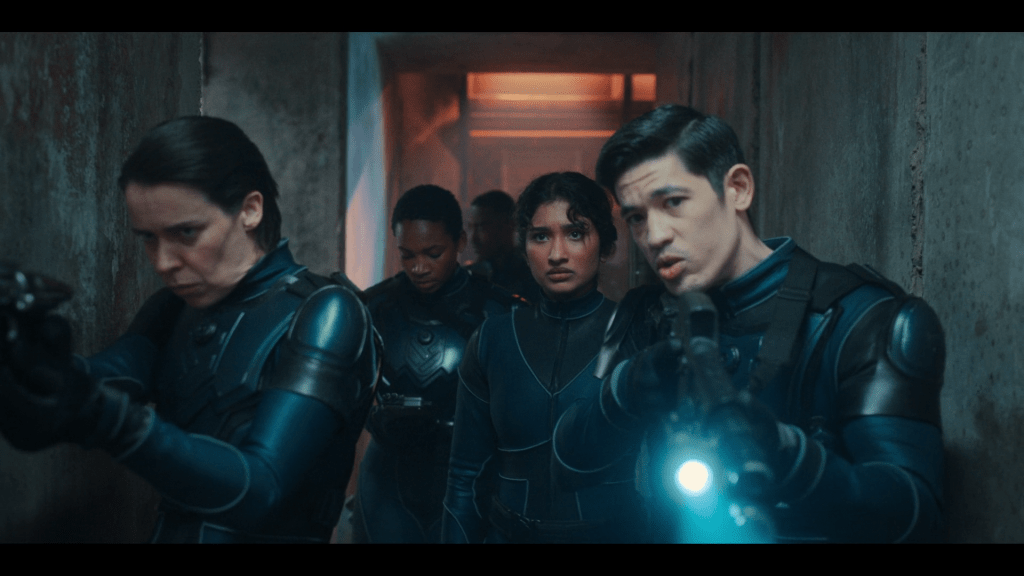
The show’s riffed on Aliens before of course, in parts of stories as varied as Dragonfire and The Satan Pit, but never quite so blatantly as here. From the outset, as the Doctor and Belinda found themselves suited up with a platoon of space marines about to do a combat drop (sans actual spaceship), it was clear where this part of the story had come from. For the avoidance of doubt, though, belligerent Trooper Cassio (Slow Horses’ Christopher Chung, on fine form) actually semi-quoted one of its best-known lines: “We should have nuked the site from orbit.”
And Aliens was far from the only sci-fi staple of my (and presumably Russell’s) youth referenced here. The corpse-littered base where all the personnel appeared to have killed each other could only have come from John Carpenter’s 1982 version of The Thing, while that fuzzy, corrupted video log that clued the Doctor in to what was happening was a clear lift from underrated cult classic Event Horizon.

However, it’s worth remembering that, however fresh they may be in my memory, these are, to today’s youth, very old movies. Modern young viewers may not have even heard of them – I felt very old recently when I realised that none of the teenagers in one of my classes knew what Aliens was. So just like me in 1978 not immediately recognising The Androids of Tara as The Prisoner of Zenda, these homages probably went right over their heads.
Even for those who remembered though, it was a clever bit of wrongfooting on RTD’s part. That Aliens-influenced opening might have led you to expect a slam bang action adventure, with our heroes besieged on every side by hostile, unstoppable beasties. Instead what we got – much like the original Midnight – was a low key exercise in creeping the viewer out, mostly taking place in one room with the lone survivor of the base’s crew.

Said survivor, Aliss Fenly, was nicely realised as someone who was sympathetic but still not entirely trustworthy. It was nice to see the role played by deaf actor Rose Ayling-Ellis, though doubtless the usual suspects will be screaming “WOKE!!!” at their televisions. Of course, they may have conveniently forgotten that Ayling-Ellis isn’t the first deaf actor to appear on the show – that would be Sophie Stone, in the excellent 2015 Capaldi two-parter Under the Lake / Before the Flood.
Here, as there, we saw extensive use of British Sign Language to communicate – nice to see that the collaboration with Disney didn’t result in using the quite different American Sign Language. Of course, the Doctor was fluent, and apparently Ncuti Gatwa actually learned BSL for the episode. Belinda wasn’t, which led to the nice throwaway line that, in this future, it’s illegal to be a nurse without the ability to sign. Good to see that even in the current climate of culture wars, RTD evidently still has some optimism about the future. Even the hardcore, tough-as-nails space marines had a nifty device to visualised their speech as words on a holographic screen, showing that they too had the deaf in mind.
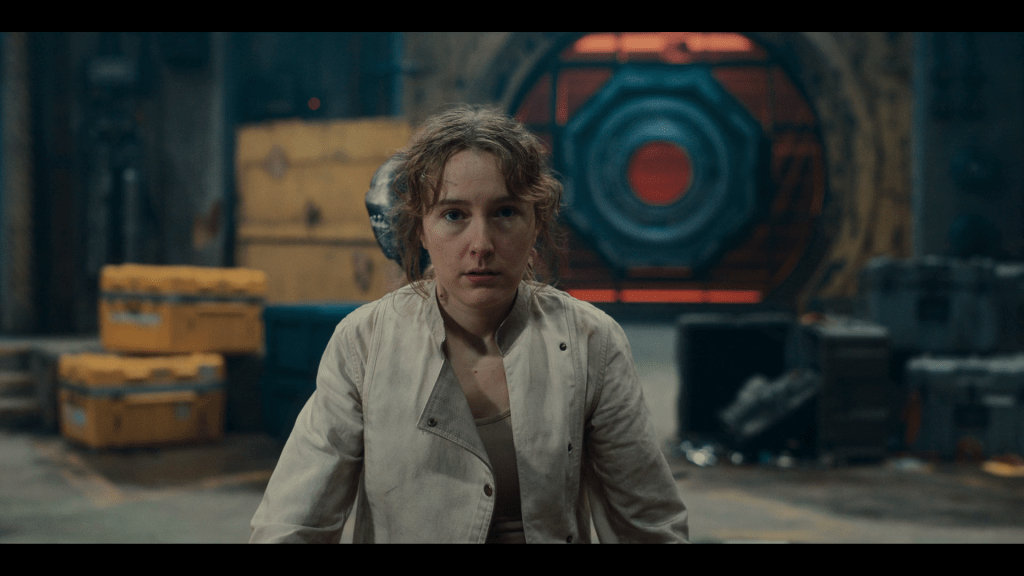
Aliss was the key to the ep’s plot, as the nameless, barely glimpsed entity behind the mind games of Midnight made a return to the show in an almost as memorable way. This time, rather than possessing the characters and messing with their speech, it attached itself to them in a way that as always just out of sight behind them, hence the smashed mirrors in every room. Actually seeing it – or even positioning yourself behind it – resulted in a telekinetic burst of violence that would leave you thrown, broken and dead, across the room.
An obvious temptation when writing a sequel to a well-regarded episode would be to expand on the nature of your mysterious antagonist. Steven Moffat did this with the second story to feature the Weeping Angels, and to be honest, that aspect of Time of Angels/Flesh and Stone doesn’t really work too well. Thankfully, it’s a temptation RTD resisted with The Well, and whatever malicious entity is behind things here remains as enigmatic and unknowable as it did in the original Midnight. That’s definitely a good thing – the total lack of explanation of the creature is what made its ambiguous debut so memorable, and it’s not enlarged on here. Even in the credits, it’s listed simply as “It Has No Name”.
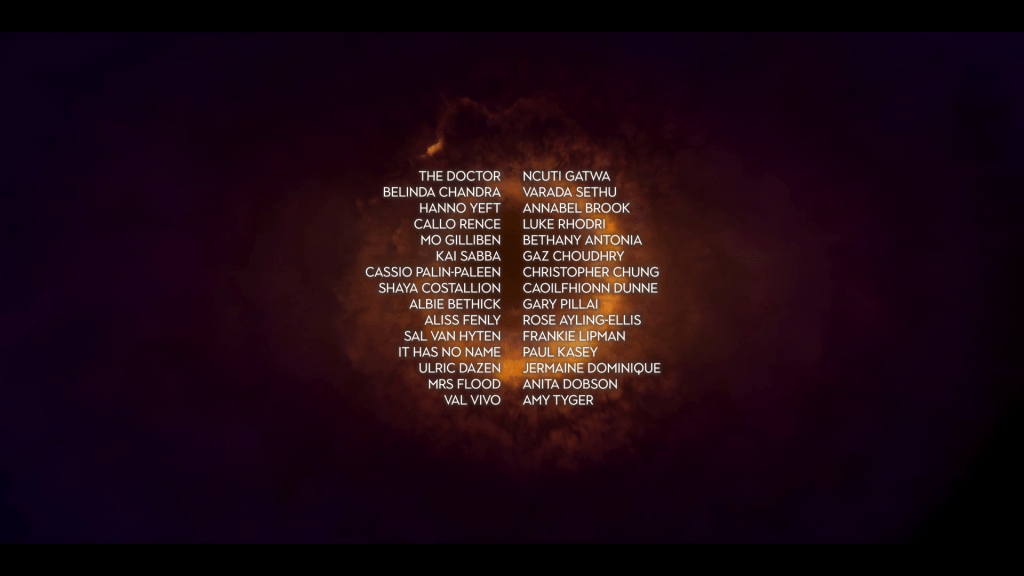
The reason for that credit, though, is that this time, we do actually get some glimpses of it. The barest of glimpses, for no more than a few frames, tantalising us with the certainty that, at least this time, we can be sure it exists.
Or can we? This is one of the points where the ep seemed to be referencing earlier stories in the show itself – specifically 2014 Peter Capaldi classic Listen. That too provided the viewer with the briefest of glimpses of its antagonist, a shapeless form unseen behind the protagonists for less than a second. In that episode, we still can’t be sure if it actually exists, or if it has been somehow willed into existence by the fears of the Doctor.

Actually, there’s no such doubt here. Even if we never really see it, it’s clear what it does, as luckless troopers find themselves flung across the room to their deaths in a gaspworthy sequence well-directed by Australian director Amanda Brotchie. Brotchie, who also directed Lux, is clearly a talent that the show will hopefully retain.
The titular Well itself was clearly another reference to the show’s past, specifically the equally titular Pit in The Satan Pit; while Belinda’s chilling possession by the creature recalled a similar fate for Amy Pond in Time of Angels/Flesh and Stone. It’s a good gambit that works precisely because by this point, we’ve really come to like Belinda. She may still be desperate to get home, but she clearly shares the Doctor’s desire to help wherever she can; this is the third episode to see her taking charge as a nurse in what’s basically a totally unfamiliar and intimidating situation.

Varada Sethu continues to have great chemistry with Ncuti Gatwa, who is really into his stride as the Doctor now. His face as he realises what is going on, set in determination and horror, very much sells the jeopardy of the situation in a way that’s quite reminiscent of David Tennant (fittingly enough for a sequel to a Tennant episode). I’m glad to see that this season, it looks like the Doctor will be front and centre in every episode, rather than mostly missing as he was for a quarter of the previous season.
Mind you, this is the third episode in a row where the actual resolution of the plot doesn’t come from the Doctor himself. While it was Belinda who ultimately saved the day in both Robot Revolution and Lux, though, here it was guest character Shaya, the troopers’ commander, who took that responsibility, selflessly allowing herself to be possessed by the creature before throwing herself down the Well to get rid of it for good (a bit like Ripley in Alien3, though I’m probably overthinking that).

Irish actor Caoilfhionn Dunne (it’s pronounced “kweelin”) did well with one of only about three of the troopers that weren’t written as disposable redshirts. Davies’ script economically gave Shaya a good backstory that was nicely referenced as she raced to her doom, while also portraying her as a ruthless soldier when she needed to be – see her clever dispatch of the mutinous Cassio. The only other trooper who got (at least a bit of) depth was Bethany Antonia’s sympathetic Mo; which was vital for that ambiguous cliffhanger ending suggesting that the monster may not be as dead as we thought.
Amidst this well-told tale, there were still hints of this season’s overarching plot. The most ominous were the blank reactions by the troopers, who were from the planet Lombardo, to any mention of Earth or the human race. I must admit, that seemed a bit weird at first, as I’d assumed the Lombardans were future humans from a colony, but later lines spelled out that they were indeed a different species. Perhaps they could have been given knobbly heads, a la Star Trek? 😊
The story may be set 500,000 years in the future, but previous stories have indicated that humanity was still (for better or worse) thriving in space by that point. The obvious implication, building on previous hints, is that the Earth is about to be destroyed on May 24 2025, hence no one in the future having any knowledge of it. As if to reinforce this, up popped Anita Dobson’s Mrs Flood again, this time acting as the space marines’ commander, and very pleased that the Doctor continues to use his oddly named “Vindicator” in his quest to return Belinda to her proper time and place.
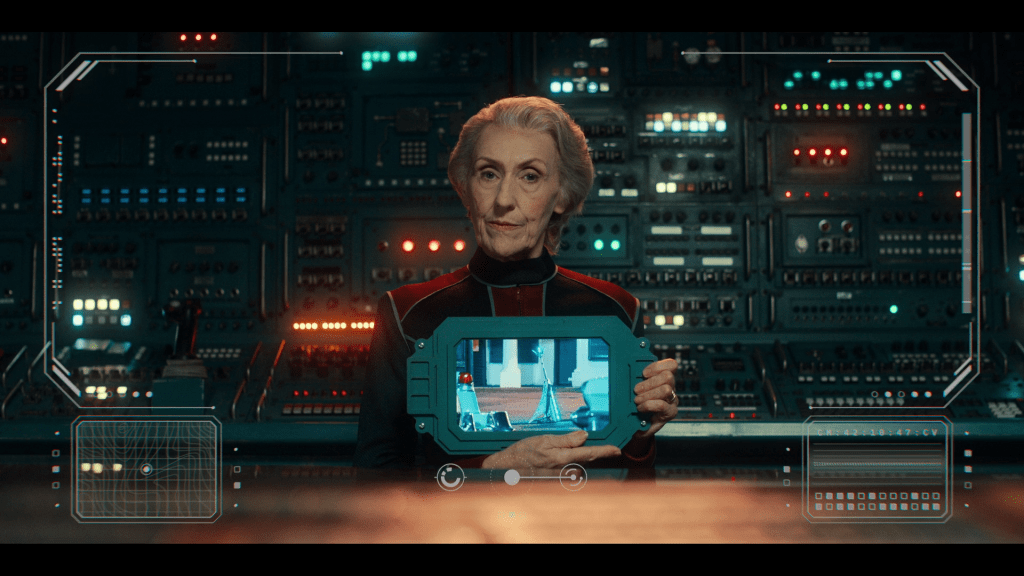
We still don’t know who Mrs Flood actually is (fan theories include the Rani, Romana or Susan – though why should she be a character who was previously female?). But her appearances across time and space, wherever the Doctor happens to be, mark her out as quite likely another Time Lord. As I’ve mentioned before, I do hope she doesn’t turn out to be the Master – not only is the character rather overused these days, it would be hard to top Michelle Gomez’s ‘bananas’ female version. Whoever she is, though, she plainly has it in for the Doctor, and it looks like she’s manipulating him into destroying the Earth himself. That could be interesting…
The Well was another excellent episode after the equally excellent, but very different Lux. This was very much a traditional Who story in the mould of its more serious sci-fi/horror episodes, once again demonstrating the versatility of the show for newer viewers after the surreal events last week. While I was lukewarm about the season opener, that’s two superb episodes in a row, which feels like a rather better hit rate than last year. Next week, though, we get a return to last year’s format with the much-touted reappearance of Ruby Sunday, in the first ep of the season not to be written by Russell T Davies. Let’s see if the season can continue this hit rate of quality!
 Simon’s Incoherent Blog