
“I want everyone to know – it’s not because I want revenge. It’s not about revenge.”
(SPOILER WARNING!)
…And if you believe that, you’ll believe anything.
It was necessarily a more sedate episode of The Last of Us this week – well, how could it not have been, after the carnage last time? After a brief prologue showing the piles of Infected corpses, and various concerned parties grieving, we cut to three months later, and the debate about what happens next.

To be honest, what happens next was pretty obvious even to a non-gamer like me. As we saw last time, Ellie was obviously set on vengeance against the group of ex-Fireflies who’d brutally murdered her pseudo-father right in front of her. Hardly surprising, given what we know of her character. And again, it was hardly surprising that the council debate about chasing after the perpetrators would rule against doing so, and Ellie would go off and do it anyway. Such is the standard way of the narrative in these stories.
So while it was well-played, there was little in the way of surprise here. I’ve seen that council debate played out in any number of post-apocalyptic dramas, from the original Survivors to The Walking Dead, so the arguments were pretty familiar. Citizen after citizen stood up to argue that retribution wasn’t worth the risk, while Ellie’s only supporter in going after Abby and her gang was, surprisingly, her nemesis Seth (looks like I was wrong about him being the old guy we saw mercy killed last week).

What was unusual, and well-played by Bella Ramsey, was Ellie’s rational, considered plea from her pre-written notes, level-headed throughout. The normal cliché in these scenes is that Our Hero will start rationally, but completely lose it when it becomes clear that nobody agrees. Here, Ellie stayed unexpectedly calm throughout. “I’ll accept whatever the council decides,” she averred, but of course we knew she wouldn’t. And judging by her knowing smile, Gail the therapist, watching from the gallery, knew that too.
Gail figured heavily through the first half of the episode, and I was glad to see that Joel’s death hasn’t relegated her to being a more minor character. She was instrumental in demonstrating that, whatever her protestations, Ellie definitely was not all right in the aftermath of what happened, and served as a useful advisor to Tommy too, with her doom-laden statement that, “Some people just can’t be saved” – referring, presumably to Ellie. I’m guessing we haven’t seen the last of the excellent Catherine O’Hara as Gail.
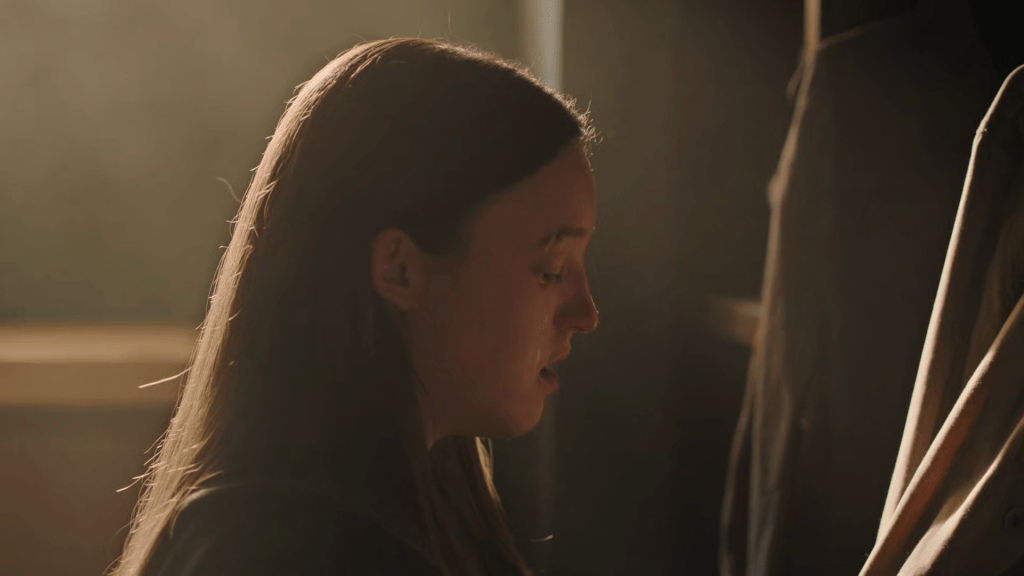
That Ellie was far from all right was established early on with her sorrowful tour of Joel’s empty apartment, even hugging one of his trademark jackets – Gustavo Santaolalla’s mournful music recalling the near-identical scene he scored at the end of 2005’s Brokeback Mountain. It wasn’t much of a stretch to guess that she’d be defying the council’s ruling and off into the wilderness by the end of the ep.
But not alone. The second half of the ep foregrounded her relationship with sometime love interest Dina, and this was by far the most interesting character stuff. Dina appears far more assured and level-headed than Ellie, but was the one who made the pursuit possible with purloined horses and excellent advice that Converse AllStars are not the ideal shoes for hiking in the mountains.
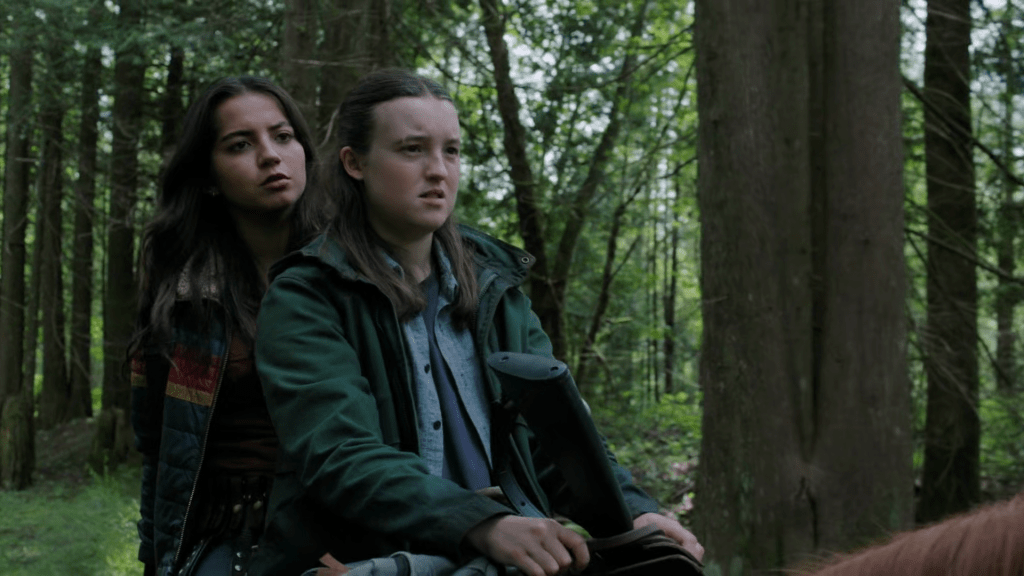
Their banter about favourite bands as they trekked towards Seattle showed an easy chemistry between Isabela Merced as Dina and Bella Ramsey as Ellie. All the more surprising, then, that their discussion of their New Year’s Eve kiss revealed that Dina doesn’t actually consider herself gay (and that Ellie does), and that she’s already back with old beau Jesse. All well and good, but she’s risking her life trekking through the wilderness with the girl she claims to have no romantic interest in. Could she be protesting too much?
It was a nice reveal, too, that Dina isn’t quite the hardened survivor she seems to be when the discovery of a murdered religious group caused her to vomit uncontrollably, while Ellie was, typically, unmoved. I presume this religious sect will feature more heavily as the show continues; else why foreground them so heavily earlier in the ep only to have them all killed off? I guess that whatever that poor little girl felt, the hammer didn’t make her any safer after all.

Again, we’re in familiar post-apocalyptic territory with new religions springing up. The usual approach is to have them either as helpless martyrs or fanatical zealots. Judging by this ep, they’re the former, but who knows what the rest of the story portends (well, those who’ve played the game, I guess). Could the enigmatic symbol scrawled on the back of one victim represent some other sect who consider them heretics – or was it the work of what we now know to be called the Washington Liberation Front?
The WLF, known logically enough as “Wolves”, are shaping up to the Big Bad of the season. It was interesting to hear the first references this season to the fascistic US government remnant FEDRA, but aside from a warning sign outside Seattle, they were nowhere to be seen this week. Nor indeed have they been since about the second episode of the first season. It looks like the Wolves have total control of Seattle (and that they’re far more numerous than Our Heroes thought), but it would be interesting for FEDRA to turn up, and Ellie and Dina to be caught in the crossfire.
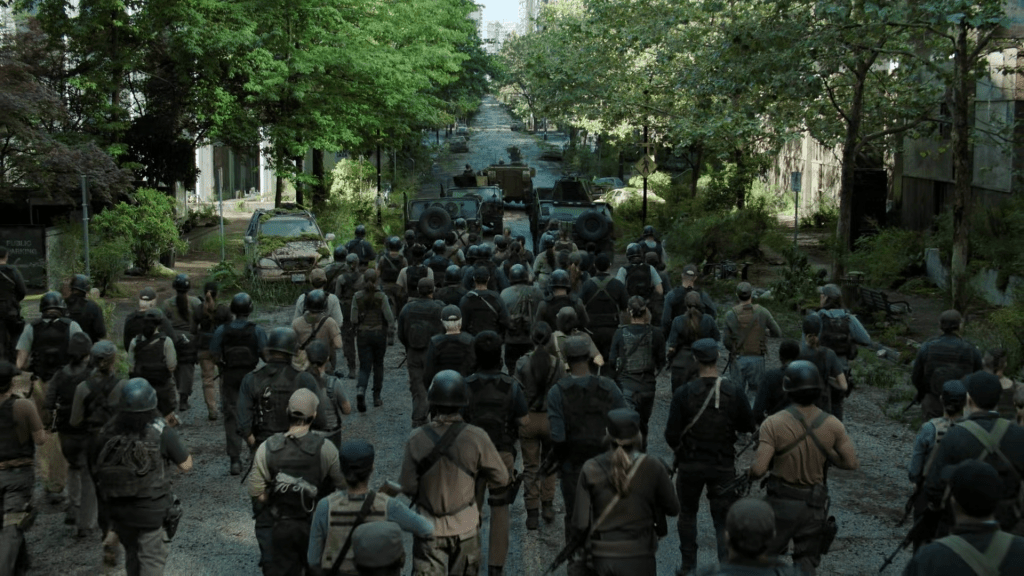
Fans of post-apocalyptic drama will have been very pleased with the well-realised vistas of ruined Seattle, and the car-wreck strewn highway leading to it. But again, we’ve been here before. It’s de rigeur for any post-apocalypse show to feature a ruined city at some point – indeed, The Last of Us did it several times in its first season. This was another nice realisation, but too much more of them and the show’s at risk of repeating itself, in the way The Walking Dead came to do in its later seasons.
Very much a character-driven episode then, but a necessary one to allow the characters (and the viewers) to process the traumatic events of last week. Gamers won’t have been surprised, but I thought killing off one of the two apparent main characters in the second episode was an unexpected dramatic masterstroke. I would have guessed that Tommy would have stepped up as a sort of replacement Joel (and I guess he still might), but for now, it looks like Dina is taking on that role. Or is he a second Ellie, so Tommy can come and rescue them both?
However, while the character work here was good, there was little new or interesting in the story itself, which played out lots of the usual post-apocalyptic staple without doing anything new with them. That’s an obvious risk for a show that has to fit a certain formula, but I hope the same passionately character-driven narrative that made the first season so good will lift this one above it in the coming episodes.
 Simon’s Incoherent Blog