
“Every day, one of your Wolves comes to see the truth, and takes Her into their heart. Every day, every day, a Wolf leaves you to take the holy mortification to become a Seraphite. And none of us ever leave to become a Wolf.”
(SPOILER WARNING!)
After an incredibly busy week enmeshed in the toils of Spanish bureaucracy (I needed to exchange my UK driving licence, a Herculean task of procedure), I’m now a week behind on The Last of Us – in fact, I’ve only just seen this fourth episode. With another one waiting in the wings, here’s some brief thoughts on episode 4 – Day One.
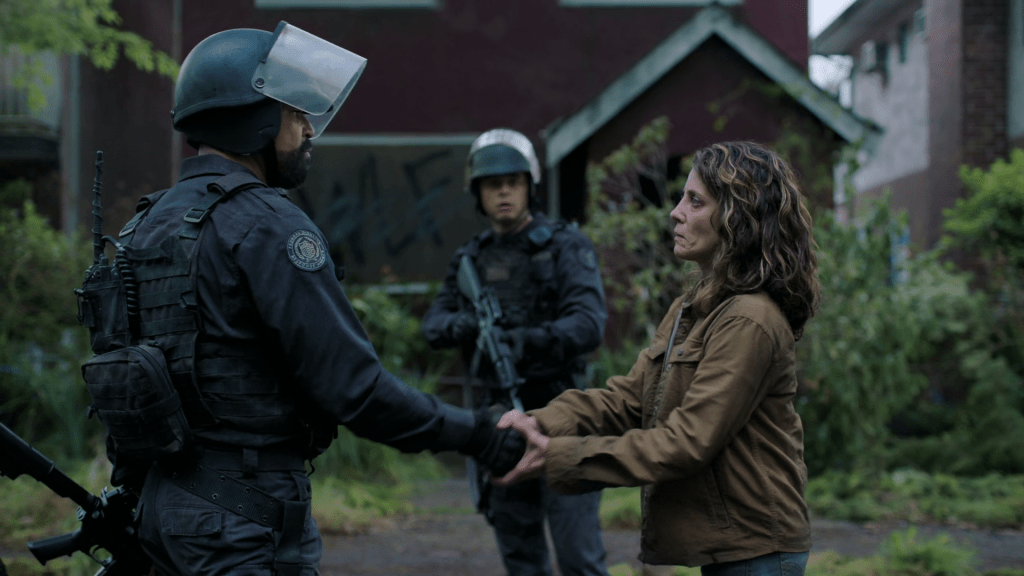
It’s interesting to note that this seems to be setting up plot threads for the season as a whole. This looks like it will strongly feature the conflict between the WLF (the Wolves), and the religious sect briefly glanced last time, who turn out to be called the Seraphites. Previously, I noted that religious sects in this kind of post-apocalyptic drama are usually portrayed as helpless martyrs or fanatical zealots; here. It turned out that the Seraphites probably qualify as both.
First, though, Craig Mazin’s script economically filled us in on the situation in Seattle, with a brief flashback to how the Wolves got the better of FEDRA (who are clearly yesterday’s villains this season). This introduced us to the treacherous Isaac Dixon, who’s clearly going to be an ongoing antagonist – you don’t cast the always-excellent Jeffrey Wright in a bit part.
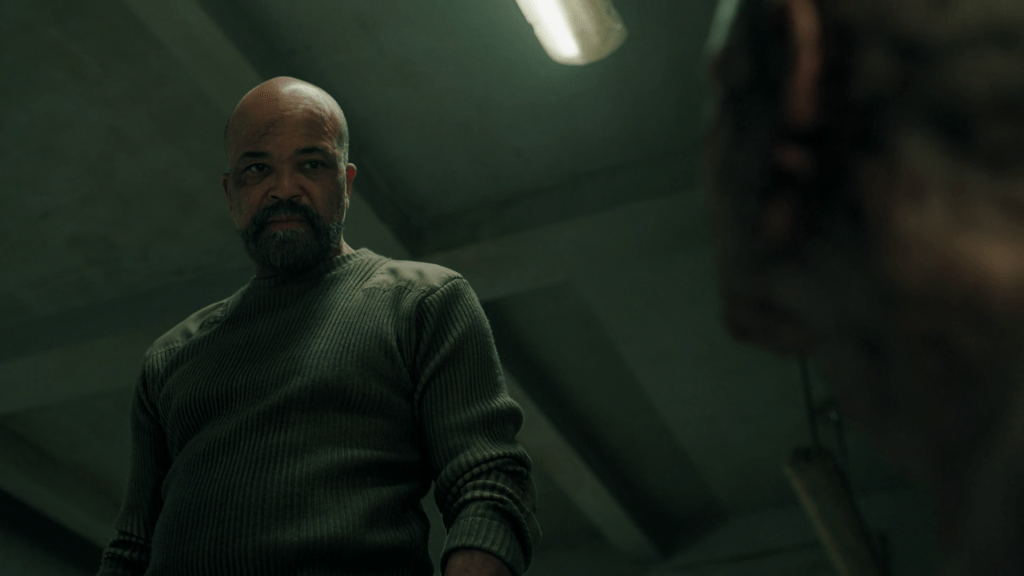
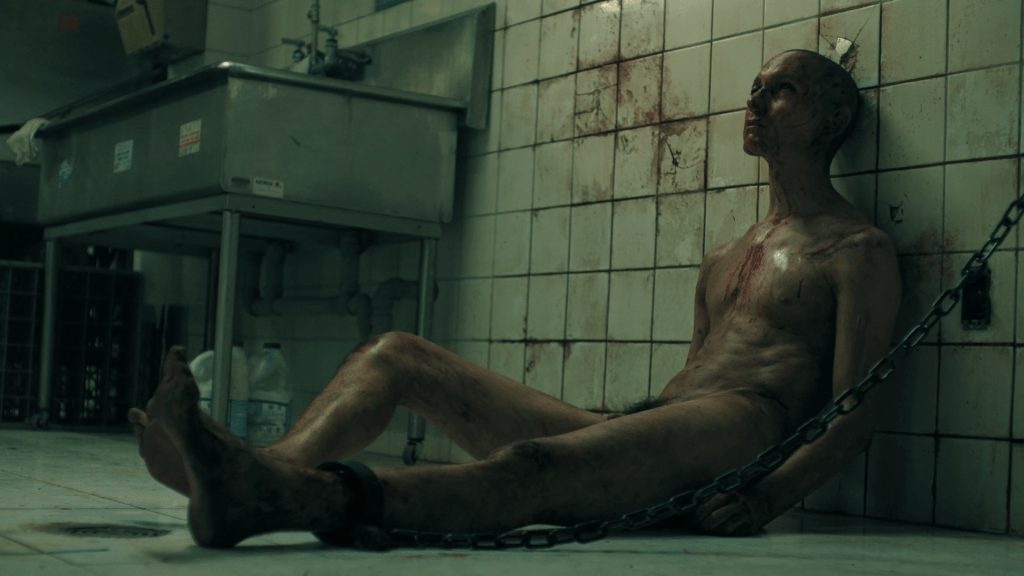
Wright, a versatile actor who can turn his hand to heroes and villains, drama and comedy, made Isaac seem a pretty nasty piece of work. Not only did he turn on his fellow FEDRA agents (to be fair, they seemed to deserve it), but we caught up with him in the present, torturing a helpless Seraphite with some very high-quality heated pans and an anecdote about his love of cooking.
This was a deliberately unpleasant scene, but it quickly told us everything we needed to know about what’s happening in Seattle. The Wolves have filled the power vacuum left by FEDRA, and don’t seem much better – proof, if you needed it, of Nietzsche’s assertion that fighting dragons causes you to become a dragon. The Seraphites appear to have taken on the role of plucky resistance; but the fanatical belief of the unfortunate torture victim here seemed to hint that they might not be much nicer. A hint that was quickly followed up on with Ellie and Dina’s discovery of a particularly gory massacre of some of the Wolves. Clearly, these Seraphites don’t take well to unbelievers.

There’s a lot of themes right there. Last season, we discovered that FEDRA and the Fireflies might as well be two sides of the same coin; this time, it seems the same could be said of the Wolves and the Seraphites. It boils down to a general distrust of all authoritarian organisations, which I’m sure viewers of different political stripes will interpret differently to suit their own worldviews. For me, it seemed apposite when a self-appointed American saviour is currently turning the country into a near-fascist state; others, though, will doubtless claim that it vindicates their distrust of big governments.
Whichever you took it to be, this was quite a brutal episode as a result. Aside from those hanging, eviscerated heretics in the Seattle Metro, Isaac’s torture of the defiant Seraphite youth didn’t pull any punches in showing you the horrific burns he was inflicting. It was also, incidentally, the first example of full frontal nudity for an actor of any gender in this show; but it was most definitely neither titillating or exploitative. Full credit to actor Ryan Masson for delivering a harrowing performance there, holding his own in a very intense scene with Wright.
With all that going on, the scenes of Ellie and Dina poking about the ruins of post-apocalyptic Seattle came almost as light relief. Gotta say, though, their discovery of the aftermath of the Wolves/FEDRA battle was inescapably reminiscent, yet again, of The Walking Dead; specifically the scene in Atlanta in its first episode, where Rick investigates a similarly stalled tank.
Still, the trademark character focus of The Last of Us was very much to the fore in those scenes, as the pair found themselves wandering the mouldering ruin of a music shop – remember, this is Seattle, a city famed for its music scene. It was an affecting glimpse, as frequently seen in post-apocalypse dramas, at an idyllic world now long gone. We know that Ellie is very much into music, and her almost reverent picking up of Tears for Fears’ The Hurting on vinyl was an insight into her longing for a supposedly better world she had never known.
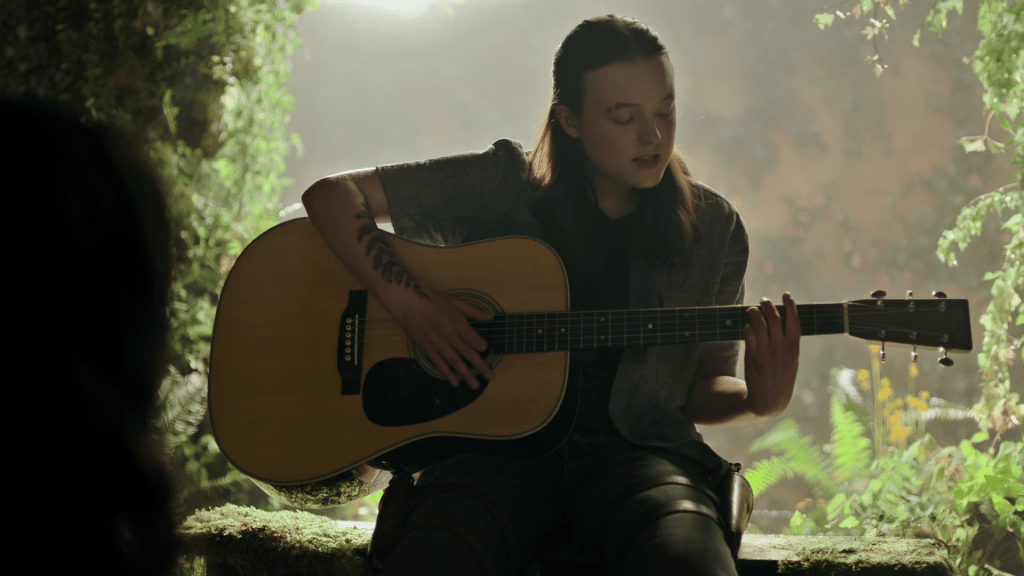
OK, it was pretty lucky that she found a well-preserved guitar packed in a case with those familiar moisture-absorbing packets. But that led into a scene which was undoubtedly one of the ep’s highlights, as she basically serenaded Dina with an achingly beautiful acoustic rendition of A-Ha’s ‘Take on Me’. Apparently that really was Bella Ramsey, an accomplished guitar player, both playing and singing. It was also, I gather, a faithful reproduction of a well-remembered scene from the game.
There, as here, it functioned to show us that Dina’s love for Ellie may not have been as platonic as she insisted last time. Isabela Merced played it well, staring raptly at Ellie with tears brimming in her eyes.
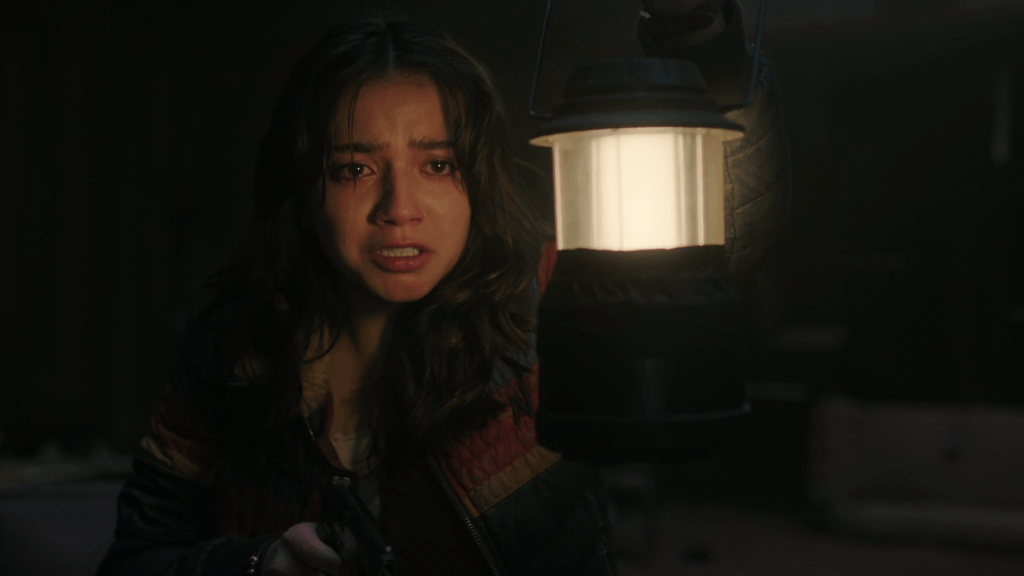
Much of this episode, outside of the action, was devoted to building their relationship. Previously, I’d thought it rather odd that a hardened survivor like Dina would throw up quite so easily at the sight of a few dead bodies. Here, as it happened again, it turned out there was a very good reason for it – she’s pregnant.
That immediately thrust Ellie into the role of protector – just like Joel was to her – but it was a relationship Dina very much didn’t appreciate. Both got to unburden their secrets to each other in the aftermath of a well-choreographed Infected attack in the Metro; Dina, may not be gay, but she is bisexual. And she now knows that Ellie is immune to the effects of the Infected’s bites.

All these scenes, well-played as two handers by Ramsey and Merced, cemented the characters’ relationship as one of lovers – a very different dynamic to the father/daughter team we saw in the first season. It was just part of the scene-setting that was this episode’s primary function. It feels like the first three episodes were just a lengthy prologue to the real plot, which is only just starting; hardly surprising, given that apparently the adaptation of the second game is scheduled to stretch on into the second season.
This ep was a nice balance of the show’s thoughtful characterisation with some well-realised Infected action; it seems that we’ll be seeing a lot more of the Infected this time than their rather sparse appearances in season one. The stakes have been established, and the title – Day One – very much tells us there’s a lot more of this plot to come.
 Simon’s Incoherent Blog