
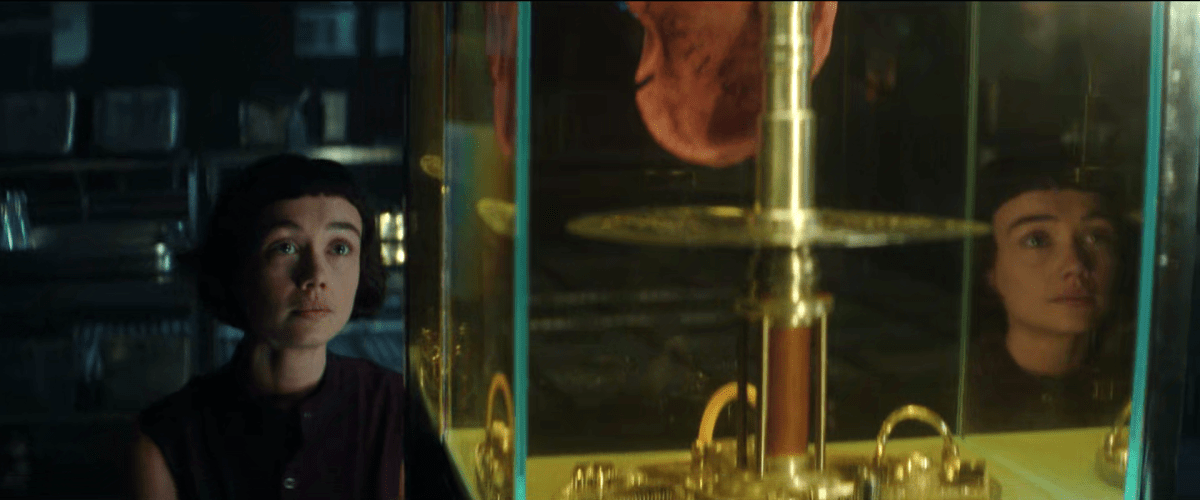
“I think they picked me. They’re talking to me. I want to hear them.”
(SPOILER WARNING!)
It was a much more character-driven, intrigue filled episode of Alien: Earth this week, with barely a terrifying beastie in sight most of the time. That’s definitely a good thing, as (besides advancing the plot) a breather in the action allows us to get to know these characters, and the world they inhabit, rather better.

The Hybrids, in particular. Up till now, only Wendy has been given much depth; Slightly and Smee have a nice comic repartee, but until this week, we didn’t know much about them. And the others have barely had more than a handful of lines to establish who they are.
So filling in their personalities is a welcome advance. As was pointed out by nervous scientist Arthur, this is experimental technology that hasn’t even been beta tested – “at best, we have machines who think they’re human. At worst, we’ve killed six kids”.

And it does already seem like it’s not quite working out for all of them. Nibs (Lily Newmark with an eerie thousand yard stare) was already freaked out by her previous encounter with the scuttling eyeball/tentacle thing. Now, she’s decided, apropos of nothing in particular, that she’s pregnant – quite a trick for a machine.
But just as Arthur was already fretting, she doesn’t think she’s a machine. And reacted with disturbing violence when confronted with the fact by Arthur’s wife, Dame Sylvia (Essie Davis). So is this a hardware problem or a software problem? And given that the ‘software’ is, ostensibly, a human consciousness, this raises all sorts of interesting questions – as Atom Eins put it when discussing the same issue with Joe, both practical and existential.

Joe asked whether they really had downloaded his sister’s consciousness, and whether Wendy was really her; and that is two different questions that have haunted the sci fi concept of artificial life. If you can download a human consciousness into a machine, is it still the original, or is it a copy, meaning that the original person is really, truly dead? And even if it is a copy, does that mean that it can’t still be the ‘real’ person?
And of course, despite appearances, these are the consciousnesses of children – of course they won’t react rationally to their circumstances. At least a couple of them are smart enough to appreciate the possibilities; particularly Tootles (Kit Young), who’s delighted that his intellect is being taken seriously, and asks to be renamed “Isaac”. But after Newton or Asimov, I wonder?

Slightly isn’t taking it nearly so well though, which is understandable now that he’s dealing with a very sly adult human who can run rings around a naive child. I mean, obviously giving Morrow his real name was going to lead to a family member hostage situation, but Slightly is just a kid – he couldn’t know that.
What’s interesting is that Morrow seems to know exactly what (if not who) Slightly is already – that he’s a kid whose consciousness has been implanted into a machine. I don’t recall him finding that out, but given that he knows it, it’s even more odd that he hasn’t told his employers at Weyland Yutani about the programme.
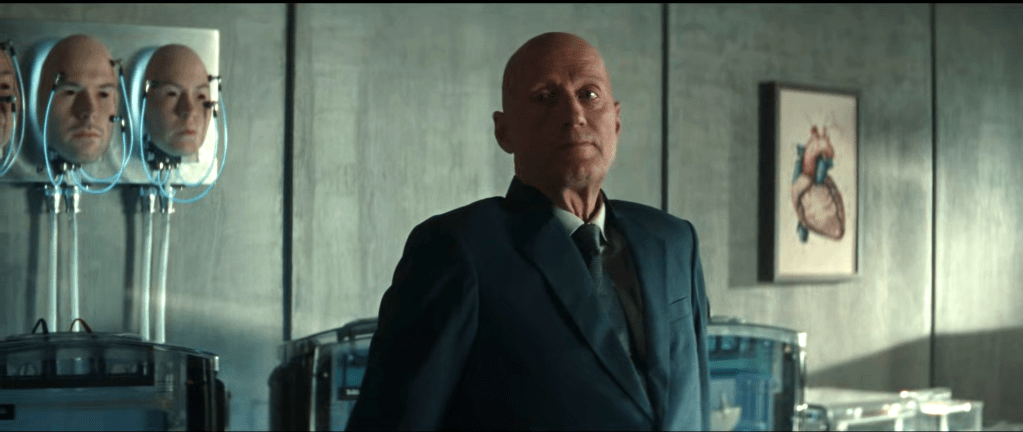
Speaking of Weyland Yutani, we get a bit more knowledge about this ultra-capitalist future this week, courtesy of Joe explaining it to the innocent Hybrids – useful to have kids on hand to explain the exposition to. It seems that having democratically elected national governments “didn’t work”; the details aren’t explained, but one look at the state of the world right now makes that seem quite plausible.
So “The Five” corporations rose up against the governments and defeated them – for the good of everyone, naturally, and with no interest in unregulated profit. They’re spinning the yarn that they’ve solved the world’s problems; but given the fact that each has its own military, and that Joe recently served in a war that was presumably between two corporations, I’m guessing that’s all just PR. The idea of militarily equipped corporations certainly brings a new meaning to the phrase “hostile takeover”.
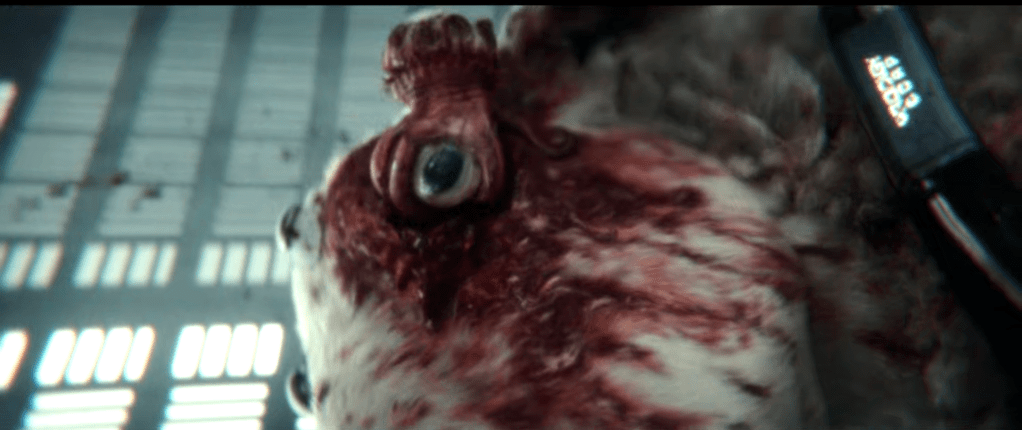
Lots of exposition, then, and lots of character development. But Noah Hawley hasn’t forgotten that this is still an Alien show, so hideous menaces aren’t entirely absent. The scuttling eyeball makes a reappearance, and this time we see in gruesome detail how it implants itself in the eyesocket of its unfortunate host – a luckless sheep in this case.
But the more interesting thing is that, having presumably killed the sheep when it ripped out the eyeball, the creature now seems to control its body. And, at least according to Kirsh’s readings of an EEG, it’s actually highly intelligent. Certainly it seems pretty menacingly watchful (no mean feat for a sheep) whenever anyone approaches its glass cage.

That question of intelligence is interesting, as I mentioned last week, because it follows up on some subtle hints in Cameron’s Aliens that the creatures are far smarter than the vicious animals they seem. OK, so the eyeball thing isn’t a Xenomorph (interestingly, everyone already seems to be calling them that), but the apparent mental communication with Wendy last time was from a Xenomorph. And judging by her modified playback of what she heard, they at least have some form of language, which already raises them above the intelligence level of most animals.
I was reminded by a friend last week that in fact the 1980s Dark Horse Alien comics had already trod this ground a long time ago. Not just that the Aliens were intelligent (and had arrived on Earth), but that they had a kind of telepathic ‘hivemind’ that some humans could tap into. The question, as raised by Wendy, is whether she’s just listening in, or whether they’re actually trying to talk to her.

Certainly her apparent ‘motherly’ bonding with the newly hatched chestburster incubated in her brother’s lung suggests the latter. You might recall the ambiguous bond between Ripley and the Xenomorph in Alien3, not to mention the also ambiguous way that (in one of the cuts) she seems to cradle the ‘baby’ that’s just burst out of her chest as she plummets to her fiery doom.
With this creature seeming to form a kind of parental bond with the unafraid Wendy, there’s plainly going to be more said about this in later episodes. It also neatly ties in to the question of how ‘real’ Wendy is – has the creature sensed that she’s related to the former owner of its incubating organ? And if the Aliens can communicate telepathically, but the brain they’re communicating with is a machine, what does that mean for the nature of consciousness?
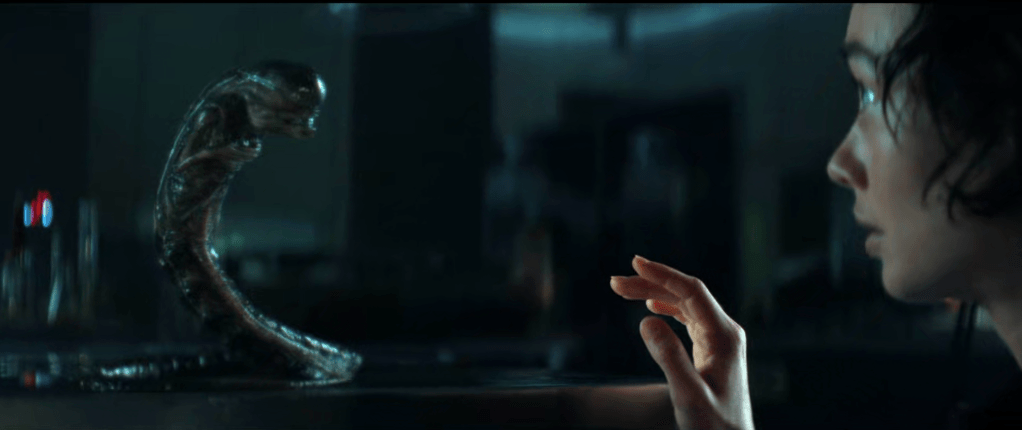
Big questions. For me, the scene gave a fascinating opportunity to actually see the chestburster stage of the creature in detail; previously they either scuttled off before you got a good look at them, or were instantly incinerated. It’s almost like a tadpole, limbless and moving on a snakelike tail; but you can see developing upper limbs in its ‘torso’. It’s a nice extrapolation of the original Giger design.
As you can probably tell, I’m still very much enjoying this series, as much for its fascinating science fiction ideas as its well-drawn characters. It was good to have Sydney Chandler and Alex Lawther back up and about this week, as their characters are plainly the heart of the story; but equally good to give more depth to the ensemble surrounding them. If you tuned in for gunfire, gore and running up and down lots of corridors, you may have been disappointed; but we got plenty of that in the first two episodes, and I’m sure there’s plenty more to come.
 Simon’s Incoherent Blog