
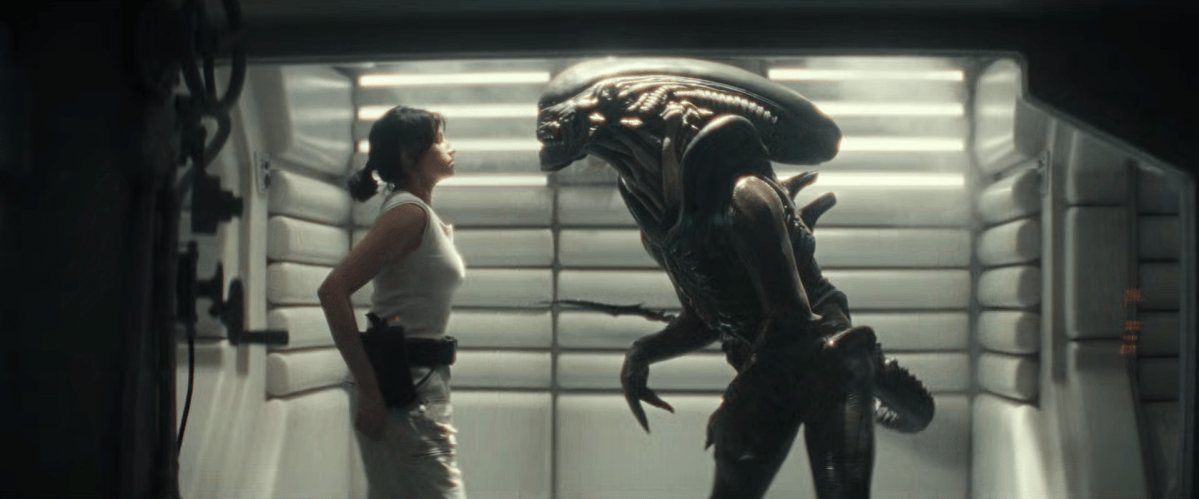
“They want their monsters. Here they come.”
(SPOILER WARNING!)
Quite a change in format for Alien: Earth this week, as the show takes a break from its ongoing plotlines (and last week’s cliffhanger ending) for a flashback ep to the events on the USCSS Maginot before its crash on Earth. Well, having so meticulously recreated the original sets from the first Alien, it would be a shame for Noah Hawley not to get as much use out of them as possible, and they’re showcased this week in what is, essentially, a beefed up remake of that film. Hence the episode title.
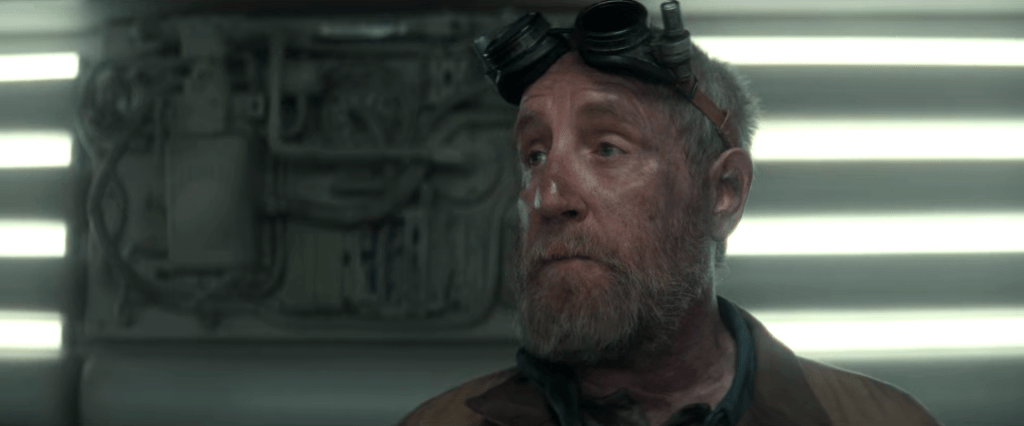
To be honest, I’d been expecting some flashbacks. Those sets must have cost a fortune to recreate. Plus at least one of the crew so briefly seen in ep1 was a pretty well-known character actor – Northern Irish legend Michael Smiley. It would have been a bit strange to hire someone so well-known to only say about two lines.
So Smiley and crew are back this week in an episode that focuses entirely on what happened before ep1. As a result, most of the regular cast are absent. Obviously, Babou Cessay’s Morrow, as one of the original crew, is there as a main character; and there’s a brief communications appearance from Samuel Blenkin’s Boy Kavalier. But otherwise, the characters we’ve been following thus far are entirely absent in this clever riff on the original 1979 movie.

While I had been expecting flashbacks, I must admit I hadn’t expected an entire episode of them at this point in the narrative. In fact, watching it, I found myself wondering why this hadn’t been the actual first episode, as it leads neatly into the one which was. The only reason I can think of is that it’s so reminiscent of the original Alien that it might have generated less interest in a series that is otherwise trying to do something new with the franchise.
Just remaking that movie with different characters would have been pretty redundant though, so the jeopardy is beefed up in this with the other, now familiar, alien menaces the ship is so foolishly transporting. Indeed, the actual Alien isn’t seen until quite late on, the danger initially provided by the superleech creatures and the scuttling eye with tentacles. Plus the most dangerous adversary of all – other people, intent on making a quick buck.

Hawley’s script gradually introduces us to the crew of the Maginot in the midst of a sabotage plot about which of them started the fire in the lab that led to two of them being grabbed by facehuggers. Unlike the Nostromo, the Maginot has a rotating crew, with half of them staying in cryosleep while the others work. Presumably not constantly though – one of the themes of the ep is that the journey they’re taking is indeed a 65 year one, meaning that everyone they left behind on Earth would be aged or dead by the time of their return.
Given that this is meant to be only two years before the original Alien, the Maginot must have travelled far further than the Nostromo ever did to gather its menagerie of lethal alien beasties. It also means, given that this is stated as being set in 2120, that the journey must have begun in 2055 – a mere thirty years from now. That seems a little optimistic, in terms of the technology that would need to be developed in that time.

Still, that’s just quibbling – after all, we’re already well past the stated time of Blade Runner (November 2019). But we learn that Morrow had a little daughter, and that he’s broken up by her death at the age of 19 in a fire. Given that, charitably, she would have been in her early 70s by his return, that might seem a bit odd – if you knowingly sign up for a 65 year space voyage, you can’t expect to return to the people you knew. Even so, I expect any father, even an absent one, would have wanted to know that his child had a happy and successful life. It explains a lot about Morrow’s dedication to the mission; he gave up everything for this.
Micheal Smiley’s engineer Shmuel is much more sanguine about the fact that his wife will be ancient or dead by the time he returns – maybe it wasn’t the happiest of marriages. That, he explains to his loveably dim apprentice Malachite, is why they get paid the big bucks. Or shares, in fact. Echoing the original Alien, the script tells us that this is what they get paid in, with Morrow echoing Ash in explaining that the penalty for failure is “total forfeiture of shares”.
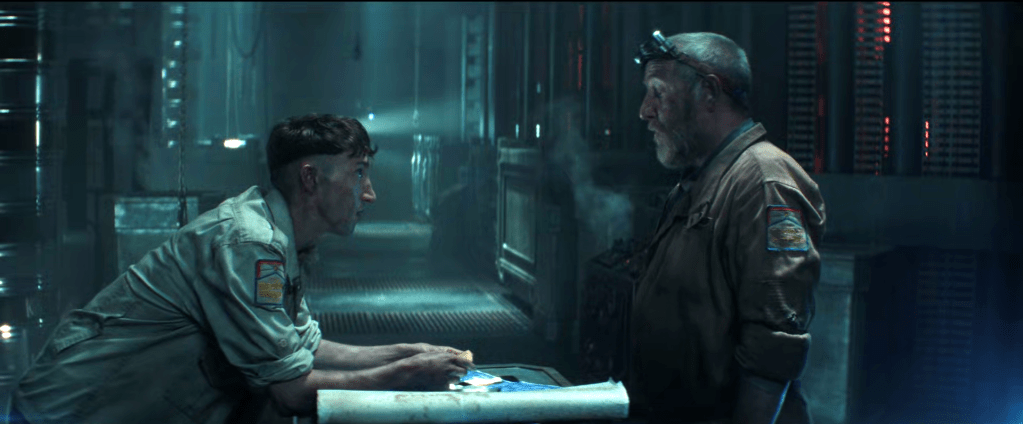
Shmuel and Malachite are a fun double act, presumably deliberately reminiscent of similar below decks grease monkeys Parker and Brett from the original. The other crew are a diverse bunch, more so than the original movie, but significantly there’s no Ripley substitute. Indeed, Executive Officer Zaveri (Richa Moorjani), who takes over after the Captain is facehugged, is shown to be weak and indecisive, with Morrow eventually wresting command from her.
We do get some depth given to the rest of the crew – there’s alcoholic doctor Rahim (Amir Boutros), careless science officer Chibuzo (Karen Aldridge), and likeable rookie Clem (Tom Moya). Then there’s the enigmatic Teng, played by Andy Yu in such a weird, mannered, sinister way that he’s practically screaming “I’m the bad guy!”

Which is of course a red herring – he isn’t. The saboteur actually turns out to be a character we hadn’t seen before, which seems like cheating in a whodunnit. As a result, Petrovich (Enzo Cilenti) gets less depth than the others. But to be fair, there’s a limit to how much character depth you can give to such a large ensemble in the space of about an hour. Because, as we know going in, everyone except Morrow is going to be picked off by various space nasties by the end of the ep. That’s another problem with placing this ep here – it’s difficult to generate much suspense when you know these people are all going to die.
And die they do, in a wider variety of ways than the crew of the Nostromo. We don’t yet know about the main Xenomorph creatures, but the superleeches and the scuttling eye are definitely intelligent. At least, intelligent enough to figure out how to escape from their containment, though it seems like pretty inadequate containment for what the company knows to be absolutely lethal lifeforms.

The superleeches are also smart enough to know that inserting their larvae into a crewmember’s drink is an ideal way to get inside a host, while the scuttling eye figures out how to knock its jar off the shelf until it smashes (why would you try and contain something so dangerous in easily smashed glass?). For that matter, it’s very obvious that the facehugger on Bronski is far from frozen in the cryopod – which also has a cover made of conveniently thin glass.
With all this lot running around the ship, obviously the crew fall like ninepins. We discover another interesting facet about the superleeches – if you try to remove their larvae from the unfortunate host (in this case comic dimwit Malachite), they can emit a corrosive gas every bit as nasty as the standard Alien’s acid blood.

In fact, by the time it actually starts taking part, the main Alien seems less like the central menace than part of an ensemble of beasties, even getting into a struggle with the rampaging scuttling eye. The revelation that the eye has possessed Shmuel is nicely done, with Michael Smiley roaring incoherently – it seems the creature isn’t smart enough to use its host’s language to communicate, even if it does control the host’s body.
Of course we know going in that Morrow is the only one who’s going to make it, which is a definite downside of placing this ep fifth in the series’ run. There’s a couple of loose ends though – what happened to the other, sleeping, crew? And just where did that cat come from that we saw when we first encountered the scuttling eye? I’d assumed it was the ship’s cat, a la Jones in Alien, but there’s no sign of a cat here. Perhaps it was unfortunate enough to wander in from the apartment building. And given that the colonists in Aliens have to wait weeks for replies to their queries to Earth, how exactly can Petrovich have an actual conversation with Boy Kavalier?

Nonetheless, this episode works excellently as a remix of the original Alien, capably directed by Noah Hawley himself with plenty of visuals echoing Ridley Scott’s original. Those lovingly recreated sets are used to their full potential – and we see that the curve-screen monitors, whatever they may look like, aren’t CRTs at all, but flatscreens.
Stripped of the need to establish the premise that takes up the first half of the movie, the ep can cram all the icky gore and action neatly into its hour-long runtime. It even manages to give its characters enough depth that we feel for them, even knowing they’re all bound for inevitable, horrible deaths. The only mystery for me is why this wasn’t the first episode, rather than the fifth, so we could feel some suspense as to who might make it.
 Simon’s Incoherent Blog
Yes, it is very competently done but ultimately by far the least interesting episode of the show so far. What was the purpose of doing this remake?
LikeLike