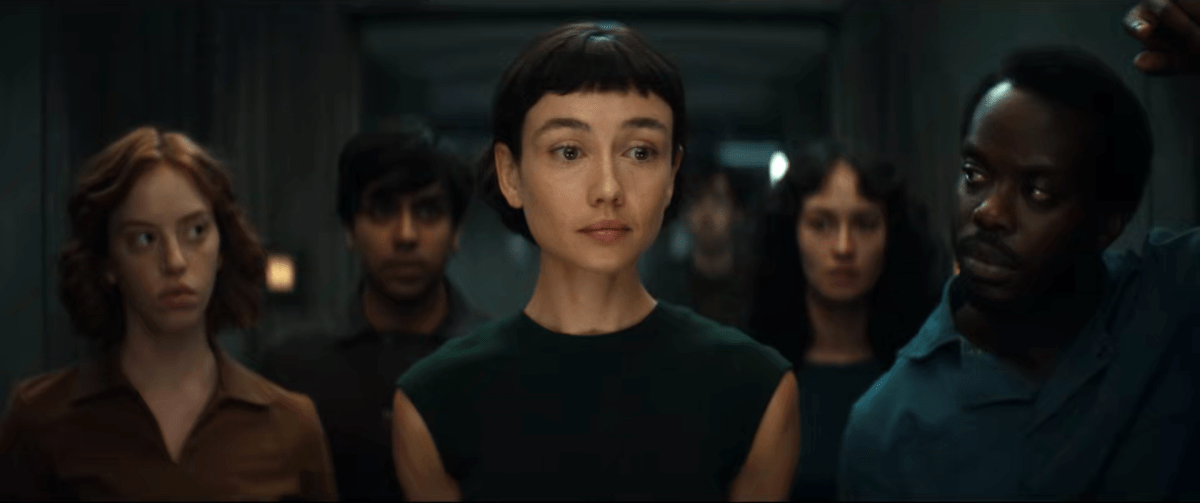
“All this time, we’ve been afraid of them. But I think… they should be afraid of us.”
(SPOILER WARNING!)
It’s become a familiar refrain both on and offscreen in the Alien universe that the Xenomorphs are not “the real monsters”. No, the real monsters would be people – in particular, the rapacious, greedy corporations eager to make a quick buck out of the uncontrollable killing machines, uncaring how many people die to make that happen.
So you’d expect this season finale, with the title ‘The Real Monsters’, to be all about demonstrating that, and showing them getting their comeuppance, wouldn’t you? Well, you do get that – to some extent – but Noah Hawley’s clever script knows that we know who “the real monsters” are, and sets out to subvert our expectations by recasting the question. If the Aliens aren’t the real monsters, but the corporations are – could it be that they’ve created something even more monstrous?
All this of course plays into the themes that the show has really been interested in throughout – the franchise’s ever-growing roster of “artificial people”. I mean yeah, obviously fans tune in to see some gruesome deaths courtesy of various species of Xenomorph – and the scuttling eyeball, T Ocellus, has been the breakout star there – but that’s pretty straightforward stuff. But in terms of actual science fiction ideas, artificial people are way more interesting.
So this season finale brings us some form of reckoning between the three variants of artificial people we’ve been following throughout. Cyborgs (humans with cybernetic bits added), Synths (fully robotic androids, like Ash and Bishop from the movies) and the Hybrids who’ve been the central characters throughout – synthetic adult bodies with the transferred consciousnesses of ten year old children.

We’ve been following Wendy’s increasing disenchantment with humanity for the last few episodes. As an experimental corporate product, she’s been exposed to the venal side of her former species in a way that normal children never are, and it’s not given her the best of impressions. And last week, even her brother – the last human she seemed inclined to trust – had seemingly betrayed her, aiding in her capture along with her fellow Hybrids. Small wonder that this week sees her mulling over the possibility of revolution against her makers.
To be fair, this is not exactly a new idea. Robots rising against their masters goes all the way back to things like Asimov in the 50s, and most recently had probably its definitive iteration in the TV version of WestWorld, which, as here, was mostly shown from the perspective of the actual robots. This works in the same way, as we’ve had a entire season of TV to get to know and like these characters. They may have the consciousnesses of humans, but because they’re children, they’re just as naïve as WestWorld’s Hosts, innocents in a corrupt world that gradually corrupts them too.

Setting out to rebel turns out to be easier than you’d think, because of Wendy’s hitherto unseen ability to control all electronics – including, it turns out, other Synths. This seems a mite convenient, and makes you ponder whether it was a feature that Prodigy intended to build in – if so, that was pretty shortsighted. I must admit, though, that as a scripting choice, I’d probably have seeded it in earlier eps rather than having it come out of the blue for the season finale. That just makes everything a bit too easy for our ‘heroes’.
There is real satisfaction in seeing the villains swap places with them in their cage, though. As ever, Samuel Blenkin chews up the scenery as Boy Kavalier, now revealed (as if we couldn’t have guessed) to have actual ADHD, his ego punctured by his creations beating and belittling him. It’s a great moment when Blenkin’s smug grin finally wavers, as he realises he can’t buy his way out of this one, chained in an open cage with two Aliens prowling outside.
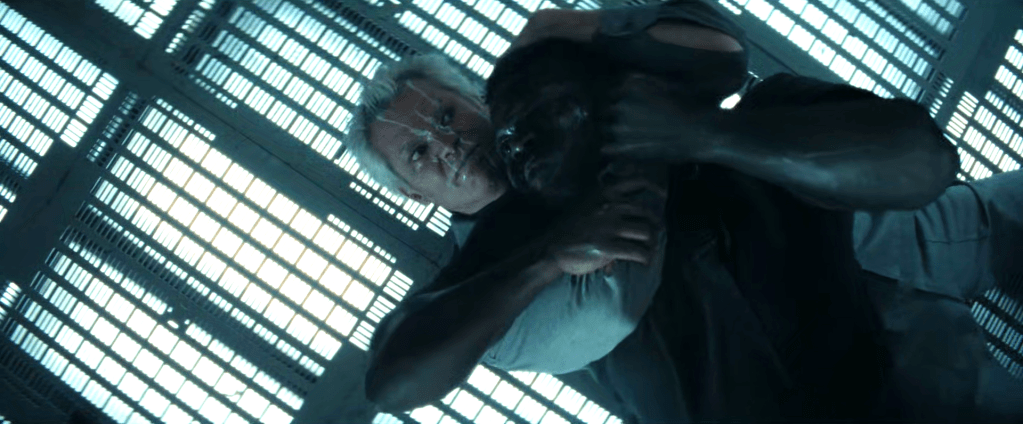
Morrow and Kirsh get their expected showdown, which seemingly ends in a draw until Wendy strides in to take control. I must admit, I’m still none the wiser as to what Kirsh’s motivations actually are, but at least he’s consistent in hating Morrow; just as Morrow hates him. Given that this finale far from concludes the story, perhaps that relationship will be further explored next season.
We also finally get some concrete information on Adrain Edmondson’s enigmatic corporate psycho Atom Eins – and it turns out he’s been a Synth the whole time. I didn’t actually see that one coming, so it’s a well-played twist; I’d actually expected him to try to infect some poor sod with the Ocellus creature, and end up infected himself, in a kind of poetic justice. Of course we now know that he can’t get infected, but he’d definitely be at risk from the metal eating flies.

Though he does try to infect an unsuspecting human, and it’s hardly a surprise that it’s Joe. Joe’s relationship with his now synthetic little sister has been the dramatic constant throughout, so it’s little surprise that, after a tense chase around the room, she rescues him from the insistent Ocellus, disabling Eins with a wave (it’s a nice touch that the immobile Synth’s eyes still keep moving).
But after last week, their relationship is more than a little broken, leading to some intense scenes between Alex Lawther and Sydney Chandler as he attempts to reassure her that he hasn’t sold her out. It’s a measure of the show’s ambiguity that this makes you wonder whether he wants to mend fences out of genuine affection – or out of fear. After all, he saw what the Hybrids could do when Nibs tore his military comrades apart last week, and he knows Wendy has an Alien at her beck and call; now he knows that she can effectively control any electronic device, including artificial people and weapons. If he is scared, maybe he’s right to be.

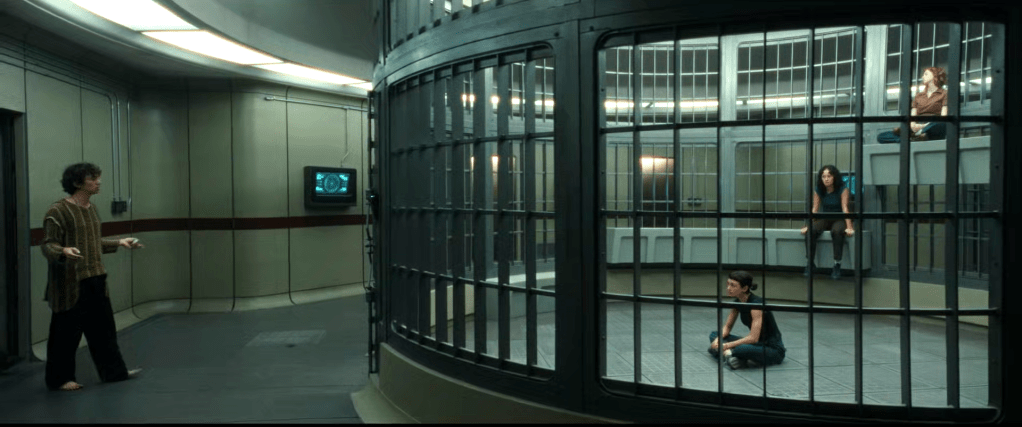
Because that’s where we leave things for this season – with all the nasty humans (and their Synth and Cyborg friends replacing the Lost Boys in the cage, with Wendy and co looking triumphant. And Joe looking distinctly queasy. And the audience is left wondering just what Wendy’s going to do next. Have the Hybrids become the real monsters?
I must say, while it’s a satisfying (sort of) conclusion to the season, it’s not exactly a surprising one. In part, that’s very much due to it treading virtually identical ground to WestWorld, just in the Alien universe rather than an amusement park. The themes are still interesting however many times they’ve been done before, of course; but as an ending, it did feel rather familiar.

And the other problem for me is that it isn’t an ending. I knew the show had a second season greenlit, of course, but I’d hoped that this first season would have been written before that was confirmed, providing a proper end to the story if it wasn’t renewed, with a few loose ends to advance if it was. Instead, we do get a nice cliffhanger, but no sense of a conclusion. Your mileage may vary as to how satisfying that is.
Still, even if I wasn’t thrilled by the ending, it’s been, for the most part, an imaginative and successful attempt to flesh out the Alien universe for long form TV. Even with its preoccupation with artificial life, it’s never failed to serve up some Xenomorph action, and even provided us with some new beasties. The Ocellus, balefully glaring at us from a sheep and now transplanted into the walking corpse of Arthur Sylvia, is the undoubted star, while the familiar Alien has perhaps been less well-served by some unflinching shots of it in broad daylight which reduced its menace and made it look rather more like a man in a suit. Nonetheless, it’s never been less than interesting, and I’ll certainly be back for the second season.

 Simon’s Incoherent Blog