Doctor Who: Series 7, Episode 6–The Snowmen

“Over a thousand years saving the universe, I have learned one thing… the universe doesn’t care.”

doctor-who-christmas-special-2012-snowmen-poster

This blog review is a little later than usual, and there are several reasons for that. I’ve had a terrible cold, I overdid the Christmas festivities, yada, yada, yada. But the main reason is that, contrary to my usual practice of recording my first impressions of a show as soon as I’ve seen it, I wanted to watch this one again. Because the first time I watched it, I found it overcomplex, convoluted and lacking in internal logic, despite its many charms. I came out of it with a lot of questions, but found that my friends on the internet (well, most of them) had a far better impression of it than I did. So I resolved to watch it again, to see if there was something I’d missed.

And do you know what? There was. Most of what I’d seen as plot holes are actually covered in Steven Moffat’s cleverly constructed but busy script; the problem (well, mine anyway) was that the breakneck speed with which they had to be addressed meant I missed more than a few in my post-Christmas dinner torpor. That, of course, is my own fault – but I can hardly have been the only one watching in such a frame of mind, given the time slot. For a Christmas romp, this had a surprisingly complex, layered plot, requiring real attention to be paid. In that, it felt remarkably similar to the also-crowded A Good Man Goes to War – but this at least was somewhat more coherent for all its complexity.

So, it was another trip to Victorian England for this year’s Doctor Who Christmas episode – yes, I know A Christmas Carol was really set on a futuristic planet, but it was a futuristic planet that had for some reason modelled itself on Victorian England. This seems to be a preoccupation for Steven Moffat, that Christmas stories are best set in the past. It’s a preconception we can probably blame on Charles Dickens, and there’d be a good essay to be written on the comprehensive domination of Christmas his classic tale has come to exert – well, if Mark Gatiss hadn’t already written it with The Unquiet Dead.

In keeping with most Christmas TV visualisations of Dickens, this was a somewhat sanitised version of the late Victorian period; nary a workhouse, an opium den or a murdered prostitute to be seen. No, this was the Victorian era of classic children’s fantasy, and it was from this that Moffat had clearly drawn most inspiration. The Doctor’s hermitage, his TARDIS parked atop a cloud reached via a magical invisible staircase from a London park, was very much the stuff of John Masefield, E Nesbit or JM Barrie (though the scene of Clara shouting his name at thin air may well have owed a debt to Star Trek IV).

Clara’s position as kindly, wisdom-dispensing governess to an emotionally dysfunctional motherless family meant she might as well have been called Mary Poppins, and the clever inversion of cosy Christmas favourite The Snowman into an army of growling, fanged monsters nonetheless keeps us squarely in the realm of fairytale. Doctor Who has never been exactly what you’d call scientifically accurate, but even under Russell T Davies reign of deus ex machina, it at least tried to maintain that impression; with this more than ever, it’s clear that Moffat thinks of it as fantasy, perhaps even classic myth.

Personally, I don’t have too much of a problem with that (though judging from the internet, there’s plenty that do). But this story had a hell of a lot to pack in while still serving as a jolly Christmas romp. For the first time, it comes in the middle of a series run; and not only does it have to bridge that gap, it also has to introduce a new companion – well, sort of – and set up a new ongoing mystery while dropping hints about the ones already ongoing.

To do all that, while packing in returns from fan favourite characters, setting up an origin story for a classic villain, dealing with the grief-stricken Doctor’s apparent retirement and telling an exciting tale all within the space of an hour was a pretty tall order. No wonder some explanations went by so closely I needed a second viewing to catch them.

WhoVastra

It did have all the hallmark Moffat strengths along with the weaknesses – primarily that gift for great characters, witty dialogue and imaginative concepts. Silurian detective Madame Vastra and her human wife Jenny were great creations in their first appearance and their return was most welcome. The obvious inversion to Moffat’s beloved Sherlock Holmes was cleverly lampshaded by villain Dr Simeon sneering that “Dr Doyle” had obviously based his creations on them (far from the only Holmes reference in a script written by the showrunner of Sherlock).

It was good to see comedy Sontaran Strax back for another go too. Played for even broader laughs here than before, Dan Starkey milked every one with perfect comic timing in the surreal juxtaposition of a militaristic clone race playing courteous Victorian manservant, albeit one with an unhealthy obsession for grenades. “Do not try to escape or you will be obliterated! May I take your coat?” It felt like another nod to a classic Who juxtaposition – neanderthal butler Nimrod from Victoriana-obsessed Ghost Light, a show whose themes were also echoed here more than once.

ScreenShot010

But if those supporting characters were richly drawn, you couldn’t really say the same for the villainous Dr Simeon. Richard E Grant looked marvellously cadaverous in the role, and gave an appropriately cold performance. But there was no real sense of depth or history to Simeon; it was as if he’d grown from a child to an adult without his personality ever changing, which seemed unlikely. Of course that could be down to Dickens again, that same odd lack of development being what blights the character of Ebenezer Scrooge. But Scrooge at least has the possibility of redemption when shown the error of his ways. Simeon, whose fault everything turns out to be, learns no such lesson – a surprisingly cynical outlook for a Christmas story.

In fact, given that his inadvertent mental creation the Great Intelligence outlives him, and continues to mirror his misanthropy for decades, Simeon must have no redeeming features at all. Working in an origin story for a classic series villain from the 60s, though, that was audacious – particularly given the need to make the story accessible to the great majority of viewers whose knowledge of 1967 Doctor Who is rather less than the average fanboy’s.

The script just about pulled it off. Ian McKellen’s brilliantly mellifluous tones lent the Intelligence a suitable air of menace, and the references to the events of The Abominable Snowmen and The Web of Fear, while fairly glaring to the fan, were unlikely to alienate the casual viewer. By the end, though, it did feel a bit like it was being hammered home somewhat with that graveside exchange: “It’s hard to see much danger from a disembodies Intelligence who wants to invade the world with snowmen.” “Or who thinks the London Underground is a strategic weakness.” Yes, thank you Mr Moffat, the fans have picked up on it now – though they may be less merciful about the implication that The Web of Fear was set in the year it was broadcast, or that the Intelligence has only existed since 1892 when Padhmasambhva claims to have been possessed for centuries in The Abominable Snowmen.

Still, while there’s no pleasing some fans, hopefully plenty more will have been delighted that Moffat resurrected one of Douglas Adams’ ideas from his tenure as script editor in the 70s – the idea that the Doctor, finally having had enough of the whole universe-saving business, has packed it all in in a fit of pique. There was no better place to fit that than here, after the trauma of just losing the show’s longest-running companions since it returned; the Doctor usually seems to get over such shocks fairly quickly, and it felt right that this time he should properly get a chance to mope.

And mope he did, with Matt Smith giving another sensational performance as a closed-off Time Lord gradually being drawn back into the world. The implication was that he might have been sulking on top of his cloud for quite some time, certainly since just after the events of The Angels Take Manhattan.

Again as with A Good Man Goes to War, it took his friends to make him come to his senses; to make him realise that he can’t repress his basic nature of curiosity, fairness, and kindness. The thing he most has in common with Sherlock Holmes is that neither can abide an unsolved mystery, but the Doctor also has a more obviously caring side. Smith’s performance, as he gradually came out of his shell with the realisation that those things are an innate part of him, was excellent – particularly the realisation that he’d unconsciously gone back to wearing his bow tie. It was a complex, affecting performance that still kept hold of the character’s sense of fun.

And there was still plenty of fun – this was a Christmas episode after all. The most obvious laughs came from Strax, though the Doctor’s inept version of Sherlock Holmes was both funny and clever – pretending to be stupid while actually being the cleverest person in the room is very Doctor-ish. The dialogue too was typically Moffat-witty; which is to say, wittier than anyone could ever be in real life, but as witty as we wish we all were. And even the broad comedy sketch involving Strax and the ‘memory worm’ (which had me laughing out loud) served a proper dramatic purpose in setting up the resolution of the plot. This wasn’t gratuitous laughs, but humour that arose from, and served, a cleverly constructed story.

But the most important thing for this story – and a burden a Christmas episode has never previously had to shoulder – was to set up numerous things for the future. Happily, for me anyway, all of them worked rather well. There’s a new title sequence, which looks for all the world like a computer generated version of the chemical splodges that formed the openings of the 60s Dalek films, and best of all it (finally!) has the Doctor’s face in it. Not sure about zooming in to the TARDIS doors opening onto the action, but generally, thumbs up from me.

WhoTitles

It’s accompanied by Murray Gold’s umpteenth rearrangement of the theme tune, which I have to say I like better than the last one; though I thought he got it pretty much right back in 2005, and find it annoying that he feels the need to change the arrangement every two years or so. After all, the classic version (from which Gold used to draw a lot the elements) lasted for 17 years with very minimal changes. Still, as I say, I think this is an improvement.

WhoConsole

Then there’s that much-publicised revamp of the console room. As with the arrangement of the theme tune, it feels like it’s getting revamped more frequently than is necessary, with the Eccleston/Tennant one having lasted four or five years, and the last one only managing two. But, if it had to be revamped, I do like the design. It feels more reminiscent of the classic 80s one (if it had been more subtly lit), all muted cream colours for the console with pseudo-roundels on the wall. In keeping with the Doctor’s sombre mood, it’s quite darkly lit, though that may change I suppose. And that doobry in the roof that rotates in multiple directions is pretty cool.

WhoNewCostume

The Doctor has a new costume too, which I have less of a problem with; it wasn’t till John Nathan-Turner’s reign in the 80s that the costume became such a uniform, and before that, Pertwee and Tom Baker wore many variations on their basic looks. Matt Smith’s Victorian look here seems to be just for this one story; I’m not sure he could permanently pull off that battered topper. But from the ‘Coming Soon’ trailer, it looks like he’s acquired a waistcoat as part of his ensemble, and to the dismay of cosplayers who thought they’d got the costume finalised, he’s changed his jacket for something darker.

WhoClara

The last new item is the most important – and almost certainly the one that’s going to provoke the most debate. We get to meet the companion – and so does the Doctor. Sort of. Just like Amy, Clara (or Oswin) is plainly more than just an ordinary young lady. Both are impossibly glamorous, witty, and resourceful, things which appeal to this Doctor (and obviously Steven Moffat) a great deal. Clara leads a double life as occasional Cockney barmaid and prim (but kindly) governess, for which little explanation is given (yet), and spends a great deal of the episode being subjected to intelligence tests.

The ‘one word answer’ interrogation by Vastra is cleverly scripted, and reveals more Moffat preoccupations (when asked to give one word to explain the Doctor’s epic sulk, Clara simply replies, “man”). The Doctor’s setup with the umbrella, leading Clara on to his plan to deal with the ice creature, was less subtle; but we’d already seen just how smart Clara was when she figured out immediately how the telepathic snow might link with a child’s dreams of a cruel woman frozen to death in a pond.

But how coincidental was her use of the word ‘pond’ to lure the Doctor into action? Because. quite contrary to set up expectations thorughout, Clara/Oswin died. Again. No wonder the Doctor’s so keen on her, she must remind him of Rory. But he belatedly realised, as she repeated her last words from Asylum of the Daleks, that this was the ‘souffle girl’ he’d already met once, centuries in the future (at least by voice, anyway). As he realises he’s already met two versions of the same girl, he’s straight off to find the next one – “perhaps the universe makes bargains after all.” Though I was a bit disappointed that the next version is another 21st century contemporary girl – I liked the idea of a woman from the past as a companion. Unless we’re going to be meeting a new Clara every week?

So what’s the explanation for Clara/Oswin (and which name will we eventually know her by)? Clearly this is going to be a major plot point for the rest of this series, which will come as something of a relief from various people portentously intoning “Doctor who?” at us. The internet’s already abuzz (as internets are wont to be) with speculation. Is she a Jagaroth, splintered through time like in City of Death (unlikely, as that was caused by a particular event and not a characteristic innate to the species)? Is she a descendant of her own previous/later character, like Gwen out of Torchwood?

For my money, knowing Mr Moffat, the answer to her mystery will be inextricably linked with the one he’s set up for the Doctor – perhaps she’s been fractured through time by something the Doctor’s will do in the future. Or is that too timey-wimey? Whichever, Jenna-Louise Coleman was again winning in the role, even if I’m less susceptible to her glamour than other, more heterosexual men.

On a second viewing then, this was less disappointing than I initially thought. But I stick to my contention that it tried to bite off more than it could chew in cramming in so many disparate complex elements into one hour long fluffy Christmas special. Yes, it was enjoyable; it had great characters, witty dialogue, imaginative concepts, and such quickfire direction that it was difficult to spot the leaps in logic. But it also had the terrifically corny and sentimental line that the only thing that could stop the telepathic snow was “a whole family crying together on Christmas Eve. It was fun but complicated, childish yet sophisticated, tricksy yet somewhat less than the sum of its parts. A  Steven Moffat story, in other words…

Doctor Who: Series 7, Episode 5–The Angels Take Manhattan

“I always tear out the last page of books. That way I don’t have to know the ending. I hate endings.”

Doctor_Who_Angels_Take_Manhattan

New York, New York. So good they named it twice. The Big Apple. The city that never sleeps. The city that… well, wasn’t strictly integral to the plot of this emotional farewell to the Ponds (finally given the name of ‘Williams’ as a last courtesy to Rory). Don’t get me wrong, the location work, by the talented Nick Hurran, was exceptional, moody and atmospheric. But really, this story could have played out anywhere. New York was just the icing on the cake. Since I’m on the topic, shame they didn’t consider Los Angeles; given the monsters involved, that might have been somewhat appropriate.
But then, it wouldn’t have had that gimmicky title, reminiscent of countless Hollywood classics (ironically enough), but most of all, for me anyway, the masterpiece Muppets Take Manhattan. Though this did manage to be scarier than that – just. I’m not sure whether I’d rather face a Weeping Angel or an enraged Miss Piggy.

Indeed, gimmicks seemed at play a lot here. As I theorised a while ago (see last week), the temptation to have the Statue of Liberty be a Weeping Angel was just too good to pass up (perhaps Mr Moffat is gambling that nobody remembers Ghostbusters II). It did look great, looming over that rooftop with a snarling mouth full of fangs, but the spectacle did require some equally spectacular leaps in logic. For a start, given its illuminated location in the middle of New York Harbor, it would have to be quite lucky to be unobserved enough to move when it needed to. And when it did, did nobody notice it had gone? It was hanging around that rooftop for quite a while!

There were leaps in logic aplenty here, both within the episode itself and as part of the larger story of Amy and Rory that started back in The Eleventh Hour. When did the future Ponds arrive to wave at themselves during The Hungry Earth? What was the real explanation for Amy’s excessively large house? Why did she not remember big events like Dalek invasions? And if we were never going to get answers to all these things, why have the Doctor continually drop hints about them?

Still, if there’s one hallmark of what I guess we must now call ‘the Moffat era’, it’s temporal paradoxes. Time has been rewritten so much over the last couple of series (not to mention rebooting the entire universe based exclusively on Amy’s memories) that it can be used as a way to paper over such inconsistencies. I don’t much care for that rationalisation though – it smacks of a post facto way to excuse loose plot threads.

Given Moffat’s fondness for rewriting timelines, it seemed a matter of convenience here that suddenly the Doctor was unable (or unwilling?) to change futures he’d seen or knew about. He’s managed to rewrite time plenty before (see Day of the Daleks for an obvious example), to the extent that Russell T Davies had to invent the concept of ‘fixed points in time’ to justify why he sometimes couldn’t. But that principle has always been flexible to fit narrative continuity; that’s why the Fifth Doctor couldn’t just nip back to that freighter and rescue Adric (thankfully).

I can understand why, reading the above, you might think I didn’t enjoy this episode. But actually I did, to the extent that I was prepared to (just about) forgive it those staggering leaps in logic. After all, they’re mostly the ones that only fanboys like me were going to spot. I’d guess that, for most viewers, the biggest concern was the final farewell of Amy and Rory.

In this, the script was clever, playful and tricksy. It had been well-publicised that they were leaving, so  I’m guessing it was written with the assumption the viewer would know they were leaving, making the suspense depend on how it was going to happen. Would they decide to stop travelling with the Doctor (after last week’s affirmations)? Would they be killed? Would they simply die of old age?

Moffat’s script cunningly played with all these expectations, ultimately managing to make the Ponds’ fate a combination of all these things with, bizarrely, still managing to live happily ever after. That might seem like trying to have your cake and eat it to some, but actually that element of the script hung together just fine. After wiping out the Angels HQ by dying twice (in one episode – a fitting farewell for Rory), Rory then got zapped back to the past. Amy chose to follow him, to be with the man she truly loved. They both lived happily ever after, in the past, unable to return. Then died of old age, leaving a Manhattan gravestone and a message for the Doctor. And as I said, all that at least made sense, and actually managed to prove just about everyone’s speculations right in one way or another.

The script was actually masterful at misdirection from the very start, introducing a Raymond Chandler-style PI who seemed to be narrating the story, then got zapped back in time by the Angels after witnessing his own death as an old man. It was good to see the Angels back to their original USP of sending people irretrievably to the past and feeding on the time energy thus produced; gripping though their last appearance was, it never seemed consistent with what we knew that they were suddenly dispatching their victims by snapping their necks.

As it turned out, most of the episode ended up being set in that film noir era of 1938, to which Rory had been zapped while off getting a coffee for Amy and the Doctor. That gave the director, set designers and costume designers the chance to have a field day with noir conventions, into which the Angels fitted surprisingly well. True, the ‘McGuffin’ of having one Angel in the custody of acquisitive crime lord Grayle (nice to see Mike McShane) neither made sense nor was followed up on after the gang escaped; but that’s the sort of window dressing so frequently used by Chandler, who confessed that even he didn’t know who’d committed one of the murders in the 1946 adaptation of The Big Sleep.

But really, all the twists, turns, moody lighting and misdirection were all to get Amy and Rory to the roof of that building, and the point of both choice and affirmation that, finally, they were more important to each other than the Doctor was to them. Rory’s plan did (just about) make sense, based on what the Doctor had already told him – avert the death of his elderly self by dying now, and (for wibbly, wobbly reasons) the resultant paradox would cancel out everything the Angels had done, leaving him alive again.

When it comes to standing on a ledge about to jump, though, it’s a leap of faith. It was the first of a number of points in the story where you thought Rory in particular was going for good. The scene was beautifully played by Karen Gillan and Arthur Darvill, who by now must feel like they know the characters inside out; and when they both jumped (to the Doctor’s anguish) it felt like that must be the end for them, slo-mo, heartfelt Murray Gold music and all.

But no, they woke up back in that graveyard, sitting bolt upright like Captain Jack returning to life. And all looked rosy until Rory noticed that gravestone – given the themes of the episode, perhaps he’d have been all right if he hadn’t seen it. His sudden instant disappearance at the hands of a lone surviving Angel was the last we’ll ever see of him, and that felt like a bit of a cheat. It did explain why the script had already given him two emotional death scenes this week, but ultimately just disappearing – that didn’t feel right, somehow.

Thankfully, Amy got a truly heartwrenching farewell, as she made the near-impossible choice to leave the Doctor, to leave her daughter, and even to leave the here and now irrevocably behind, to be with the man she loved. That scene, for me, was actually quite difficult to watch – given the genuine offscreen chemistry oft displayed by Karen Gillan and Matt Smith, their emotions seemed to transcend mere acting.

It was the little coda that really got me, though, as the Doctor realised that the handy “River Song, Private Eye” book referred to throughout must have been published by Amy herself, and would have an afterword. So it proved, and as Karen Gillan’s voiceover reminded us of everything Amy’s done and seen over this last three years, it was hard not to tear up.

So, the Doctor’s lost his best friends, for the first time in this regeneration. How will he cope? “Don’t travel alone,” was Amy’s sage advice – we all know what happens when nobody’s there to stop him. It might have been fun if River had accepted his offer to travel with him for a bit – Alex Kingston was on good form this week, balancing the scenery-chewing with moments of genuine pathos and emotion. She also looked surprisingly good in a trenchcoat and fedora, though I would have expected 1938 eyebrows to be raised at a woman dressed like that!

However, I’ve had my complaints over these last few years that River’s ubiquity and dominating presence seemed to be turning the Doctor into a supporting character in his own show, so having her around all the time might not be a good idea. Besides it would be hard to square with what we know of her character’s future. She’s already been paroled from prison and gained her professorship – because the Doctor’s been wiping out everyone’s records of him, not just the Daleks. Lucky for UNIT last week that he left their database alone.

Farewell then, Amy and Rory. I know they’ve not been to everyone’s taste; some friends of mine have been less than keen (putting it mildly) on Amy’s character or Karen Gillan’s realisation of it. But I’ve enjoyed them both. I think Gillan did have to grow into her character more than Arthur Darvill did (he seemed to have it nailed right away), but Amy ended up being far more interesting than she first appeared.

Whatever your opinion of Moffat’s stewardship of the show, you have to concede he’s tried doing something really different with these companions – having them flit in and out of the Doctor’s life but never really leave, while they aged in real life between his visits. And let’s not forget that they ended up being the parents of the Doctor’s wife!

And now they’re gone, after a longer continuous period on the show than any companions since its return. Christmas will explain how the Doctor manages to pick up the girl he’s already seen converted into a Dalek then blown to bits. Well, it might explain; with Moffat, you can never be too sure.

For now, this was an emotional episode that frustrated as well as entertained. Ten out of ten for Amy’s farewell, only five out of ten for Rory’s. Brilliantly atmospheric, but often didn’t make sense if you stopped to think about it. Mind you, doesn’t that just sum up Moffat’s style in one sentence?

Doctor Who: Series 7, Episode 4–The Power of Three

“Every time we flew away with the Doctor, we became a part of his life. But he never stayed still long enough to become a part of ours. Except once. The year of the slow invasion – the time the Doctor came to stay.”

Doctor_Who_The_Power_of_Three

Bit late reviewing Doctor Who this week – ironically because I was at a Doctor Who convention all weekend, without my laptop. Regenerations in Swansea (for that was its name) was a lot of fun involving far too much drink. At one point I found myself clutching a pint glass of white wine, sitting behind Sir Derek Jacobi while Sylvester McCoy sang Tainted Love.

It also meant that we all sat and watched a Doctor Who episode’s first broadcast with various ex-members of the cast. In front of me was Richard Franklin (Captain Mike Yates) and a couple of seats down was John Levene (Sergeant Benton), both of whom were delighted to hear that UNIT were back this week. At one point I tried to take a picture of my friend Mette sitting next to me, but the camera-hungry Levene instantly photobombed me:

091

Thankfully, he wasn’t singing songs from his recently released album, which only one of my friends was insane enough to buy!

Lots of fun then, but what of the episode itself? Of all these standalone movie-type eps so far, this was the hardest to categorise in a single sentence. Part domestic comedy, part imaginative alien invasion, it had humour, surrealism, drama and some real character insight mixed in to very good effect. And it was written by Chris Chibnall! After enjoying the light romp that was Dinosaurs on a Spaceship, it was yet another revelation that he could write something with so much empathy and emotion, still humorous but with real pathos and drama too. I think I may have to start re-evaluating him…

The episode’s main USP was to reverse the recent trend of “Ponds hang out with the Doctor” to “the Doctor hangs out with the Ponds”. We’ve been here before of course, with 2010’s The Lodger showing the bizarre consequences of having the Doctor in an everyday domestic setting, but this had the heightened drama/humour that it was with his own companions. Imagine if Pertwee’s Doctor had had to hang around Jo Grant’s flat for a year while she did the washing up.

With the perspective of the story refreshingly told from the Ponds’ point of view, we got a glimpse at what their double life was like, working and doing the housework punctuated by occasional visits from a bizarre alien who would whisk them away at a moment’s notice. So we got to see Amy and Rory’s “real life” established – clearing out the fridge, doing the washing up, emptying the bins – until the sudden appearance of millions of mysterious cubes brought the Doctor back. And when the cubes singularly failed to do anything, he decided to stay.

Unlike Craig in The Lodger, Amy and Rory know full well who/what the Doctor is. With no need for subterfuge, he could be as mad and eccentric as always – and this certainly was a vintage week for Matt Smith, who got to show his versatility far more than in recent episodes, switching from madcap to serious to sad at the drop of a hat. The montage of him trying to ‘keep busy’ was very much in the zany/comic tone of Dinosaurs on a Spaceship (capped with the inevitable “How long have I been gone?” “About an hour”). We saw the Doctor playing on the Wii, and practising his football skills (Matt Smith still seems pretty good), and watching The Apprentice while eating fish fingers and custard.

But there were also magical scenes like the one on the roof of the Tower of London, which spelled out explicitly the ongoing theme of his most unconventional relationship with his current companions. It’s been ten years now for Amy and Rory; ten years in which she has (thankfully) gone from being a fashion model to a travel writer, and he has become a respected nurse about to go full time. The Doctor knows it can’t last forever, this double life, and as he and Amy open their hearts to each other, it’s another genuinely tear-jerking scene; “I’m running to you and Rory before you fade from me.”

Hard to believe that Chris Chibnall, previously so enamoured of dialogue that seemed cribbed from cheap porn, could write such a moving exchange. And the earlier one, with incoming UNIT chief Kate Stewart, as he realised who her father must be, was a beautiful tribute to Nick Courtney’s Brigadier Lethbridge-Stewart. Jemma Redgrave as Kate was marvellous, with her brisk, scientific attitude and dry sense of humour (“I’ve got officers trained in beheading. Oh, and ravens of death.”) I really hope we get to see her again in later episodes.

UNIT and the Brigadier weren’t the only fanboy references here, as we also got a mention of the Zygons and their shapeshifting abilities during the other montage, as the Doctor whisked Amy and Rory off on a time tour for their anniversary. Lovely to see Rory reciprocating the Doctor’s kiss to him a couple of episodes ago, and for those annoyed by Amy’s ever-short skirts, there was a droolworthy shot of him in his pants.(I’m sure there’s plenty of slash fiction already).

RoryPants

They’re available from Topman, should you want them – I’m heading out to buy some in a while…

The tone shifted again from comedy to pathos as they returned to the party seven weeks later (from their perspective), and the Doctor had to tell Brian what happened to all his other companions.

Yes, Brian was back, played again by the marvellous Mark Williams. After, Russell T Davies’ trend of every companion being accompanied by a large brawling family, you can see why Steven Moffat resisted dragging another family member in till now, but Mark is so good in the part that he’s irresistible. The point has been made that he’s basically similar to Bernard Cribbins’ Wilf, but that’s a recommendation in my view. And like Wilf with Donna, he actually wants Amy and Rory to travel with the Doctor – “It’s you they can’t give up, Doctor. And I don’t think they should.” – even after hearing about the fates of some of his previous fellow travellers. After the reactions of Rose’s and Martha’s mothers, that’s a refreshing change.

In previous character-driven stories like this, the ‘standard Doctor Who plot’ is usually grafted on as a McGuffin, and is pretty unimaginative as a result (think School Reunion). But here, the “slow invasion” was a genuinely intriguing and weird premise, laced with humour – I loved the cube that played the Birdie Song on an endless loop. The identical, cube-mouthed orderlies kidnapping patients from Rory’s hospital were spooky in a Sapphire and Steel mould, as was the creepy little girl droid – you can’t go wrong with a creepy little girl. A dimensional portal in a goods lift was a nice touch, as was the casting of the always-intimidating Steven Berkoff as the Shakri’s holographic messenger. I know at least one four-year-old in our audience got the willies scared out of him by that.

Despite taking place over the course of a year, this was another frantically-paced episode.  You can see why Moffat wanted to place the slower-paced Town Called Mercy in between this and Dinosaurs on a Spaceship, just to give the audience a breather. Unfortunately the breathless pace was probably the reason for the episode’s biggest logical flaw – its resolution.

Even if the Shakri didn’t recognise the Doctor as a Time Lord, he clearly knew all about their technology, so why give him the run of the ship, allowing him to reprogramme the cubes and blow the place up? It seemed a bit of a return to the old deus ex machina endings of the RTD era, a shame for an episode that was so good in so many other regards. That frenetic pace meant a general lack of exposition; I can forgive not being told exactly what the orderlies were for, why they were kidnapping people, or why the cubes clearly displayed a worrying looking countdown in conveniently recognisable numerals. But that resolution (or lack of it) stuck out like a sore thumb. Still, it’s nothing like the logical flaw in Chibnall’s 42, where the button to retrieve the escape pod was on the outside of the spaceship (however good he gets, I’m never going to forgive him for that).

Leaps of logic aside though, this was another enjoyable episode from Chibnall (I previously assumed that typing those words must be a harbinger of the apocalypse), which addressed the ongoing theme of the Ponds and the Doctor ultimately drifting apart directly for the first time. These may be standalone episodes, but there are still clear threads running through them. I wonder if we’ll see any follow up to the Shakri’s talk of “the Tally”, which the Doctor refers to as “Judgement Day, or the Reckoning”?

It’s also been pointed out that there’s a running hint involving flickering lights – in the Dalek asylum, the bulb Brian was changing, the streetlamps in Mercy – perhaps leading in to next week’s Weeping Angel story; you certainly don’t want the lights to flicker when they’re around! I’ve also wondered (on Facebook, some days ago) whether that very large statue in New York Harbor might be something to do with the Angels (even if it is made of copper, not stone). I guess at least some of these answers will be revealed next week, as we say goodbye to the Ponds for the last time…

Doctor Who: Series 7, Episode 3–A Town Called Mercy

"“We all carry our prisons with us.  Mine is my past, yours is your morality.”

Doctor_Who_A_Town_Called_Mercy

As the mini-season of Doctor Who ‘standalone movies’ continues, this week we get the first attempt at an actual genre piece – the genre in question being the Western. The show’s tried doing one before, with questionable results in 1965’s The Gunfighters, which gave us this untrammelled musical classic from an offscreen Linda Baron (and, occasionally, Peter Purves):

The Man Who Never Would. Well, almost never.


This episode, however, directly confronts the issue of the Doctor’s morality, and how far he’s prepared to go. We needn’t be too shocked by the gun, which ultimately he declines to use. As with the best stories, he relies on his ingenuity, sending the gunslinger out after decoys to keep the town safe. And when Jex answers his own moral dilemma by blowing himself and his ship to bits, the Doctor’s prepared to see Kahler Tek as a victim as much as a villain, and entrust him with the town’s safekeeping from now on.

If the episode has a notable failing, it’s that it does seem to move quite slowly as a plot. Perhaps that’s due to the complex moral issues being debated by some well-drawn characters, but equally possibly, it’s that Leone influence again. Let’s not forget, Once Upon a Time in the West opens with a whole 15 minute sequence of gunslingers waiting for Charles Bronson’s arrival at a station in which nothing happens – and yet it’s a masterclass in building tension. A Town Called Mercy may not have time in its 45 minute runtime for that kind of operatic grandeur, but it certainly has a more measured pace than last week’s enjoyably frenetic offering.

A pretty good guest cast breathed life into Whithouse’s characteristically thoughtful dialogue (although some of the townsfolk’s American accents seemed a mite shaky). Aside from Browder’s likeable turn as Isaac, the standout was prolific character actor Adrian Scarborough, who imbued the nuanced character of Kahler Jex with pathos and likeability despite his crimes. His description of his people’s afterlife, climbing a rock carrying the souls of all those you’ve wronged, was beautifully written and delivered, giving his ultimate sacrifice a natural tear jerking quality far removed from the show’s frequent contrivance in this area.

Andrew Brooke as the gunslinger was suitably scary while also being sympathetic, not an easy trick to carry off from under all those prosthetics. Mind you, the design was very reminiscent of Red Dwarf’s simulants:

simulant_6

And the idea of a beloved British sci fi show doing a Western also recalled that show’s classic episode Gunmen of the Apocalypse. Not a bad thing necessarily, but difficult to avoid for viewers of my age!

I thought this was an excellent episode, though my love of Westerns probably makes me less than objective here. It had real depth and complexity, while there was enough classic cowboy action to keep kids entertained. There was also some more hinting about Amy and Rory’s life passing by with occasional Doctor-visits, and what may be a developing theme about the Doctor’s morality, something Steven Moffat seems to keep returning to. Overall, another bullseye at making a movie-style episode in a season which so far has been more consistently enjoyable than last year. Next week it’s back to Chris Chibnall on scripting duties, but his effort last week makes me less trepidatious about that than I might once have been…

Doctor Who: Series 7, Episode 2–Dinosaurs on a Spaceship

“The creatures aboard this ship are not objects to be sold or traded.”

Doctor_Who_Dinosaurs_on_a_Spaceship

Doctor Who does dinosaurs? Oh dear, I thought, remembering previous excursions into this territory in which the prehistoric beasties were represented by barely mobile bendy toys badly superimposed onto live action footage, surrounded by that distinctive shimmery yellow line produced by CSO. Invasion of the Dinosaurs (1974) is a good story hamstrung by its appalling effects, which only works because author Malcolm Hulke keeps the dinosaurs mostly to the background of the piece.

And now we get to see them again, in a piece by Chris Chibnall. It’s fair to say that Chibnall is far from my favourite Who writer. I found his early Torchwood scripts to be witless, po-faced and gratuitously laced with the sort of humourless sexual excess that passes for ‘adult content’ if you’re a fifteen-year-old boy, while his Who debut 42 was a disjointed, badly characterised mess so lacking in internal logic as to have a control to retrieve an escape pod located on the outside of the spaceship concerned.

Still, I always try to go into his work with an open mind, and sometimes he surprises me by producing work I really enjoy. His scripts for Life on Mars were well-characterised and enthralling, and his opener for season 2 of Torchwood actually redefined the show by giving it a sense of humour and playfulness that was noticeably lacking from its first season. And his Silurian two-parter in Matt Smith’s first year of Who, while no classic like Malcolm Hulke’s original, was a serviceable enough rework of the original 1970 concept.

With Dinosaurs on a Spaceship, it seems Chibnall is being groomed as Hulke’s New Who equivalent. Having done Silurians a couple of years ago, he now gets to include actual dinosaurs. And you know what? It was actually a lot of fun. Not only does Chibnall bring a sense of humour to the concept, but this time he actually plays the whole story very much in a humorous vein (despite its underlying seriousness). I rather like classic Who’s occasional veers into outright comedy, and this felt like the closest the new series has got to that since its return.

It helped that the dinosaurs were rather more convincing than their 70s equivalents. A mix of CG and real props, they were reminiscent of far bigger-budgeted work like the BBC’s Walking With Dinosaurs or even Jurassic Park. Of course, both of those were made some years ago, and even their pioneering CG now looks occasionally dated and unconvincing, but generally it still holds up. And the same was true here. There were one or two shots of the dinos that looked quite ropey, either as CG or props, but the success rate was far better than any bendy toy from the 70s.

Given that ridiculously hokey, Snakes on a Plane-recalling title, Chibnall seems to have turned to Jurassic Park for a lot of his inspiration. Hence, here we get a Triceratops (also one of the friendlier saurians in the Spielberg movie) playing fetch with a golf ball and licking our heroes, a T-Rex nest like the one in JP sequel The Lost World, a pterodactyl enclosure as in JP3 and an attack by several velociraptors working in threes.

Nothing wrong with that – Who’s roots have often been obvious, and nobody’s going to slag off Brain of Morbius just because it’s obviously Frankenstein. Of course, riffing on Jurassic Park does mean you fall victim to its scientific inaccuracies; it’s now generally accepted that velociraptors were probably feathered, and the species itself is actually less than half the size of the Spielberg movie beasties. But again, Who is hardly full of scientific accuracy at the best of times.

Having established a plausible level of spectacle though, the story’s true strength was in its characters, something Chibnall seems to get better at with each successive script. Matt Smith’s Doctor was at his most exuberant and childlike here with his unalloyed wonder at the prehistoric creatures, and for reasons that seemed initially unclear, had chosen to surround himself with a “gang” rather than the usual Amy/Rory combo.

This gang included characters that ranged from the broadbrush to the complex. Riann Steele gave a spirited performance as Egyptian Queen Nefertiti, the latest River Song substitute in a show that increasingly seems incomplete without at least one dominating female character with a snarky sense of humour. To be fair, her near-arrogance as a major historical figure and prominent monarch made her more distinct from River than Oswin last week though. The real Nefertiti actually did mysteriously vanish from Egyptian history in the 14th year of her husband Akhenaten’s reign, so the idea that she was whisked away to 1902 to spend her life with a Boy’s Own style big game hunter is as plausible a theory as any other (well, a bit of a stretch maybe).

Said big game hunter, the redoubtable Rupert Graves from Sherlock as John Riddell, was a bit of a caricature, part Lord John Roxton, part Allan Quatermain. But of course the visual effect of the costume, combined with his stand against the horde of velociraptors, called to mind Jurassic Park again, and Bob Peck’s cynical hunter from that movie. As the raptors approached, he almost got to mutter, “clever girl…”

And Rory’s dad got roped into the shenanigans too. Brian Williams was incarnated well by comedian-turned-national-treasure Mark Williams. Which was nice. And all-purpose rotter David Bradley (Mr Filch from Harry Potter and Walder Frey from Game of Thrones) made a believable baddie in Solomon, with his timely motivation of seeing everything only in terms of its consumerist value. With his special device that assessed the monetary value of whatever it scanned, I couldn’t help being reminded of the timeless quote about the Conservative Party – “they know the price of everything and the value of nothing”.

Which made the Doctor’s apparently callous treatment of him at the end of the story seem somewhat justified. Leaving him to the mercy of the Earth missiles might have felt a bit un-Doctorish, but the Doctor’s got form on this kind of thing. His treatment of the Family of Blood in that episode was arguably even more callous, and a fate worse than death – “we wanted to live forever. So the Doctor made sure that we would”. Remember, the Doctor can be pretty nasty sometimes. He never points the gun at the baddie and pulls the trigger, but he’s ensured the destruction of plenty of villains in the past by other means.

Besides, Solomon had admitted to actual genocide, shoving newly awakened Silurians off the ship in the manner of illegal slave traders about to be boarded in the 18th century. The involvement of the Silurians was a nice surprise, and made perfect sense of a situation (dinosaurs on a spaceship) that otherwise would take some justifying. I’m not sure about that postcard at the end though, with its attempt to retcon the historical inaccuracy of the name ‘Silurian’ by asserting that they come from somewhere called Siluria. Bit of a stretch, that one.

But perhaps the most interesting thing about the episode was its treatment of the Ponds, and its veiled hints about where their story is going. With the party separated and the Doctor eventually held captive by Solomon, we got to see Amy and Rory stepping up as actual Doctor-substitutes. It made sense of the Doctor’s apparently random gathering of the ‘gang’ – Nefertiti, Riddell, and even Brian were there as Amy and Rory’s companions. Is the Doctor grooming them as his replacements?

Also notable were the hints about the decreasing frequency of the Doctor’s visits to them. Amy complained that it had been ten months since they’d last seen him, and significantly Rory, commenting to his dad about Christmas lists, said, “I’m 31, I don’t have one”. I’m pretty sure that when we first met Rory, he was in his early 20s at most; now he’s 31. That’s a fair bit of time under the bridge – and might account for his new look, complete with greased hipster hairstyle. If the Ponds have been hanging around with the Doctor for, from their perspective, about ten years, how old will they be next time he ‘visits’? It’s a genuinely innovative thing to do with the companion characters, and allows for more actual character development than ever before.

It was one interesting idea in an episode full of them. I’m not sure what future time period this was set in, but it was nice to see the problem of near-Earth collisions being dealt with by the Indian Space Agency, with a woman in charge no less. Then there was the wave-powered Silurian ship – not sure how that would actually work, but again a nice idea (even if it was plainly shot at the same beach location used in Time of Angels). Like Let’s Kill Hitler, if this had a problem it was that there were so many interesting ideas thrown into the mix that few got properly explored. But it’s pretty churlish of me to complain about Chris Chibnall having an excess of imagination after my previous criticisms!

Bringing humour to the fore was a surprising tactic for Chibnall, but for me at least a very successful one. Yes, the gag about “Any vegetable matter in your trousers?” “Only my balls” (complete with ‘comedy’ music from Murray Gold) was difficult to forgive. As was the “you want a man with a big weapon” shot from Riddell, followed up with a face-saving remark from Amy about gender politics that was a bit cheeky from the author who gave us the immortal line “when was the last time you came so hard you forgot where you were?”

But generally, the comic tone was a refreshing change, and well-handled particularly by Matt Smith and Mark Williams. I liked the comedy robots with the completely undisguised voices of David Mitchell and Robert Webb – a little camp, perhaps, but so much more imaginative than a voice-synthesised Nick Briggs intoning that resistance is futile.

Dinosaurs on a Spaceship is unlikely to go down as a future Who classic, and it’s not free from flaws – at times Chibnall seemed to be struggling with the excess of characters and ideas, to the detriment of the script’s coherence and structure. But still, it felt like what it was – a fun, lightweight romp with just an occasional hint of darker things beneath. I gather from online reaction that opinions are very much divided, but I found it an enjoyable 45 minutes of uncomplicated fun, carried off with some gusto by all concerned.

Doctor Who: Series 7, Episode 1–Asylum of the Daleks

“You will save the Daleks!”

613x459

So, the young/old feller’s finally back, in the first of five new adventures that showrunner Steven Moffat has said will be standalone stories, each in the style of a ‘blockbuster movie’. This should please those who found last year’s convoluted, overcomplex story arc too dominant in that series, but from the looks of things Moffat still can’t resist seeding future plotlines into these ‘standalone’ stories. We open with Asylum of the Daleks – not, as I first imagined, a story of the metal meanies hiding out in the Ecuadorean embassy to avoid extradition.

So how ‘blockbuster’ was this series opener? Even apart from that stated intent, the first episode always has to be a grabber – you’ve got to hook the audience on your new run with some spectacle and a meaty story. As so often these days, this one seemed to mostly succeed, but had (for me) a few glaring flaws.

It has to be said, the flaws I perceive are generally products of the writing style Moffat employs; others may not find them so objectionable. Still others find them unbearable – I know many fans who have come to actively dislike the show under Moffat’s tenure. Fair enough, every era of the show has had its haters – who can forget fanzine headlines like “JNT Must Die!”? But still, a change in style might bring a few of those doubters back, and I wouldn’t be surprised if Asylum of the Daleks managed it. In fact, judging by the Facebook comments I’ve seen so far, some of the earnest Moffat-haters I know seem to have been swayed somewhat. Perhaps the changes are working.

There was plenty of tinkering, to be sure. For a start, the title sequence has been tinkered around with again, with a different typeface and an altered logo. Not to mention the fact that Moffat has split up the couple whose dynamic was vital to the chemistry of the TARDIS crew. Well, split them up for a bit anyway. Actually that was one of my biggest criticisms, so let’s get it out of the way early.

We’d seen from the last of the short ‘webisodes’ Pond Life that Amy and Rory’s idyllic marriage has come to an end, and that was reinforced in the (very, very long) precredits sequence as he turned up at her modelling shoot with divorce papers. Fine, I thought, one of the good things about New Who is that it actually develops its regular characters rather than leaving them likeable but static as the original show did. Bringing Amy and Rory back not as a couple, but as bickering exes who have to rediscover their relationship, would be a plot thread that could be interesting.

So it seemed a little convenient that the requisite ‘tear-jerking’ scene (© Russell T Davies) got them right back together again after a mere one episode. Yes, I know I’ve been harping on about my preference for standalone storylines, but it felt like an artificially manufactured crisis. It did at least provide some payoff for those like me who found Amy’s lack of concern over her kidnapped child last year somewhat unlikely. And it was sweet that each of them had pushed the other away rather than confront the issue that Amy can’t have children any more – and that the only one she did have was stolen from them so they never experienced actually bringing her up.

Nevertheless, it all felt too quick, too convenient, and something of a box-ticking exercise, with the result that I was left distinctly unmoved, despite some earnest teary acting from Karen Gillan and Arthur Darvill. Still, if standalone stories it is to be, I suppose I see the reasoning behind sorting it out quickly. It’s just that it felt like padding to have the plotline there at all.

Still, if that didn’t work for me, there was plenty here that did. The episode certainly had the epic feel of a blockbuster movie, with some spectacular (and well-realised) CG vistas – the giant Dalek statue amid the ruins of Skaro, the massively-populated Dalek Parliament. Not to mention some impressive location work; I don’t know where they went to film the snowy, mountainous exteriors of the Asylum planet, but it looked great. And had the presumably intentional effect of calling to mind The Empire Strikes Back, what with those Dalek eyestalks popping up out of the snow like the Imperial spy drone in that movie.

As has often been mentioned, the Daleks have become so ubiquitous of late that it’s hard to think of anything new to do with them – at least they weren’t invading Earth again. Top marks to Moffat for giving them a rest since 2010’s underwhelming Victory of the Daleks introduced the less than well-received New Dalek Paradigm. Those flabby, Austin Allegro-coloured New Daleks were to be seen here again, but as if acknowledging their unpopularity with the fans, Moffat kept them largely to the background. Instead, we were treated to the much-hyped spectacle of “every Dalek ever”.

In practice, this mostly meant the previous bronze and gold design seen from 2005 onwards. This is no bad thing – it’s an excellent redesign that keeps the basic proportions Ray Cusick designed back in 1963, unlike the flabby, unwieldy New Daleks. It was down on the Asylum planet itself that we saw some of the oldies, but the atmospherically dark lighting and general decrepitude of the Asylum’s inmates meant that you had to look pretty hard to see that any were different from recent styles. Most obvious was the Special Weapons Dalek from 1988’s Remembrance of the Daleks – lucky for the heroes that one didn’t wake up! Later on, it was a nice callout to classic Who having a room full of the survivors of Kembel, Aridius, Exxilon etc, but a bit of a fail that those ones were still the 2005 style.

And the Daleks have a Parliament and a Prime Minister now, as opposed to their previous power structure of being led by an Emperor and/or Davros. How this state of affairs came to be was not revealed, but it’s hard to imagine a Dalek democratic process – the select committees could just exterminate the likes of Rupert Murdoch. This is already causing much hilarity on Twitter under such hashtags as #tweetlikeadalekmp . For myself, I couldn’t help thinking, “so that’s what a sweeping Conservative majority would look like…”

The Daleks’ actual plan (ie the plot of the episode) didn’t really seem to hang together logically. It’s a nice idea that the Doctor’s arch enemies have something they’re so scared of that they would call their nemesis in to help them, but a Dalek Asylum? Really? I mean, how mad would you have to be to be too mad for the Daleks? None of them have ever seemed particularly well-adjusted in the first place.

As I suspected, “too mad for the Daleks” was something Moffat couldn’t quite pull off, and in sanity terms, there didn’t seem to be much to distinguish the inmates from regular Daleks. Yes, they were in the sort of disrepair I’m used to from buying secondhand cars, but that hardly gave them mental problems.

Also, if the Daleks needed the Doctor to switch off the forcefield surrounding the planet so they could bombard it from space, why couldn’t they just send a small team of their own, as the Doctor snarkily asked? And for that matter, if the forcefield was so impenetrable, how did a human spaceship manage to crash through it, with its escape pods landing intact?

Plot holes seem to be a bit of a Moffat weakness, but let’s be fair, the original series was hardly immune from them. At least the pacing was pretty good, with the initial kidnapping of the Doctor, Rory and Amy being the beginning of a mounting level of action and… well, ‘headfuckery’ is the best word I’ve heard for it. It’s something Moffat specialises in, twists that turn what you thought you were seeing completely on its head, with often impressive dramatic results.

We got that from the very start here, with the reveal that the nice lady asking for the Doctor’s help was a Dalek agent capable of extruding an eyestalk from her forehead, not to mention a gunstick from her hand. She didn’t even know that she was a Dalek ‘puppet’ – as it turned out, a vital plot point.

It happened again with the nice chap who greeted Amy and the Doctor as they popped down to the snowy wastes of the Asylum planet, who, it turned out, had died a year ago but been reanimated by Dalek ‘nanogenes’ (a word coined by Moffat in 2005’s The Doctor Dances, if memory serves). The reveal that even the dead could be reanimated as ‘puppets’ gave rise to a nicely horrific moment as the shrivelled, rotten cadavers in the escape pod came to shuffling life around the Doctor and Amy – never thought I’d see a zombie equipped with a Dalek gunstick.

But the biggest headfuck of all was reserved for Oswin, the poor young lady the Doctor had been trying to rescue all along. Her story never added up – as the Doctor kept asking, where did she get the milk for all those souffles? I began to suspect fairly early on that her perception was not reality, and her easy interface with all that Dalek technology gave the game away pretty quickly – she was, of course, a Dalek herself. And given her delusions, probably the only one we saw who genuinely could be called ‘mad’.

But it was a headfuck for we the viewers too, for Oswin was played by none other than Jenna-Louise Coleman, widely publicised as the Doctor’s new companion when Amy and Rory leave in the fifth episode. Moffat had said that the circumstances of the Doctor meeting her would be like no companion ever before; he was right there, given that she’s been converted into a Dalek then blown to smithereens along with the whole Asylum planet.

So just how will she become a companion? Presumably the Doctor will have to meet her earlier in her timestream. If so, will he have to hide the knowledge that she eventually becomes a Dalek, goes mad and dies? Will he do something clever like trying to change the outcome? If so, that would surely undo her clever bit of trickery at wiping all knowledge of the Doctor from the Dalek database.

That was a nice bit of retconning from Moffat, but I’m not sure it really adds up. It’s the same problem as the whole ‘Doctor faking his own death’ thing – it only works on a linear timeline, not with a character who can pop up anywhere in history. The Daleks aren’t going to be lulled into a false sense of security thinking the Eleventh Doctor is dead, when for all they know Patrick Troughton could pop up next week to ruin their plans.

So, have the Daleks forget the Doctor altogether; that’s one major baddie dealt with in that regard. Trouble is, that assumes that the Doctor and the Daleks always meet sequentially. In practice, the show has usually adhered to that idea. But given Moffat’s delight in using time paradoxes, it would be just as valid for the Doctor to meet up with the Daleks later at a point before they’d forgotten all about him.

Moffat’s witty, flirtatious dialogue was very much in evidence throughout, but every time Oswin dispensed a bit of flirty banter, I couldn’t help thinking, “she talks just like River Song”. Because she does; every line out of her mouth could be given to Alex Kingston’s spacetime diva, or Sherlock’s Irene Adler for that matter. A friend of mine asserts that while Moffat’s dialogue is wonderfully clever, it all actually sounds like Moffat himself, with only the actors’ performances to give it any individuality. I wouldn’t go quite that far, but certainly I’m beginning to feel like he has a special computer program to spew out similarly toned lines for his identikit strong, dominating women.

Nitpicking aside, I did enjoy this episode, even with its flaws. It moved well, there was genuine spectacle, a bit of horror, some inventive direction from Nick Hurran and it was mostly self-contained. Plainly the story of Oswin will form at least one continuing plot thread, and we kept being reminded of “the final question” as referenced by Dorium Maldovar last year. It was on the lips of the Daleks (insofar as they have lips) and later the Doctor himself – “Doctor Who?” Like so many ‘blockbuster movies’ this was a lot of fun, and its breathless pace generally stopped you from thinking too much about its logical inconsistencies, which is probably a good thing.

Doctor Who Season 5–the Facebook Marathon: Part 10

The adventure concludes!

March 12, 2011, 2.21 pm. It’s been one evening and one morning of ploughing through season 5 of Doctor Who, with a night’s sleep halfway through. Thinking about it, if I’d planned it better I could have started the previous morning and finished the same day. But no, it was all very impromptu, and I might have given up before this if not for the remote participation, via Facebook, of friends of mine from Arizona to Ireland, from Australia to Wales, from Banbury to… well, you get the idea.

NB – as before, if your name or image is on these screenshots and you’d rather it wasn’t, PM me on Facebook and I’ll edit the image. Thanks!

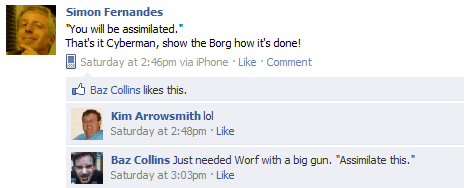
It’s the end – has the moment been prepared for? Find out as we rejoin Mr Moffat and his creations for one last dance:

Season 5, Episode 12: The Pandorica Opens

ScreenShot098.png

A precredits sequence gathers together most of the guest cast we’ve seen this year to send an impossibly convoluted message to the Doctor:

ScreenShot099.png

River’s back too, but as more than a cameo. Dealing with the conniving Dorium Maldovar (the excellent Simon Fisher-Becker), she employs a plan she must have learned by being a film buff:

ScreenShot100.png

The message having led the Doctor, Amy and River to Roman occupied Britain, they start poking about under Stonehenge. At which point they encounter an amazingly tenacious ‘dead’ Cyberman:

ScreenShot101.png

River is elucidating on the legendary being imprisoned within the Hellraiser-style Pandorica. Something about this seems a little obvious:

ScreenShot103.png

Outside, aliens of all kinds are converging on Stonehenge, seemingly intent on gaining the legendary Pandorica. Sadly, more are mentioned than are seen, but Dan has an interesting casting idea:

ScreenShot103.png

(Would she be a Drahvin or a Zygon?)

There’s a dodgy looking Roman soldier hanging around. But for some reason, the director won’t let us see his face:

ScreenShot104.png

Having not quite reattached its head, the knackered Cyberman is still gamely trying to convert Amy:

ScreenShot105.png

But – just in time – she’s saved! But… by who?

ScreenShot106.png

River has been dispatched to the present day, to search Amy’s bedroom for clues. At least that’s what the Doctor told her.

ScreenShot107.png

Having failed to find anything of interest in Amy’s bedroom (unlike my friends), River has got back in the TARDIS. Which promptly explodes. Followed, not too long after, by what appears to be the rest of the universe. Whoops.

ScreenShot108.png

And it IS a great cliffhanger. The problem being that in future seasons, it’s impossible to top the destruction of the entire universe, and modern Who just has to keep trying to outdo itself each successive year.

But I’m getting ahead of myself. Speaking of which, it’s the timey wimey conclusion:

Season 5, Episode 13: The Big Bang

ScreenShot109.png

Despite the universe going phoom, Earth is still there, and we’re back to Amy’s childhood. But things aren’t the same:

ScreenShot110.png

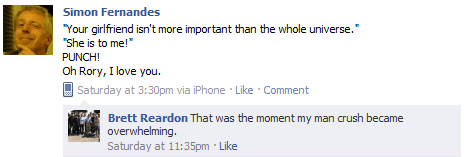
The Doctor faces up to plastic Rory as he patronisingly explains that there’s a bigger picture, receiving a thump for his pains. Brett and I approve:

ScreenShot111.png

Back (or is it forward?) in the 21st century, Amy has just let Amy out of the Pandorica using a sonic screwdriver that only exists in a time paradox? Confused? So was I, but not by that:

ScreenShot112_thumb.png

With the last remnants of the universe about to collapse, the Doctor comes up with  perhaps the most obvious solution ever:

ScreenShot113.png

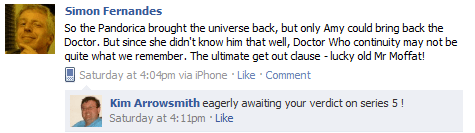
By an even more convoluted twisty turny plot, the Doctor died along with the universe, but Amy brought him back. Giving Moffat the ultimate licence that John Nathan-Turner could only have dreamed of:

ScreenShot114.png

Making a triumphant reappearance at Amy and Rory’s wedding, the Doctor wastes no time in kidnapping the happy couple for a trip in the TARDIS. But where to go for a honeymoon? The Doctor has an idea, but unfortunately we’ll never see it:

ScreenShot115.png

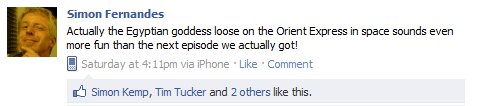
When my head stops reeling and I apply a bit of analysis, it’s time for the verdict on the finale:

ScreenShot116.png

And finally, on the whole of season 5. That provoked a bit of discussion:

ScreenShot117.pngScreenShot118.png

And so it ended. A day and a half (ish) of me in a house by myself doing a sort of online live feed from a solo Doctor Who marathon. Unusual, but it felt social – Facebook gets (rightly) criticised for a lot of things, but it’s kept me in instant touch with friends from far away in a way that would never have been possible previously. For that, I have to thank it – and all the friends who put up with/joined in my strange exploit. I’ll give the last word to me of last year. And some of my friends:

ScreenShot119.png

Until the next time…

Doctor Who Season 5–the Facebook Marathon: Part 9

The adventure continues.

March 12, 2011, 1.31 pm. After the undoubted beauty of Vincent and the Doctor, it’s time for another self-contained standalone episode. But this one is quite different in tone…

NB – as before, if your name or image is on these screenshots and you’d rather it wasn’t, PM me on Facebook and I’ll edit the image. Thanks!

We’ve had sci fi, we’ve had horror, we’ve had heartbreaking emotional drama. Now it’s time for something rather different, courtesy of writer Gareth Roberts – sitcom!

Season 5, Episode 11: The Lodger

Starting this episode involves inserting the next disc of the box set. I now know exactly how long this takes.

ScreenShot086.png

Steaming mug of tea in hand, I settle down to watch the Doctor arrive somewhere surprisingly average, and reveal an unexpected knowledge of stationery supplies:

ScreenShot087.png

Across town, beaten down everybloke Craig (James Corden playing it straight for once) is pining after his best friend. She, typically, doesn’t know anything of this:

ScreenShot088.png

Stranded and unable to find the TARDIS, the Doctor decides to move into Craig’s spare room. Thus ensues a scene establishing Smith and Corden as a comedy double act to watch out for, including what must be an intentionally risque reference to a senior clergyman:

ScreenShot089.png

I was quite enthusiastic about the comedy, but others saw it differently. And to be fair, I know Corden gets a fair bit of stick too:

ScreenShot090.png

Never one to pass up an opportunity to lust after a scantily clad young man, I was happy to see the Doctor’s shower scene. Happier than I would have been if he’d still been William Hartnell anyway:

ScreenShot092.png

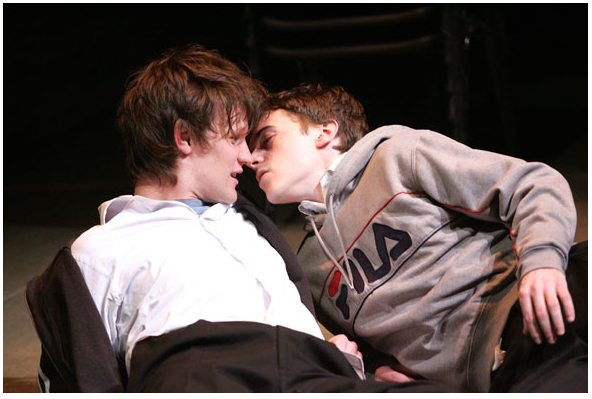
At which point Steve directed me to a picture he’d found, much to several people’s delight:

ScreenShot091.png
ScreenShot093.png

Much to Craig’s alarm, the Doctor decides to help out on his pub football team, showing the level of football knowledge achieved by most Who fans:

ScreenShot094.png

For my part, I’ve found my attention drawn to part of Craig’s decor – intentionally on the director’s part, it seems:

ScreenShot095.png

(Corden did return as Craig, but nothing ever came of the mysteriously prominent picture. Or the duck pond. Yet)

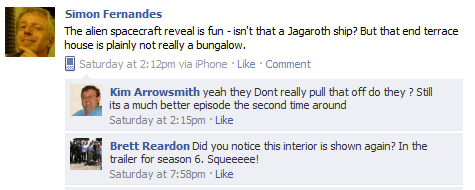
The Doctor discovers that the top floor of Craig’s house is actually a spacecraft that looks oddly familiar:

ScreenShot096.png

(Yes, the spacecraft control room was featured in season 6, as the buried Silence ship in Day of the Moon. Significant, or just a cheap reuse of an existing set?)

And the verdict:

ScreenShot097.png

Yes, the end draws near! Two more episodes, one more story, with Mr Moffat back on writing duties for the first time since episode 5. Coming up in a moment…

Doctor Who Season 5–the Facebook Marathon: Part 8

The adventure continues.

March 12, 2011, 12.38 pm. After cleaning my brain from the previous story, it’s a relief to have another self-contained, non-epic, intimate story about people. And strange invisible beasties.

NB – as before, if your name or image is on these screenshots and you’d rather it wasn’t, PM me on Facebook and I’ll edit the image. Thanks!

Having tried one guest writer, it’s time for Moffat to wheel out the big guns. Step forward, writer of the excellent Blackadder and romcoms that I can’t stand – it’s Richard Curtis with:

Season 5, Episode 10: Vincent and the Doctor

Taking Amy’s mind off Rory’s recent death (which she doesn’t remember anyway), the Doctor takes her to a Van Gogh exhibition, giving him the chance to wax lyrical in the established new series style about how bloomin’ marvellous a historical figure is. Backing him up is a surprise cameo from a beloved Brit actor whose own name was linked to the role of the Doctor a few times:

ScreenShot078

The Doctor has spotted something ‘evil’ in a Van Gogh painting, so it’s off to 1890 Provence for a word with the man himself. They find him getting drunk in a French cafe with some rather odd accents:

ScreenShot079

Van Gogh is being played (quite brilliantly) by well-known Scot Tony Curran. I cast my mind back to my earliest acquaintance with his work:

ScreenShot080

Our heroes track down the mysterious alien, only to discover it’s a wounded creature that doesn’t mean any harm. Ben spots the hammer-subtle parallel with Van Gogh himself:

ScreenShot081

Meanwhile, I’m luxuriating in the director’s skill with a camera:

ScreenShot082

Amy and the Doctor try to see the sky through the Doctor’s eyes, resulting in a magical cross fade into one of the man’s best known paintings – the one Don McLean kept going on about:

ScreenShot083

Having dealt with the alien, the Doctor tries (unwisely, as it turns out) to deal with Van Gogh’s depression. This is achieved via a trip to the future, where the tortured artist can listen to Bill Nighy unwittingly describe his genius while a mopey Athlete song plays in the background:

ScreenShot084

Still, despite the transparent emotional manipulation, I still really enjoy the story. To judge by comments throughout, I’m not the only one:

ScreenShot085

An atypical story then, but a hugely rewarding one, Curtis’ sensitive writing ably assisted by Curran’s excellent performance. I’m forced to agree with Stuart’s comment from a few episodes ago – the hit rate in this second half of the season is much more consistent!

Doctor Who Season 5–the Facebook Marathon: Part 7

The adventure continues.

March 12, 2011, 10.56 am. Amy’s Choice was as enjoyable as the first time, but now it was time to face up to my bete noire of Who writers – Chris Chibnall. Thankfully, my Facebook friends were becoming more numerous in their comments to help me through it. And as before, I’m counting this two-parter as one story, so I’ll cover both episodes here…

NB – as before, if your name or image is on these screenshots and you’d rather it wasn’t, PM me on Facebook and I’ll edit the image. Thanks!

Oh, the dilemma – one of my favourite ‘aliens’ done by my least favourite writer. Can Malcolm Hulke’s legacy survive Chris Chibnall as we delve into:

Season 5, Episode 8: The Hungry Earth

Watching this episode involves slipping the next disc of the box set into the PS3 and waiting for the menu to pop up. This takes some time.

ScreenShot060

We’re back on contemporary Earth, in a setting any Jon Pertwee fan will instantly recognise – the standard Big Scientific Project as visited in almost every story of his first season. However, the rather limited budget for sets immediately makes this look a bit more low-rent:

ScreenShot061

Informed of her location, Amy tries out her keen observational skills:

ScreenShot062

The casting of comedienne Meera Syal as the project’s director raises a few eyebrows, but the celebrity guest Who of the 80s had its odd moments too:

ScreenShot063

By this point I’ve noticed that the village where the project is located seems curiously underpopulated. My Irish and Welsh friends hasten to inform me that this is entirely accurate:

ScreenShot064

And since we’re in Wales, not even advanced technology can keep the weather out:

ScreenShot065

A Silurian appears (well, whatever they’re called now, anyway). She has some pretty cool make up, but I miss the quivering rubber of the Pertwee years:

ScreenShot066

The Doctor makes a stab at telling the Silurian when she’s from. And gets it wrong, like every other time they’ve appeared:

ScreenShot067

With this two-parter, I was pleasantly surprised enough by rewatching part one to offer a verdict on ‘the story so far’:

ScreenShot068

But like football, it’s a game of two halves, Brian. And the second half would make me wish that Malcolm Hulke was till around to substitute for Mr Chibnall:


Season 5, Episode 9: Cold Blood

The second part reveals another Silurian warrior. She looks identical to the first one apart from some red patches on her scales. This raises an interesting question:

ScreenShot069

Channelling Jon Pertwee in the first Silurian story (as does most of the script), Chibnall gets the Doctor to moralise a bit:

ScreenShot070

Meanwhile, the scary Silurian scientist has been revealed to be a nice bloke after all. So we’re supposed to just forget that he dissected that first guy while he was conscious:

ScreenShot071

The Silurian warriors are now itching for a fight with the ‘apes’, and it’s all a bit one-sided:

ScreenShot072

Peace having proved elusive, the Doctor places the burden of both species’ future co-existence onto one little boy (despite UNIT and therefore the UN being well aware of the Silurians). His advice, while well-meaning, doesn’t seem to have been thought through:

ScreenShot073

The wise old Silurian leader decides to go to sleep for another thousand years, reckoning humanity will be mature enough to deal with the situation then. But there’s something rather significant the Doctor isn’t telling him:

ScreenShot074

But Restac is vengeful, and shoots Rory, who promptly tumbles into Amy’s crack and dies. Again. This causes heartache and confusion:

ScreenShot075

Having run out of story, Chibnall blows up the project:

ScreenShot076

Leaving us free to cogitate on the quality (or lack thereof) of the story, and indeed of the season so far:

ScreenShot077

So, no consensus as to how good/bad the season is (though everyone seems on board with this particular story being rubbish). But thankfully, a civilised level of debate rather than the insane vitriol and mud slinging of most online Doctor Who forums!