What if God was one of us?

Some musings on the current uneasy relationship between religion and secular society…

religion-politics

In recent weeks, there’s been a surge of news articles which detail religion coming into conflict with states that are, nominally at least, secular.

Religion is a thorny issue for secular liberals to get their heads around. A defining factor for liberals is our insistence on tolerance and inclusivity for all, and that usually includes religious freedom. The problem comes when the religions whose freedom we’re insisting on espouse beliefs that come into direct conflict with our own philosophy of tolerance – and while it may not be true of all who follow each faith, almost every major religion has one or more group that they are actively intolerant of. Women and homosexuals tend to come top of the list, with varying degrees of intolerance directed at them notably from the mainstream of all three Abrahamic faiths. But religious dogma has been used to discriminate against other groups throughout history – and that tends to be most focused on a dislike/hatred of religious groups other than themselves.

So what do we secular, inclusive liberals do when faced with the problem of tolerance for groups who tend towards intolerance? There’s a tendency towards contorted doublethink, but it’s a hard one to address without coming across as hypocritical. At this point, it’s worth noting that objections to a religious philosophy don’t (or shouldn’t) encompass all those who follow it. I know both Christians and Muslims, and not one has a problem with either my atheism or my homosexuality. Neither do I have a problem with them having beliefs that I don’t share.

No, our objections to religion (if we have them) should be directed at religious orthodoxy – those who come up with the mainstream positions of each faith on issues that might seem reactionary in a secular, inclusive country. Even here, this is far from a clear issue. Within each major faith are any number of factions, large or small, whose feelings on such issues vary wildly. Beyond the obvious division of Christians into Catholics and Protestants, there’s a variety of smaller subsets, while Islam’s notable division into Sunni and Shiah also embraces a multitude of factions within each. Indeed, Islam is difficult to ascribe any overriding, definitive philosophy to, in the absence of a central governing body like the Anglican Synod or the Catholic Vatican.

Compounding the problem is that the lines between religious faith, culture, politics and ethnicity are extremely blurred. And if there’s anything we liberals hate, it’s racial prejudice and bigoted stereotyping. But it’s not that simple. Judaism in particular is associated with a specific ethnicity, which is to ignore the wide variety of Jewish racial and cultural characteristics. Islam tends to be associated with Arabic peoples, due to its area of origin, but encompasses huge swathes of other races in the West, Asia and Africa. Nonetheless, criticism of these religions tends to be simplified into a debate which generalises any objectors to them as racists, in a way that tends not to happen with Christianity (stereotypically, and inaccurately, viewed as a faith dominated by Caucasians).

The gold standard for this is, of course, the Holocaust, which still casts such a long shadow over history that it’s the standard reductio ad absurdum response in any debate, particularly online. Adolf Hitler, ironically, made no distinction between the boundaries of faith, culture or race in his persecution of the Jews – if you had any trace of Judaism in you, whether it be genetic or cultural, off to the camps you would go. It’s still a massively emotive historical event, as evidenced by the slightly cynical manipulation inherent in the articles by Owen Jones and Jonathan Freedland which invite you to substitute “Jew” for “Muslim” in criticism of Islam “and be shocked”. As though Judaism should, somehow, be above criticism because of its long history of pogroms and persecution.

The irony is that in reducing all criticism of religion to the accusation of racism, those commentators who most strenuously oppose interference in religion tend to be guilty of the same kind of generalisation. The current wave of articles decrying the UK’s ‘Islamophobia’ is a perfect example. There undoubtedly is an excessive media fixation on Muslims in the UK (and the US, for that matter). It’s been argued (with some validity) that Islam seems more socially acceptable to criticise than other faiths. And it is utterly ridiculous that anyone writing about Islam should be required to state their positions on the faith’s more contentious philosophies in order to be taken seriously.

But to sweep all objections to Islam into the gross generalisation of ‘Islamophobia’ is similarly bigoted. There is, I think, a wide variety of people and motives in this slew of criticism. Some, like the EDL and a disturbing number of ‘neo-Nazi’ groups in Europe, genuinely do seem to be motivated by racism, or at the very least xenophobia – the irrational fear of ‘others’ that seems hardwired into the human psyche, which civilisation strives to overcome.

Then there are those who object to all religion on principle – these tend to be militant atheists of the Richard Dawkins school, who fail to notice the irony that they are constantly proselytising for their own belief system just as much as any religion does. In fact, this kind of atheism seems blind to its own illiberal prejudices, flinging insulting terms like “sky fairy”, “invisible friend” and “childlike nonsense” at believers. I tend towards atheism myself, but I realise that it’s a belief system as much as any religious philosophy, and that we atheists would find it unacceptable for devout believers to be as insulting as we often are.

However, any religion should be able to bear criticism (in much the same way as I’ve just criticised atheists), and it’s right and fair that Islam or Judaism should not be exempted from this in secular societies. Most nominally secular Western states evolved from overtly Christian ones, and liberal commentators certainly don’t shy away from pointing out Christianity’s failings.

Islam over the last few decades has been conspicuously resistant to criticism, which ironically has probably spurred more to fixate on its perceived failings than they otherwise might have. The September 11 attacks were obviously the work of a small group of fanatical extremists (which every religion has), but even before those we had the Iranian-issued fatwa on author Salman Rushdie for his perceived blasphemy in his novel The Satanic Verses. And more recently, the admittedly childish provocation of the cartoons depicting the Prophet Muhammad in Danish newspaper Jyllands Posten resulted in a hysterical outcry from some Muslims across the world, which encompassed death threats, violence and arson. This despite the fact the proscription on depicting the Prophet is a comparatively recent ruling in Islam, and not a specific commandment in the Qu’ran but an interpretation of the general antipathy towards icons in Islam.

Islam is also the only major religion to still rule over states as actual theocracies, and where it does, the leaders’ interpretation of their faith is massively intolerant in its treatment of those old bugbears, non-believers, women and homosexuals. Saudi Arabia has policies directed at its female population that would be considered repressive and totalitarian in secular states, while Iran’s treatment (frequently execution) of homosexuals would be considered barbaric in the West (except perhaps by the Westboro Baptist Church). In Pakistan, the draconian anti-blasphemy laws (ironically derived from colonial rules established by the British) make its religion almost totalitarian in nature.

But those are sovereign states with their own cultures, and despite Tony Blair’s fervent wishes, we don’t have a moral high ground to change their practices by force. All we can do is try to influence them by other means. We should, however, resist any pressure to exempt their beliefs from the rules of our own secular societies, and firmly refute any attempt to influence the law of the land in the name of those beliefs. That goes for fundamentalist Christians too, whose virtual hijacking of the Republican Party in America is abhorrent to the freedoms espoused in its Constitution.  Anyone should be free to believe whatever they like, and to practise whatever rites their faith demands – up to and until the point where those practices have a negative impact on others.

So, I would defend to the death Cardinal O’Brien’s right to believe that I am an abomination and bound for Hell. It’s when he starts using that belief to try and influence the laws of the land that he becomes fair game for criticism. I am not ‘racist’ against Celtic Catholics for objecting. Neither am I being anti-Semitic if I object to the partially secular state of Israel’s treatment of Palestinians, nor rabidly Zionist when I assert Israel’s right to exist.

There’s a common consensus in most secular societies that religions have had to adapt to as their political power became less all-pervading. Christianity survived being told that it could no longer burn heretics, prohibit English translations of the Bible, or stone adulterers to death, and it will survive equal marriage. Islam as a philosophy seems to be adapting more slowly when in secular states, but it has adapted. There’s no reason to assume it won’t continue to do so (although trying to hurry it along can be tempting).

But what about that German ruling on infant circumcision? That’s an example of how none of this is clear cut or simple, as usual. Speaking from my own cultural perspective, it seems an act of irreversible bodily alteration carried out without consent (ie a negative impact), and should be resisted (though whether a state ban is the best way to resist it is a complex debate in itself). Muddying the waters is the fact that a great deal of infant circumcision has no religious motivation at all (notably in the US, where it’s more of a cultural norm, though this appears to be declining).

Defenders of the practice produce convincing scientific studies alluding to health and hygiene benefits, while opponents produce equally convincing studies arguing precisely the opposite. A wealth of data supporting both positions means that neither is conclusively convincing, and in the end it boils down to a question of cultural tradition. Tradition is a very hard thing to change, whether religious or not, and in the case of Judaism circumcision is so fundamentally bound up with Jewish identity that it’s virtually impossible. The statement on Abraham’s covenant with God, and its foreskin-removal requirement at the age of eight days, is pretty unequivocal.

Islamic circumcision is a more recent tradition, but still of very long standing. It does have the get out clause of not being mentioned in the Qu’ran itself, but the obligation is spelled out in Sunnah and is unlikely to find much appetite for abandonment. Christians, of course, manage to sidestep the whole issue via Christ’s New Covenant, which renders a number of Old Testament conventions obsolete.

A slightly less draconian regulation of the proposed German ban was tried in Sweden in 2001, and has had little effect on its frequency. Like all of the subjects touched on here, this is by no means a straightforward issue – what may seem a negative impact to me may seem quite the opposite to those inside a religious community. Obviously if we had deranged mohelim going around trying to circumcise the secular, that would be unacceptable. But we don’t – it’s a rite which affects Jews, and many would say positively.

And yet, we have legislated against other practices which religious communities would like to carry out internally – for example, forced marriage or female genital mutilation. Secular states have been able to do this because of an overriding consensus that these are ‘negative impacts’ (to put it mildly), a state of affairs we’ve yet to reach with circumcision, which is less demonstrably harmful. Given all of that, I’d say we need to work towards making the tradition less generally acceptable via education rather than the blunt tool of a state ban.

This lies at the heart of the problem with our acceptance (or not) of religious rites and influence on general society. These are practices which have become so deeply entrenched because of centuries, sometimes millennia, of tradition that they are rarely questioned – and yet, were they to be introduced now, many would be unfathomable and unacceptable. Obviously, this will always be the viewpoint of those outside religious communities.

The more longstanding the tradition, the less it’s questioned, hence the numerous exemptions from social rules that the Abrahamic faiths in particular benefit from. The First Amendment of the US Constitution has the balance about right – “Congress shall make no law respecting an establishment of religion, or prohibiting the free exercise thereof” – and yet the incoming President still swears the Inauguration oath with one hand on the Bible.  More recently established religions find less reverence from outsiders; Mormonism (founded in the 1820s) had to abandon its cherished practice of polygamy due to US law, and a Supreme Court ruling held that the right to “free exercise” of religion did not extend to religious practices that conflict with the law of the land.

And yet so many secular states (the UK may have an established church, but its government is nominally secular) still extend freedoms to longstanding religions that would seem distinctly peculiar if they were asked for in the present day. And in order to ensure fairness, these then have to be extended to any officially recognised religion, however bizarre it may seem (hello, Scientology).

I’d contend that in a secular society (as the US First Amendment states), we should be tolerant of religion but allow it no role in governing a populace, and further that a secular government should be able to criticise, and in some cases outlaw, traditional practices if they are judged (by majority consensus) to be unacceptable. In the UK, we should not have 26 seats in the House of Lords reserved for bishops. We should not allow religious organisations to practise outright discrimination because of their beliefs. We should not be giving state funding to faith schools whose primary raison d’etre is to perpetuate the beliefs of some of the richest organisations on Earth. And for the same reason, religious property, institutions and personnel should not be exempt from taxation (estimated to be depriving the US Treasury alone of some $71 billion a year).

Obviously I’d prefer it if everyone shared my belief system (atheism), but believers of all other stripes must feel the same, and let’s face it, it isn’t going to happen. Religions may die out – some have, over the course of history – but none of the currently prominent ones are in any danger of that. But if we are to respect them, they must respect us – and I’m not restricting that to any but ALL of them. Yes, including the Jedi.

The Newsroom: Season 1, Episode 5 – Amen

SPOILER WARNING – THIS IS FROM LAST NIGHT’S US BROADCAST, AND MAJOR PLOT POINTS ARE DISCUSSED. DON’T READ AHEAD IF YOU HAVEN’T SEEN EPISODE 5 YET.

“I’m just a middle aged man who never lived up to his potential. You don’t want to be on the wrong end of me if I ever do.”

NewsroomNealMackenzie

After last week’s character heavy episode, it should perhaps have been a relief to find the focus of this week’s The Newsroom more thoroughly on actual news. And yet, Mr Sorkin’s skill with characters means that I’ve come to enjoy the ‘soap opera’ aspects of the show too. This week, the show managed to balance that with its critique of news and politics, together with its ongoing narrative, just about right. For this viewer at least, it lurched a little too far into Sorkin’s frequent mawkish sentimentality at its climax, but the rest was strong enough for me to forgive it that.

The big news topics covered this week were as important as ever (Will McAvoy might be aware of Justin Bieber, but you’ll never see him treated as news) – the emergent Arab Spring and the aftermath of President Mubarak’s resignation in Egypt, along with Wisconsin Governor Scott Walker’s undemocratic public sector union-busting bill with the spurious justification of balancing the state budget. As we now know, neither of these stories ended well, at least if you’re of the political leaning shared by Sorkin and myself. The Egyptian people managed to topple a dictator and end up with a military junta that dissolved an uncooperative Parliament, while an attempt to recall Governor Walker recently met with defeat. As usual, the slightly unfair advantage of ACN news in being written from a year into the future allowed the show to cast a few notes of caution on both stories.

Along the way, the script, as cleverly constructed as usual, allowed for musings on journalistic integrity and courage, particularly when it comes to journalists putting themselves in harm’s way to report the facts. Will’s former colleague Elliot was reporting from Cairo, but stuck in his hotel room and unable to see the hell breaking loose in Tahrir Square below, much to Don’s frustration. After generally behaving like an asshole in the control room (his signature move), Don disappeared only to re-emerge later with the news that Elliot had after all ventured outside and got himself seriously beaten as a result.

It didn’t take a genius to work out that this must have been on Don’s instructions – as Will pointed out when Don finally confessed, everybody had known already. But it allowed Don to once again make amends for behaving like an asshole by overcompensating with acts of contrition throughout. I may have been wrong in my earlier assessments of Don as a one-dimensional asshole; at least he’s learning. And to be fair, his flaws here probably make him a more realistic character than half the staff – who hasn’t screwed something up at work and then tried to justify it afterwards?

The difference here being that screwing up can get people killed, an echo of similar storylines in The West Wing about shouldering responsibility for sending people into danger. As a former war correspondent, Mackenzie presumably knows all about that, but it was Neal’s turn to learn the lesson when he made contact with an underground Egyptian blogger and suggested they use him as a correspondent in the injured Elliot’s place.

After being reduced to stereotypical nerd comic relief with last week’s Bigfoot obsession, this week saw Neal restored as one of my favourite characters by giving him some truly meaty dialogue and storylines. We learned some of his news background as an amateur cameraman caught up in the 2005 London bombings, giving Dev Patel the chance to expertly deliver some well-crafted dialogue that truly captured the horror of that situation. It also gave him every reason to draw parallels between himself and the Egyptian blogger calling himself ‘Amen’ – as Neal pointed out, not the Christian blessing, but an Egyptian word meaning ‘hidden one’ (deriving from the god Amun, the ‘hidden’ form of Amun-Ra).

But Neal’s experiences in London hadn’t been in the context of a state in anarchy, and he soon came to realise the danger ‘Amen’ was putting himself in – especially when Mackenzie apologetically insisted that, for his reports to have validity, he’d have to reveal his real name and his face. So off came the bandanna to reveal a handsome young guy called Kahlid Salim (Amin El Gamal), and from then on it was pretty predictable that he was going to find himself in some danger – if not actually killed.

Predictable it may have been, but it was well played when Kahlid inevitably disappeared after being sent to military HQ chasing a story. Dev Patel was so good at showing Neal’s anguish that I just wanted to give him a hug. And his mounting anger at a clip of right wing pundit/moron Rush Limbaugh making light of the situation led him to punch the monitor with Rush’s visage so hard that he broke two fingers, adding him to the ever-growing list of injured ACN staff.

This was a peculiar little running plot point, perhaps meant to (hamfistedly) indicate that being in the studio can be just as dangerous as being in the field. Since this is plainly not true, I can only hope it wasn’t the intent, but that was how it came across. Still, it did allow for some blackly comic moments as a mounting number of ACN staff found themselves bandaged, splinted or in slings (or some combination of all of these). It started with Maggie tripping up (a slapstick character trait I’d hoped we’d left behind), and bashing Jim on the head with a door, which later required stitches. Elliot returned from the field looking pretty battered, and Don managed to sprain his shoulder trying unwisely to break into Reese Lansing’s office (in another attempt to assuage his guilt by trying to secure ransom money for Kahlid). By the end of the episode, the newsroom was starting to resemble a hospital emergency room, there were so many bandages and slings in evidence.

While all this was unfolding, Will and co were doing some digging into Gov Walker’s reasons for trying to shut down public sector unions in Wisconsin, coming up with an interesting conspiracy theory I hadn’t come across before. Will noted the involvement of conservative lobby group Citizens United in the Walker campaign, along with some carefully circumspect speculation about the alleged funding for the organisation from the billionaire Koch brothers (yep, them again).

He followed that up with some more carefully circumspect theorising about the 2008 Supreme Court ruling in Citizens United’s favour, which for the purposes of free speech gave corporations the same rights to fund political campaigns as individuals. It has been alleged that Supreme Court justices Thomas and Scalia had a conflict of interest in ruling on the case, particularly Thomas, whose wife Virginia’s own political group was apparently in receipt of significant donations from the Tea Party, and by implication the Kochs. Having secured a judgement that would allow corporations the same freedoms as individuals, the only thorn in the corporate side was the fact that it gave the same freedoms to unions. Unions like those Walker was trying to drive into the ground, for reasons that now seemed obvious.

This had no real bearing on the story per se (and the Walker story wasn’t given as much prominence as the Egypt one anyway). But it was an interesting collection of information to have, whether or not you accept the conspiracy theory (and I’m inclined to). Yes, it was Aaron Sorkin once again using the show as a political platform, but it still worked as drama, I thought, in much the same way as similar scenes of speculation in Oliver Stone’s JFK.

This was some heavy stuff, but the tangled love lives of the characters at least provided some light relief. Maggie is still, bizarrely, trying to salvage her relationship with Don, shooting herself in the foot by trying to set up the much nicer Jim with her roommate Lisa instead. This week, this manifested itself in a somewhat contrived plot of Maggie determinedly trying to set up a date between Jim and Lisa so Lisa wouldn’t spoil her own night with Don. Inevitably, in sitcom style, it didn’t work out because Jim was so busy working he forgot to meet Lisa. But not to worry, the storyline can be strung out further yet, because Lisa’s initial fury soon melted with her confession that she was wearing edible underwear. Perhaps I’m beginning to see some reason behind those criticisms of Sorkin’s female characters…

Mackenzie wasn’t helping much there either, as it turned out her boyfriend, who she’d had on the show repeatedly as a guest, was running for Congress, leading to inevitable speculation as to her political bias and corruption. This fed into the running plotline of ACN’s attempts to discredit News Night and Will by using their own, vicious, gossip columnists. Charlie stepped in with a voice like thunder in the earpiece of a smarmy daytime show presenter when he repeated these allegations on air, but the damage was done – so badly, in fact, that Will was considering the option of actually paying the columnist in question to buy her off the story.

This led to another of those scenes in which Will confronts hypocrisy with the cheerable but improbable eloquence of a signature Sorkin character. On the point of paying the woman, he balked when she referred to herself as a journalist, going on a long rant about how real journalists (ie his staff) were honest and altruistic (possibly not true of all journalists in reality).

It was another wish-fulfilling moment, common on Sorkin shows, of being able to batter your opponent down with your intellect and your moral integrity; realistic it may not be, but satisfying it most definitely is. Mackenzie, of course, realised she’d been had and told the boyfriend to “go to Hell”, while Will made better use of his money to pay the ransom for the captive Kahlid.

This was where the schmaltz came in, rather too heavily for my taste. Earlier in the story, much had been made of Will’s fondness for a tearjerking sport movie called Rudy. Sorkin’s use of sport and sporting drama as reference/metaphor is always rather lost on me for a variety of reasons. I don’t really like sport, most American sporting dramas are about sports we know little of in the UK (baseball, American football), and the vast majority of sport movies are mawkishly sentimental in the extreme (Rocky, Jerry Maguire, A League of Their Own).

So I was unfortunately completely unmoved at what I presume to be a recreation of the heartstring-tugging ending of Rudy – staffer after staffer came in to Will’s office to pay what they could towards the $250,000 Will had paid to secure Kahlid’s release. To be fair to Sorkin, it felt less contrived when it was revealed that Mackenzie (knowing Will’s fondness for the movie) had orchestrated the stunt as a Valentine’s present. It still felt unpalatably sickly though.

Still, as usual there was enough good stuff for me to forgive the comparatively infrequent Sorkin excesses of sentiment. I can understand the objection that the show is “too preachy”, but for me that’s a huge part of its appeal. Yes, Sorkin is using the drama as a political platform, but he’s also using the drama to inform, to debunk widely held conservative myths using facts rather than ill-informed rhetoric – the very mantra of the show within the show, News Night. Of course, your tolerance for this is probably in direct proportion to your agreement with Sorkin’s leanings, and I fear he’s preaching to the choir and unlikely to change the minds of any watching conservatives. But for liberals like me, there’s something very entertaining in seeing your views borne out with actual research, and that polemic is at least half of the show’s appeal. With February 2011 out of the way, I’m looking forward to seeing what issues will be addressed next.

True Blood: Season 5, Episode 7–In the Beginning

SPOILER WARNING – THIS IS FROM LAST NIGHT’S US BROADCAST, AND MAJOR PLOT POINTS ARE DISCUSSED. DON’T READ AHEAD IF YOU HAVEN’T SEEN EPISODE 7 YET.

“I have been born again. Made again, in my new Maker’s image.”

TrueBloodRussell

After the glut of action last week, it was back mostly to intrigue and plotting in this week’s True Blood. Hardly a surprise, as the season’s only halfway through – I really don’t think they could have maintained (and stepped up) that level of madness for the next six episodes!

Foremost in the intrigue was the ongoing backstabbing in the vampire Authority. After his deliciously feral rampage last week, Russell Edgington was contained surprisingly easily by Authority security, though not before amusingly hanging Eric from a nearby pillar. Given the sheer power Russell had displayed and his apparent madness, it seemed odd that he should be so easily overpowered. But as usual, there was a reason. As speculated last week, the whole thing had been deliberately orchestrated by Salome as a kind of palace coup. With Roman out of the way, Salome was free to let her Sanguinista beliefs all hang out. Escorted to her chamber, Bill and Eric found her luxuriating in her newfound power, along with the now freed Nora. And – surprise, surprise – a newly contrite, ‘born again’ Russell.

I was as sceptical as Bill and Eric about Russell’s claim to have turned over a new leaf, but I needn’t have been. Whatever Russell’s true intentions, the Sanguinistas’ agenda of subjugating humanity is pretty much in line with what he’s always wanted anyway. As a consequence, we got to see Denis O’Hare back to his sinister, manipulative turn as the deceptively friendly Russell, all laid-back charm and convincing Southern manners. He’s still the best villain the show’s come up with, and it’s nice to be reminded that his evil encompasses far more than just unrestrained ferocity.

Russell may or may not be a believer in the Sanguinistas’ fundamentalist religious beliefs, but he’s certainly playing along convincingly enough. As Salome assembled what was left of the Council to commit the ultimate heresy of drinking Lilith’s long-preserved blood, Dieter was the only dissenter; and for his pains, he got a lightning fast decapitation at Russell’s hands. The Authority are falling like dominoes – Roman last week, and now Dieter. I shall miss actor Christopher Heyerdahl in the part; he does this sort of thing so well that he’s pretty much typecast (see also his bloody terrifying turn as the demon Alastair in Supernatural).

After that demonstration of the rewards dissenters can expect, it was no surprise that the remaining Council members were jumping over themselves to join Salome in her ‘heresy’. Of course, Bill and Eric aren’t ‘believers’, but don’t see the harm in playing along. After all, as Eric says, “it’s just vampire blood. What could happen?”

Quite a lot, as it turns out. As the mother of all vampires, Lilith’s blood plainly has quite a kick. Hence the immediate jump cut to the whole fang gang stumbling through the party thronged streets of New Orleans, plainly in a trippy/drunken state, and eager for confrontation with the ‘”cattle” of humanity. Russell seems to have found a new soulmate in ‘gay vampire American’ Steve Newlin, who admires his Blues Brothers-style disguise.

Bill and Eric were just as affected as the rest, joining in as they terrified an impatient cab driver who dared to sound his horn at them. The cabbie got off lightly though. In a darkly comic scene, the vampires showed up to slaughter a pretty nauseating wedding party at a nearby bar, their appearance heralded by Russell suddenly joining the bride in singing ‘You Light Up My Life’. Frankly, after that I’d have been tempted to slaughter them.

And it seems the slaughter has been capable of actually summoning up Lilith from beyond the grave, as she formed herself from a pool of blood and stepped out full-frontal nude to join her subjects. It wasn’t clear whether this was real, or a hallucination brought on by her powerful blood. But Eric had a different vision, as a spectral Godric popped up to tell him that what was happening was wrong. It seems ironic that Eric, previously shown as pretty amoral, is now becoming the conscience for other vampires. But it was nice to see Allan Hyde as Godric again; being as natively Swedish as Alexander Skarsgard meant that they could carry on a fluent conversation in that language.

So, perhaps unexpectedly, Eric’s conscience may be humanity’s only hope. It’s a measure of how well done True Blood is that I really don’t mind seeing the plot of vampires trying to subjugate humanity yet again – even this show has been there before, with Russell’s plans in the third season. Strategically though, it looks a bit dodgy. After all, humanity all know about vampires now, and they outnumber them millions to one. Surely even with their powers, those are odds the vampires can’t beat? Stay tuned, I guess, and we shall see…

If the Sangunistas’ plans seemed rather familiar, so too did one of this week’s other main narratives, as Hoyt became increasingly caught up with the gang of good ol’ boys going around shooting supernaturals while wearing Obama masks. They may be a bit more amateurish, but this surprisingly diverse hate group are basically a rerun of season two’s Christian hate group (and Steve Newlin’s old outfit) the Fellowship of the Sun.

Still, the show’s having some fun with them – they got some laugh out loud dialogue as Hoyt proclaimed “I’ve felt more love and affection in this hate group than I have anywhere else”, to which their leader passionately replied, “that’s right, hate groups are about so much more than just hate!” They may be pretty dense, and the dialogue may be pretty funny, but there’s a good underlying point there about the feeling of community and shared identity that presumably holds hate groups together. Perhaps it will be developed further in later episodes.

Sam and Sheriff Andy got their fair share of this plotline too, as they continued their investigation into the shooters. So we got treated to the spectacle of Sam writhing around sniffing at the floor to track them while a deputy looked on in some surprise, and Andy paying a visit to his crusty predecessor as Sheriff, Bud Dearborne, for a bit of professional reassurance. It was nice to see the ever excellent William Sanderson back for a cameo as Bud, who was none too sympathetic at being interrupted by Andy when he had a hot tub appointment with his fancy woman in his wife’s absence!

Lafayette’s brujo demon problem also got some prominence this week, as he travelled down to see Jesus’ uncle Don Bartolo, unsurprisingly the one behind the whole thing. As nasty as ever, Bartolo promptly clobbered Lafayette, sewed his lips shut and prepared to sacrifice him to retake the ‘magic’ that Jesus had given him. I expected Lafayette to be last minute saved by Jesus’ ghost, but in the event it was Don Bartolo’s abused wife who stepped up and stabbed him from behind. Like the Master said in Doctor Who after a similar plot development, “it’s always the women”. But are Lafayette’s problems over? Somehow, I rather doubt that…

There was also time to pay quick visits to some of the other plotlines, just to keep them bubbling along. Tara and Pam got one significant scene, as Tara’s reformed alcoholic Christian mom turned up at Fangtasia to disown her while she was pole dancing. A comforting chat with Pam showed how she’s mellowed as a character, despite trying to hide it; she now thinks of herself as Tara’s real mother. It was a nicely played little exchange, though I kept being distracted by Pam’s new frizzy hairstyle – I don’t like it. Nice to know I’m paying attention to the dramatic details that really matter.

After a scene of Arlene watching her and Terry’s wedding video (presumably a new recording, as it was clear this happened during Sookie’s absence in fairyland), we got to see a quick look at the man himself as he waited resignedly for death at the hands of the fiery Ifrit. But as it turns out, the Ifrit isn’t ready to kill him or Patrick – yet. It popped up, laughed at them, and buggered off. I’m guessing they’ve made a strategic miscalculation here – the curse was that “you and all you love will burn”. I think Arlene and the kids are probably next on the charbroiling list, and Terry had better get back to Bon Temps pronto.

And finally, Jason and Sookie were dealing with the revelations from their fairy cousins. Jason, trying to reconcile his friendship with Jessica with the newfound knowledge that vampires killed his parents, ended up in an almighty fight with her at Bill’s mansion. Only in True Blood could a domestic tiff end with one of the participants being shot in the head after having tried to drink the blood of the other, with both able to come back for round two at a later date!

Sookie, meanwhile, had been told by Claude (more of Claude, please) that, being only half-fairy, her magic was finite and could be exhausted. Leaving her, basically, as normal and human as anyone else (which isn’t many people in this show). It was an interesting dilemma, summed up in a conversation with Sam – if you’re in a minority group trying to fight prejudice from ‘normals’, would it count as giving up to simply succumb to the temptation to join their number?

Given the show’s recurring subtexts, it was hard not to see this as another comment on real life outsiders like homosexuals, particularly with the myriad, usually religiously-backed, ‘ex-gay’ therapies so common in the US. Sookie maintained that even as a ‘normal’ she could continue her fight against prejudice and injustice, but even so it was disappointing to see her decision to try and exhaust her fairy magic and give up her identity. Jason was rushing off to investigate, so perhaps he’ll talk her out of it…

It would be easy to criticise the show this season for a few things – primarily, redoing plots it seems to have done before, retreading past glories by bringing back previous villains, and cramming so many plots in that it’s hard to keep up with them. But True Blood does it all with such gusto that it’s still hugely enjoyable, a mad, OTT supernatural soap whose excesses are hard not to love. There may be little here that’s new, but I’m still enjoying it immensely.

The Newsroom: Season 1, Episode 4–I’ll Try to Fix You

SPOILER WARNING – THIS IS FROM SUNDAY’S US BROADCAST, AND MAJOR PLOT POINTS ARE DISCUSSED. DON’T READ AHEAD IF YOU HAVEN’T SEEN EPISODE 4 YET.

“What you do is a really bad form of pollution, that makes us dumber, and meaner, and is destroying civilisation. I’m saying, with all possible respect, that I would have more respect for you if you were a heroin dealer.”

NewsroomWill

After being pushed very much to the background last week, the soap opera aspects of The Newsroom pretty much dominated this week’s episode. And you know what? It was actually very entertaining, and as ever, the character drama came to have a real bearing on the points Aaron Sorkin was trying to make, and the larger issues of the plot as a whole.

For most of the episode, the actual news reporting was fairly thin on the ground, eclipsed for the first time by the drama/comedy surrounding the characters. But the Sorkin sermonising (not necessarily a bad thing) was very much in evidence both in these occasional flashes of the news and in the drama throughout.

Targeted again this week was the extreme right, and particularly its outspoken mouthpieces in the media. Hence, Will had a pop at the media narrative that Obama is fanatical about gun control, debunking that myth and adding that those who propagate it benefit by gaining viewers and a massive upswing in gun sales. The point was not to take a stance about gun control (though later events in the story made Sorkin’s views on that pretty clear) but to highlight the media lies about it from many hyperbolic rightwing institutions. Considering that the show is primarily about media integrity, this was an important distinction to make, one that was hammered home repeatedly by characters within the show not ‘getting it’ themselves.

To follow that up, Will took an indepth look at the media myth current at the time that Obama was spending $2 billion of taxpayer money on a trade negotiating trip to India. Again, this was thoroughly debunked with actual facts rather than rumour (“travelling with 34 warships, or 14% of the US Navy?!”). These retorts were aimed at actual clips of hard right pundits such as Glenn Beck and Rush Limbaugh, which intrigued me a little. Do these guys need to give permission for footage of them to be used on a drama show, I wonder? If so, it seems remarkably magnanimous of them to allow that use in such a damning context on such a liberal-leaning script! Mind you (and again, I’m not too clear on the state law here), I spent a while early in the episode marvelling that Will McAvoy can so freely smoke in the workplace. Having been to New York City, I know that smoking is banned in most such places…

I must say though, that the show’s consistent focus on debunking the myths of the right is in danger of making Will McAvoy and co seem as partisan as those whose work they’re decrying. OK, Will is employing facts rather than rhetoric or opinion, but the repeated target of his (admittedly well-constructed) arguments seems quite one-sided. Is the US liberal media (small though it may be) not guilty of any similar transgressions? I’m no rightwinger, but I’ve seen plenty of left wing polemic that could equally easily be demolished by the use of actual facts. Sorkin has the getout clause that Will is a centrist, moderate Republican, but thus far we’ve seen scant evidence that he holds much in the way of conservative views. I suppose it’s fair to say that the liberal media play a far smaller part in shaping the American political narrative as a whole, making them less of a viable target. Still, some balance would be welcome.

Having said all that, the politics seemingly took second place this week in an episode primarily devoted to advancing the character drama. This it did very well, and I’m warming to this aspect of the show more than I did at the beginning, when the characters seemed little more than cyphers.

It all began at a typically awkward workplace New Year’s Eve party, which at least means the story has now advanced to 2011. Much relationship-based skulduggery was unfolding, as Don (still, at this point, being an unperceptive asshole) tried to set Maggie’s roommate Lisa up with Jim, while Neal was functioning as the comic relief nerd, in his overly earnest attempts to convince his workmates that Bigfoot is actually real. I thought this thread, returned to throughout the episode, did his character something of a disservice after having skewed the stereotypical perception of ‘nerds’ last week. But aside from giving a few cheap laughs, it did ultimately have a payoff at the end of the show.

As did Will’s comically hilarious attempts to date various women, with the dubious advice of the none too helpful Sloan (The Daily Show’s Olivia Munn). “This is not my area of expertise”, she commented – a reference to fellow Daily Show alumnus John Hodgman’s book The Areas of My Expertise, perhaps? In any case, a slight degree of contrivance, that put Will in social situations with women he was bound to disagree with, allowed us to see how his forthright principles make him a pretty lousy Don Juan. Each encounter started well, developed into an argument, and ended with Will having a drink thrown in his face. A bit forced maybe, but done so well by Jeff Daniels that it was hard not to laugh while simultaneously nodding in agreement with him.

Significantly, the first of these ill-advised pickup attempts was a gossip columnist for ACN’s own parent company, and it was she who held the key to the theme of the whole cleverly constructed script – the disturbing rise of the celebrity gossip culture, and its increasing precedence over news that that actually has any real import. As the episode progressed, Will found himself at the centre of a suspiciously well-informed campaign of gossip attack that had details of each and every one of his failed conquests.

Again, Will’s diatribes made Aaron Sorkin’s stance on this culture fairly clear – why, Will kept arguing, is a ‘celebrity’ personal life somehow fair game for the kind of invasion of privacy that most people would find monstrous? And why, when so many genuinely important things are happening in the world, do so many choose to focus on this instead? The whole ironic “guilty pleasure” thing was dismissed summarily (shortly before its exponent, Will’s second date of the week, threw the requisite drink in his face).

In the UK, we’re familiar with such arguments from the interminably long Leveson Inquiry into press standards, which despite its length seems to throw up new horrors every week. And yet, while I tend to share Sorkin’s views, I found his contempt for that public appetite for gossip a little difficult to deal with. It’s one thing to condone the tapping of a public figure’s private phone message, but quite another (and far less serious) to enjoy the glut of reality shows that came in for so much withering criticism from Will. I too think they’re asinine nonsense (as I wrote in a VERY ranting blog post once), but I’ve realised that I have no right to deny other people’s enjoyment of this stuff whatever my opinion of it. People have different tastes. And if enjoying the panem et circenses of reality shows is a choice freely taken (without underhand exploitation of their ‘stars’), who am I to deny it?

Still, the gossip campaign against Will continued to mount until, finally, it became clear that it was the advancement of a vital plot thread whose apparent abandonment I was ready to be critical about this week. Charlie suddenly realised that, given some of the information, the gossip had to be coming from inside their own organisation. And suddenly it became clear that this was the ‘context’ Leona Lansing had talked about manufacturing last week, the climate by which it would be seen as righteous for ACN to sack Will. This was a very clever way of both advancing the story and addressing the theme of invasive celebrity gossip, and it was at this point that I marvelled somewhat at Sorkin’s clever construction of the narrative.

The Maggie/Don/Jim romcom plot was also heavy throughout, but actually seemed more plausible than in previous instalments. Maggie is still inexplicably intent on salvaging her relationship with Don, but obviously hasn’t come to terms with her feelings for Jim yet. And plainly, despite his altruism in trying to salve her relationship, neither has Jim, hence feeling the need to lie about how well his date with her roommate went and whether he’d be seeing her again. Unfortunately for Maggie, Don chose this point to demonstrate that he’s still an asshole by underhandedly revealing to her that Jim was again with Lisa late at night (“she really should change that ringtone”). This led to an almighty slanging match in the newsroom which severely disrupted Neal’s latest attempt to promote the reality of Bigfoot in the meeting room (“this isn’t soundproof glass!”).

This may seem like pretty light stuff, but it was genuinely enjoyable to watch. And the show managed to pull an eleventh hour ‘serious’ plot thread from its sleeve with the sudden news of the January 2011 Tucson shootings at a rally for Congresswoman Gabrielle Giffords. Suddenly we were again into one of those electrifying, action-packed ‘breaking news’ moments that the show does so well. And along the way came another chance to reaffirm our heroes’ atypical integrity, as they refused to bow to corporate pressure to follow other news organisations’ lines in pronouncing Giffords dead without official confirmation.

Here again, the show’s setting in the recent past perhaps allowed too much perfection in Will and co’s reporting, but it also gave Don the chance to unexpectedly reveal that he’s not a complete asshole after all. In the face of corporate lackey Reece’s furious insistence that Will pronounce Giffords dead, Don spoke up to say, “doctors pronounce people dead, not the news”. It was an unabashed ‘punch the air’ moment, made more resonant by the sentiment being put forward by the show’s resident dickhead, and made Don finally seem like less of a cardboard cutout asshole. Mind you, I had to wonder at the time why Will couldn’t have commented with something like “some news outlets are reporting the Congresswoman’s death, however there is no confirmation for this at this time and we will update you when we have an official statement either way”.

It was another great set piece of reportage, but I did have one criticism. I really wish Sorkin would refrain from employing what’s by now a massively overused cliche of US drama – the climactic montage soundtracked by a ‘profound’ emotional song. In this case, it was Coldplay’s ‘Fix You’, which Sorkin obviously likes well enough to quote in the episode title. While it might work as dramatic shorthand, it’s such an overused trope by now that you’d think a dramatist of Sorkin’s skill wouldn’t fall back on it so easily.

Criticisms aside, this was another enjoyable episode of a show that, for me, is improving week by week from an already promising start. I’m glad to see that The Newsroom has definitely been renewed for a second season, as given time it might even rival the venerated West Wing in viewers’ affections.

True Blood: Season 5, Episode 6–Hopeless

SPOILER WARNING – THIS IS FROM LAST NIGHT’S US BROADCAST, AND MAJOR PLOT POINTS ARE DISCUSSED. DON’T READ AHEAD IF YOU HAVEN’T SEEN EPISODE 6 YET.

“Maybe you’re ready to die. Maybe you’re bored after a thousand years. But you do not get to make that decision for me.”

TrueBloodRussellRoman

As I predicted last week, it was all action in this week’s ep of True Blood, as the multifarious plots careered forward at breakneck speed. Unlike, say, Game of Thrones, which rests some plotlines in most episodes, this one managed to squeeze pretty much every one in, while showrunner Alan Ball’s script, typically, still managed not to neglect the rich characters in the mix.

Sookie had her hands full dealing with two of the plotlines this week. First, we had to deal with her expedition to find the missing Russell Edgington, along with Bill, Eric and Alcide. In the deserted hospital last week, they’d found Russell seemingly laid out on a stretcher and barely capable of movement. Again as predicted, he was faking it, and mayhem soon ensued as his werewolf henchmen erupted from every available crevice.

As I’ve remarked before, Russell is probably the show’s most effective villain, due in large part to Denis O’Hare’s full throttle performance. Returned from the grave and plenty pissed, he didn’t hold back this week with the mania. After Alcide had seen off the werewolves, some taciturn Authority soldiers turned up to retrieve Russell, Bill and Eric, and Russell was set to stand trial at Authority HQ.

Sookie had already left, which was unfortunate as her fairy magic had once again been capable of blasting Russell off his feet. As is standard in this plotline (see Marvel’s The Avengers for a recent example) the Authority’s confidence that they could hold the deranged villain was entirely misplaced. Dragged in for execution, Russell revealed his true colours (as if he’d ever been hiding them) in an enraged tirade against both the Sanguinistas and the Authority, calling them both hypocrites for their differing fundamentalist views of a holy book he regards as nonsense.

Yet again, this is interesting stuff from a religious perspective, painting both factions as irreconcilable fundamentalists whose only difference is their interpretation of the vampire Bible. As almost every major religion is rent with sectarian conflict derived from such different interpretations, you couldn’t really look at it as just an attack on Christianity per se. And yet the universe of True Blood has rarely featured any other religion (Greek gods and Celtic faeries notwithstanding), so it’s hard to see it as anything else.

It looked like Russell was poised to be a Sanguinista martyr, regardless of his own views and much to the cellbound Nora’s apparent ecstasy. And yet when Roman used his phone to activate Russell’s iStake, things went tits up in a major way. Not only did it not work, but Russell was on the hunky Authority leader in a microsecond, gorily staking him. I shall miss Christopher Meloni as Roman, but this was not at all an unexpected turn of events. Nora may indeed be the Sanguinista fanatic she seems, but I think she and her movement are going to find out that Russell is far from the easily manipulated pawn they expected!

The only question we still haven’t had answered is that of who freed him in the first place. Given that it was her responsibility to fit Russell with that iStake that mysteriously failed to function, it looks like it could be Salome. But the delight of this show is that this kind of reveal at this point is almost certainly a red herring. Or is it a double bluff, and that’s what we’re meant to think?

Still, Russell’s back to cause havoc, which can only be a good thing for the fans, and we can expect more of him next week. Unaware of his rampage, Sookie had to deal first with Alcide’s apparent, sudden revulsion to her (a nice touch, as jealous old Eric had glamored him not to touch Sookie “like that”). Understandably vexed she went off on a rant at the bar about how much of a pain in the ass the men in her life were. As if to prove it, up popped Jason, to drag her off to the fairy nightclub in search of the truth about their parents’ death.

No surprise again that Sookie found the magic gate to the club in seconds, dragging Jason in behind her. The fairies, as ever, are all deceptively good looking, but in a very artificial, photoshopped-magazine way. Given that they apparently shape themselves to the onlooker’s conception of beauty, that’s an amusing comment on society’s unreal expectations of appearances these days. Unless, of course, the show’s casting people missed the irony…

Be that as it may, I’ve never cared much for artificially gym-buffed men with curiously hairless bodies, so it was a relief for me that Sookie’s required torrent of exposition was delivered by one much more to my taste. Claude (previously played by a different actor when he helped Sookie escape Queen Mab last year) is played by cute, slender Brit Giles Matthey, who we’d previously seen so intriguing Jessica a couple of episodes ago. I hope to see more of him (as it were) as the season progresses.

Together with Hadley, he revealed that these were a rogue sect of fairies hiding both from Mab and the vampires, and that a mysterious vampire had indeed lured the Stackhouse parents to their death in a flood all those years ago, drawn by the scent of Sookie’s blood in their car. As we didn’t see the vampire’s face, this is yet more intrigue, not to mention another burden of guilt for poor old Sookie, the unluckiest woman in Bon Temps.

Arlene wasn’t faring much better though. Terry and Patrick had fled the frankly terrifying Ifrit and returned to Bon Temps, only for Terry to finally explain the whole thing, including his part in what is, basically, a war crime. Of course, Arlene leapt to the conclusion that he was off his meds, and this was another manifestation of his PTSD, but Terry was adamant about not returning to their house and putting her and the kids in danger. So maybe Sookie has competition for that ‘unluckiest woman’ title; after all, Arlene has had her first husband turn out to be a serial killer, been haunted by a baby snatching ghost and had her house burned down already since the series began!

Terry’s cousin Sheriff Andy was meanwhile on the trail of the redneck shooters who’d been hunting shapeshifters (and it turned out, other supernaturals), with Sam as his ‘dogged’ assistant. Luna’s daughter, in wolf form, had fled the attack to her grandmother’s house, and it looks like this plot at least might be put to rest now; Martha seems happy to be involved in her granddaughter’s life without wanting to take her from her mother.

In an increasingly crowded season, putting one plot at least to bed has to be a good idea. But there’s still Marcus’ old pack to deal with; Alcide knows they were the ones helping Russell, and he’s out for blood in a duel with their nominal leader. Lafayette got to discuss his dead boyfriend’s spectral head apparition with his incarcerated mother (the excellent Alfre Woodard). And Tara, taking something of a back seat this week, is still smarting at Pam’s virtual enslavement of her. While Hoyt, desperate for anyone to suck his blood, can’t be convinced that Jessica doesn’t want him any more (and it looks like he’s right). Resorting to offering his throat to a scuzzy older guy vampire, he’s rudely interrupted by the mob of shooters, who seem to know who he is…

As I said, a heck of a lot going on this week, with the action slightly crowding out the ironic humour that’s often present in the show. The characters were far from neglected, but with so much going on, they didn’t really develop very much. Still, it’s hard to carp when the show is moving with this kind of breathless, riveting pace. We’re actually only halfway through the season, so I’m guessing the show’s going to have to take a breather at some point!

Doctor Who Season 5–the Facebook Marathon: Part 10

The adventure concludes!

March 12, 2011, 2.21 pm. It’s been one evening and one morning of ploughing through season 5 of Doctor Who, with a night’s sleep halfway through. Thinking about it, if I’d planned it better I could have started the previous morning and finished the same day. But no, it was all very impromptu, and I might have given up before this if not for the remote participation, via Facebook, of friends of mine from Arizona to Ireland, from Australia to Wales, from Banbury to… well, you get the idea.

NB – as before, if your name or image is on these screenshots and you’d rather it wasn’t, PM me on Facebook and I’ll edit the image. Thanks!

It’s the end – has the moment been prepared for? Find out as we rejoin Mr Moffat and his creations for one last dance:

Season 5, Episode 12: The Pandorica Opens

ScreenShot098.png

A precredits sequence gathers together most of the guest cast we’ve seen this year to send an impossibly convoluted message to the Doctor:

ScreenShot099.png

River’s back too, but as more than a cameo. Dealing with the conniving Dorium Maldovar (the excellent Simon Fisher-Becker), she employs a plan she must have learned by being a film buff:

ScreenShot100.png

The message having led the Doctor, Amy and River to Roman occupied Britain, they start poking about under Stonehenge. At which point they encounter an amazingly tenacious ‘dead’ Cyberman:

ScreenShot101.png

River is elucidating on the legendary being imprisoned within the Hellraiser-style Pandorica. Something about this seems a little obvious:

ScreenShot103.png

Outside, aliens of all kinds are converging on Stonehenge, seemingly intent on gaining the legendary Pandorica. Sadly, more are mentioned than are seen, but Dan has an interesting casting idea:

ScreenShot103.png

(Would she be a Drahvin or a Zygon?)

There’s a dodgy looking Roman soldier hanging around. But for some reason, the director won’t let us see his face:

ScreenShot104.png

Having not quite reattached its head, the knackered Cyberman is still gamely trying to convert Amy:

ScreenShot105.png

But – just in time – she’s saved! But… by who?

ScreenShot106.png

River has been dispatched to the present day, to search Amy’s bedroom for clues. At least that’s what the Doctor told her.

ScreenShot107.png

Having failed to find anything of interest in Amy’s bedroom (unlike my friends), River has got back in the TARDIS. Which promptly explodes. Followed, not too long after, by what appears to be the rest of the universe. Whoops.

ScreenShot108.png

And it IS a great cliffhanger. The problem being that in future seasons, it’s impossible to top the destruction of the entire universe, and modern Who just has to keep trying to outdo itself each successive year.

But I’m getting ahead of myself. Speaking of which, it’s the timey wimey conclusion:

Season 5, Episode 13: The Big Bang

ScreenShot109.png

Despite the universe going phoom, Earth is still there, and we’re back to Amy’s childhood. But things aren’t the same:

ScreenShot110.png

The Doctor faces up to plastic Rory as he patronisingly explains that there’s a bigger picture, receiving a thump for his pains. Brett and I approve:

ScreenShot111.png

Back (or is it forward?) in the 21st century, Amy has just let Amy out of the Pandorica using a sonic screwdriver that only exists in a time paradox? Confused? So was I, but not by that:

ScreenShot112_thumb.png

With the last remnants of the universe about to collapse, the Doctor comes up with  perhaps the most obvious solution ever:

ScreenShot113.png

By an even more convoluted twisty turny plot, the Doctor died along with the universe, but Amy brought him back. Giving Moffat the ultimate licence that John Nathan-Turner could only have dreamed of:

ScreenShot114.png

Making a triumphant reappearance at Amy and Rory’s wedding, the Doctor wastes no time in kidnapping the happy couple for a trip in the TARDIS. But where to go for a honeymoon? The Doctor has an idea, but unfortunately we’ll never see it:

ScreenShot115.png

When my head stops reeling and I apply a bit of analysis, it’s time for the verdict on the finale:

ScreenShot116.png

And finally, on the whole of season 5. That provoked a bit of discussion:

ScreenShot117.pngScreenShot118.png

And so it ended. A day and a half (ish) of me in a house by myself doing a sort of online live feed from a solo Doctor Who marathon. Unusual, but it felt social – Facebook gets (rightly) criticised for a lot of things, but it’s kept me in instant touch with friends from far away in a way that would never have been possible previously. For that, I have to thank it – and all the friends who put up with/joined in my strange exploit. I’ll give the last word to me of last year. And some of my friends:

ScreenShot119.png

Until the next time…

Doctor Who Season 5–the Facebook Marathon: Part 9

The adventure continues.

March 12, 2011, 1.31 pm. After the undoubted beauty of Vincent and the Doctor, it’s time for another self-contained standalone episode. But this one is quite different in tone…

NB – as before, if your name or image is on these screenshots and you’d rather it wasn’t, PM me on Facebook and I’ll edit the image. Thanks!

We’ve had sci fi, we’ve had horror, we’ve had heartbreaking emotional drama. Now it’s time for something rather different, courtesy of writer Gareth Roberts – sitcom!

Season 5, Episode 11: The Lodger

Starting this episode involves inserting the next disc of the box set. I now know exactly how long this takes.

ScreenShot086.png

Steaming mug of tea in hand, I settle down to watch the Doctor arrive somewhere surprisingly average, and reveal an unexpected knowledge of stationery supplies:

ScreenShot087.png

Across town, beaten down everybloke Craig (James Corden playing it straight for once) is pining after his best friend. She, typically, doesn’t know anything of this:

ScreenShot088.png

Stranded and unable to find the TARDIS, the Doctor decides to move into Craig’s spare room. Thus ensues a scene establishing Smith and Corden as a comedy double act to watch out for, including what must be an intentionally risque reference to a senior clergyman:

ScreenShot089.png

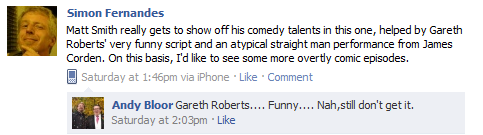
I was quite enthusiastic about the comedy, but others saw it differently. And to be fair, I know Corden gets a fair bit of stick too:

ScreenShot090.png

Never one to pass up an opportunity to lust after a scantily clad young man, I was happy to see the Doctor’s shower scene. Happier than I would have been if he’d still been William Hartnell anyway:

ScreenShot092.png

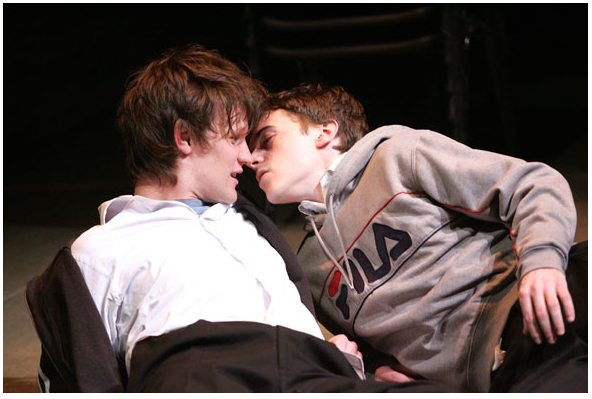
At which point Steve directed me to a picture he’d found, much to several people’s delight:

ScreenShot091.png
ScreenShot093.png

Much to Craig’s alarm, the Doctor decides to help out on his pub football team, showing the level of football knowledge achieved by most Who fans:

ScreenShot094.png

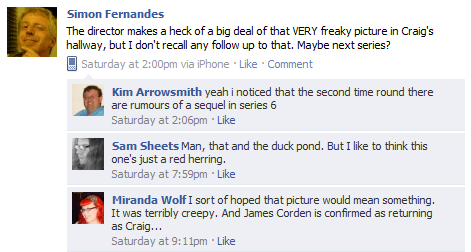
For my part, I’ve found my attention drawn to part of Craig’s decor – intentionally on the director’s part, it seems:

ScreenShot095.png

(Corden did return as Craig, but nothing ever came of the mysteriously prominent picture. Or the duck pond. Yet)

The Doctor discovers that the top floor of Craig’s house is actually a spacecraft that looks oddly familiar:

ScreenShot096.png

(Yes, the spacecraft control room was featured in season 6, as the buried Silence ship in Day of the Moon. Significant, or just a cheap reuse of an existing set?)

And the verdict:

ScreenShot097.png

Yes, the end draws near! Two more episodes, one more story, with Mr Moffat back on writing duties for the first time since episode 5. Coming up in a moment…

Doctor Who Season 5–the Facebook Marathon: Part 8

The adventure continues.

March 12, 2011, 12.38 pm. After cleaning my brain from the previous story, it’s a relief to have another self-contained, non-epic, intimate story about people. And strange invisible beasties.

NB – as before, if your name or image is on these screenshots and you’d rather it wasn’t, PM me on Facebook and I’ll edit the image. Thanks!

Having tried one guest writer, it’s time for Moffat to wheel out the big guns. Step forward, writer of the excellent Blackadder and romcoms that I can’t stand – it’s Richard Curtis with:

Season 5, Episode 10: Vincent and the Doctor

Taking Amy’s mind off Rory’s recent death (which she doesn’t remember anyway), the Doctor takes her to a Van Gogh exhibition, giving him the chance to wax lyrical in the established new series style about how bloomin’ marvellous a historical figure is. Backing him up is a surprise cameo from a beloved Brit actor whose own name was linked to the role of the Doctor a few times:

ScreenShot078

The Doctor has spotted something ‘evil’ in a Van Gogh painting, so it’s off to 1890 Provence for a word with the man himself. They find him getting drunk in a French cafe with some rather odd accents:

ScreenShot079

Van Gogh is being played (quite brilliantly) by well-known Scot Tony Curran. I cast my mind back to my earliest acquaintance with his work:

ScreenShot080

Our heroes track down the mysterious alien, only to discover it’s a wounded creature that doesn’t mean any harm. Ben spots the hammer-subtle parallel with Van Gogh himself:

ScreenShot081

Meanwhile, I’m luxuriating in the director’s skill with a camera:

ScreenShot082

Amy and the Doctor try to see the sky through the Doctor’s eyes, resulting in a magical cross fade into one of the man’s best known paintings – the one Don McLean kept going on about:

ScreenShot083

Having dealt with the alien, the Doctor tries (unwisely, as it turns out) to deal with Van Gogh’s depression. This is achieved via a trip to the future, where the tortured artist can listen to Bill Nighy unwittingly describe his genius while a mopey Athlete song plays in the background:

ScreenShot084

Still, despite the transparent emotional manipulation, I still really enjoy the story. To judge by comments throughout, I’m not the only one:

ScreenShot085

An atypical story then, but a hugely rewarding one, Curtis’ sensitive writing ably assisted by Curran’s excellent performance. I’m forced to agree with Stuart’s comment from a few episodes ago – the hit rate in this second half of the season is much more consistent!

Doctor Who Season 5–the Facebook Marathon: Part 7

The adventure continues.

March 12, 2011, 10.56 am. Amy’s Choice was as enjoyable as the first time, but now it was time to face up to my bete noire of Who writers – Chris Chibnall. Thankfully, my Facebook friends were becoming more numerous in their comments to help me through it. And as before, I’m counting this two-parter as one story, so I’ll cover both episodes here…

NB – as before, if your name or image is on these screenshots and you’d rather it wasn’t, PM me on Facebook and I’ll edit the image. Thanks!

Oh, the dilemma – one of my favourite ‘aliens’ done by my least favourite writer. Can Malcolm Hulke’s legacy survive Chris Chibnall as we delve into:

Season 5, Episode 8: The Hungry Earth

Watching this episode involves slipping the next disc of the box set into the PS3 and waiting for the menu to pop up. This takes some time.

ScreenShot060

We’re back on contemporary Earth, in a setting any Jon Pertwee fan will instantly recognise – the standard Big Scientific Project as visited in almost every story of his first season. However, the rather limited budget for sets immediately makes this look a bit more low-rent:

ScreenShot061

Informed of her location, Amy tries out her keen observational skills:

ScreenShot062

The casting of comedienne Meera Syal as the project’s director raises a few eyebrows, but the celebrity guest Who of the 80s had its odd moments too:

ScreenShot063

By this point I’ve noticed that the village where the project is located seems curiously underpopulated. My Irish and Welsh friends hasten to inform me that this is entirely accurate:

ScreenShot064

And since we’re in Wales, not even advanced technology can keep the weather out:

ScreenShot065

A Silurian appears (well, whatever they’re called now, anyway). She has some pretty cool make up, but I miss the quivering rubber of the Pertwee years:

ScreenShot066

The Doctor makes a stab at telling the Silurian when she’s from. And gets it wrong, like every other time they’ve appeared:

ScreenShot067

With this two-parter, I was pleasantly surprised enough by rewatching part one to offer a verdict on ‘the story so far’:

ScreenShot068

But like football, it’s a game of two halves, Brian. And the second half would make me wish that Malcolm Hulke was till around to substitute for Mr Chibnall:


Season 5, Episode 9: Cold Blood

The second part reveals another Silurian warrior. She looks identical to the first one apart from some red patches on her scales. This raises an interesting question:

ScreenShot069

Channelling Jon Pertwee in the first Silurian story (as does most of the script), Chibnall gets the Doctor to moralise a bit:

ScreenShot070

Meanwhile, the scary Silurian scientist has been revealed to be a nice bloke after all. So we’re supposed to just forget that he dissected that first guy while he was conscious:

ScreenShot071

The Silurian warriors are now itching for a fight with the ‘apes’, and it’s all a bit one-sided:

ScreenShot072

Peace having proved elusive, the Doctor places the burden of both species’ future co-existence onto one little boy (despite UNIT and therefore the UN being well aware of the Silurians). His advice, while well-meaning, doesn’t seem to have been thought through:

ScreenShot073

The wise old Silurian leader decides to go to sleep for another thousand years, reckoning humanity will be mature enough to deal with the situation then. But there’s something rather significant the Doctor isn’t telling him:

ScreenShot074

But Restac is vengeful, and shoots Rory, who promptly tumbles into Amy’s crack and dies. Again. This causes heartache and confusion:

ScreenShot075

Having run out of story, Chibnall blows up the project:

ScreenShot076

Leaving us free to cogitate on the quality (or lack thereof) of the story, and indeed of the season so far:

ScreenShot077

So, no consensus as to how good/bad the season is (though everyone seems on board with this particular story being rubbish). But thankfully, a civilised level of debate rather than the insane vitriol and mud slinging of most online Doctor Who forums!

Doctor Who Season 5–the Facebook Marathon: Part 6

The adventure continues.

March 12, 2011, 9.56 am. Having tired myself out with incessant Doctor Who and a lot of gin, I’d gone to bed after The Vampires of Venice, but woke up fresh the next day to continue the marathon in the morning. Now I think on it, I’d done a mid-season break before Steven Moffat had! Thankfully, many of the usual suspects were still online to keep the chat going…

NB – as before, if your name or image is on these screenshots and you’d rather it wasn’t, PM me on Facebook and I’ll edit the image. Thanks!

Next up, the first iteration of one of Steven Moffat’s better ideas – getting established, big-name authors new to the show itself to write Who. First out of the gate was Men Behaving Badly scribe Simon Nye, giving us a most atypical episode that was one of the wittiest – and most meta – of the season:

Season 5, Episode 7: Amy’s Choice

I got up, yawned, stretched and had a cup of tea (9.56 am being a little early for gin):

ScreenShot051

Somehow, Amy and Rory are back in Leadworth village, and the Doctor’s popped in for a visit. It makes a nice change after Russell’s era for the Earth people not to live in a grimy London housing estate:

ScreenShot052

The Doctor’s having trouble with the TARDIS, but he’s ‘misplaced’ the Haynes manual:

ScreenShot053

Surprisingly to everyone, the impish Toby Jones pops up wearing a suspiciously familiar costume. His first act is to utterly demolish the tropes that make up the Doctor’s character:

ScreenShot054

Trapped in what might (or might not) be a fake reality, the Doctor and co are chased by a marauding army of the elderly, angrier even than when George Osborne froze their pension increases:

ScreenShot055

The script continues to play with and subvert the tropes of the show in both ‘realities’:

ScreenShot056

And then, shockingly, the first appearance of a new trope that would become all too familiar over the next couple of years. The bemulleted Rory is unexpectedly turned to dust, disintegrating in Amy’s arms, the first of many, many deaths:

ScreenShot057

By the end of the episode, it’s become clear that neither ‘reality’ was real, and neither was the Dream Lord. I remembered having heard gripes about the mechanism that allowed all this to happen, when the method was so much less important than the psychological exploration it caused:

ScreenShot058

And the conclusion:

ScreenShot059

Yes, the intervening hours of sleep had at this point lessened the number of friends chiming in on the comments. But like sand people, they’d soon be back, and in greater numbers…